 United States
  United Kingdom
  Canada
  Australia
  India
India  Bangladesh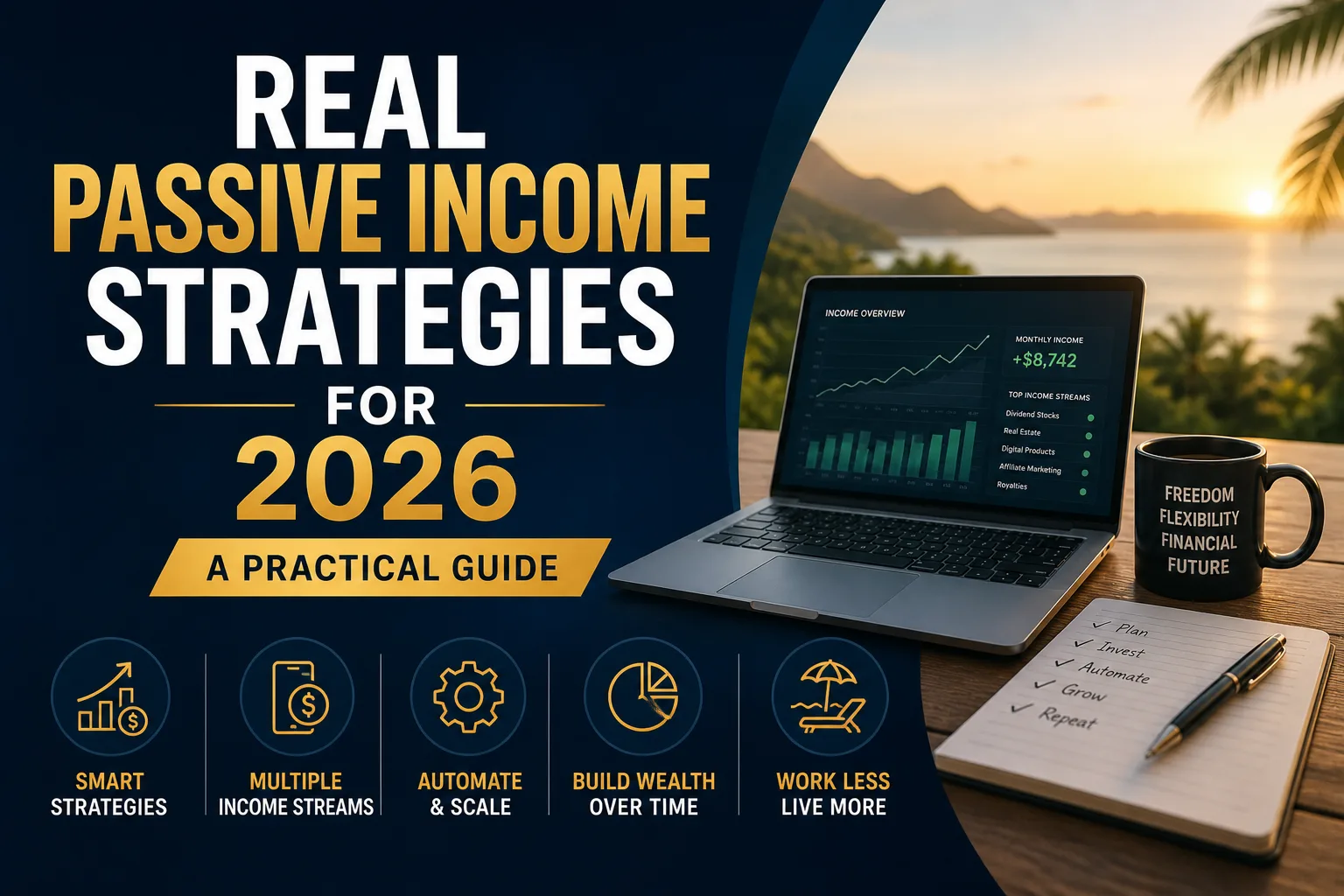
Key Takeaways
- Passive income in 2026 requires significant upfront 'active' work to build systems that eventually run themselves.
- The most successful strategies focus on 'Information Gain' and unique data rather than generic content.
- Diversification across digital assets and traditional financial instruments is the only way to ensure long-term stability.
The dream of earning money while you sleep has changed significantly over the last few years. If you look at advice from 2020, you will see suggestions like starting a generic blog or a dropshipping store. By 2026, those markets are so saturated that they rarely offer a true passive return for beginners. The digital economy has shifted. Automation is now a baseline requirement, not a competitive advantage. To actually build a stream of income that does not require your constant presence, you must build systems that provide high-value, unique utility.
Many people fail because they mistake 'passive' for 'easy.' In reality, every reliable passive income stream starts as a very intense active project. You spend months building an asset, and then you spend years collecting the rewards. This article covers five specific frameworks that have proven resilient in the 2026 market. These methods are not about getting rich by next Tuesday; they are about building digital and financial infrastructure that pays you for the long haul.
The New Reality of Passive Income in 2026
What worked two years ago likely does not work today. Search engines have evolved to prioritize 'Information Gain'—the idea that your content or tool must provide something that does not already exist elsewhere. If you are just recycling information, AI models will summarize your work, and no one will visit your site. You need to own the source of the value.
Currently, the most successful creators focus on three pillars: ownership, automation, and community. You want to own the platform or the data, automate the delivery or production, and build a community that stays for the long term. This shift means that 'low-effort' content is dead. High-value systems are the only things left standing.
The Upfront Work Requirement
Before we look at the specific ideas, we must be honest about the timeline. Most of these strategies require 100 to 500 hours of initial work. Some users report seeing their first dollar within thirty days, but for most, the 'passive' phase does not kick in for at least six months. If you are looking for immediate cash to pay rent this week, these are not the right solutions. These are wealth-building assets.
1. Programmatic SEO and Niche Data Vaults
Programmatic SEO is the practice of generating hundreds or thousands of high-quality, data-driven pages to capture specific search queries. In 2026, this has moved away from 'best coffee shops in London' and toward hyper-specific technical data. Think about 'The cost of solar panel maintenance in [Zip Code]' or 'API latency comparisons for [Software A] vs [Software B].'
The goal is to build a site that acts as a utility. You find a dataset—like public government records, weather patterns, or historical pricing—and you create a template that presents this data better than anyone else. Once the site is indexed, it earns money through high-end display ads or, more effectively, lead generation. For example, a site that compares local construction permit costs can sell leads to local contractors. This is far more stable than traditional blogging because you are providing a hard utility that AI cannot easily replicate without the same dataset.
How to Start with Programmatic SEO
First, identify a niche where people need to compare numbers or locations. Use a tool like Airtable to organize your data and Softr or Next.js to turn that data into a website. You do not need to write 1,000 articles; you need to build one great template that displays 1,000 data points. Results vary widely based on the niche, but niche utility sites often see higher RPMs (revenue per thousand impressions) than lifestyle blogs.
2. Specialized Micro-SaaS and Browser Extensions
You do not need to be a software engineer to build a Micro-SaaS (Software as a Service) in 2026. No-code tools like Bubble and FlutterFlow have made it possible for anyone to build functional apps. The most successful passive income apps are those that solve a 'tiny' problem for a specific group of people.
Consider a browser extension that helps Shopify sellers calculate their shipping margins in real-time, or a simple tool that converts specific file types for legal professionals. These tools are 'set it and forget it' once the code is stable. You charge a small monthly fee—perhaps $9—and as long as the tool works, users will keep their subscription active for years. Real-world examples include simple Chrome extensions that have grown to $2,000 in monthly recurring revenue (MRR) with almost zero ongoing maintenance.
Maintenance and Scaling
While the income is passive, you will occasionally need to fix bugs when browsers update. However, the ratio of work-to-income is incredibly favorable. Once you have 100 users, your primary job is done. Your only 'active' task is basic customer support, which can often be handled by a simple FAQ or an automated chatbot.
3. Paid Micro-Communities and Gated Knowledge
The internet is currently flooded with AI-generated noise. Because of this, people are willing to pay for 'signal'—curated, high-quality information and access to experts. This is where micro-communities come in. Platforms like Skool and Circle allow you to host a private group where you share specific expertise.
If you are an expert in something—whether it is vintage watch restoration, specific tax strategies for freelancers, or high-level gardening—you can charge a monthly membership fee. The passive element comes from the community itself. Once a community reaches a certain size, the members begin to help each other. You provide the framework and the initial content, and the community provides the ongoing value. Some creators earn thousands per month by spending just two hours a week moderating their groups.
Building a Membership Asset
- Identify a problem that people are already spending money to solve.
- Create a 'Starter Kit' of resources (videos, templates, or checklists).
- Launch on a platform like Beehiiv or Skool to manage payments and access.
- Seed the community with your first 10 members at a discount to build momentum.
4. Digital Product Ecosystems on Gumroad or Etsy
Selling a single ebook is rarely a sustainable passive income stream. However, building an ecosystem of digital products is. This means creating a suite of templates, presets, or assets that work together. For example, instead of selling one Notion template, you sell a 'Business Operating System' that includes 20 interconnected templates.
In 2026, the most successful digital products are 'Done-For-You' assets. This includes things like specialized Excel models for real estate investors, Canva templates for specific industries (like dental clinics), or even specialized AI prompts for marketing agencies. Once these assets are uploaded to a marketplace like Gumroad or Etsy, the platform handles the traffic and the transactions. Your job is simply to keep the assets updated once or twice a year.
| Platform | Best For | Passive Potential |
|---|---|---|
| Gumroad | Software, templates, and complex guides. | High (Global reach, simple checkout) |
| Etsy | Visual assets, planners, and creative templates. | Medium (High traffic, but high competition) |
| Stan Store | Mobile-first social media link-in-bio sales. | High (Great for social traffic conversion) |
5. Fractional Real Estate and Yield-Bearing Assets
If you have some capital to start with, the most traditional form of passive income remains the most reliable. However, the entry point has changed. You no longer need $50,000 for a down payment on a rental property. Platforms like Arrived or Fundrise allow you to buy fractional shares of rental properties or commercial real estate for as little as $100.
You earn a portion of the rental income and any appreciation in the property value. This is 100% passive; you do not have to fix toilets or chase tenants for rent. While the returns are usually lower than building your own business (typically 5% to 10% annually), the risk is significantly lower. Some users report building a portfolio of 50 different 'fractions' of houses, creating a highly diversified stream of dividends that hits their bank account every quarter.
The Role of Index Funds
We cannot discuss passive income without mentioning low-cost index funds like VTI or VOO. While not as 'exciting' as a Micro-SaaS, these are the gold standard of passive wealth. If you reinvest your dividends, the power of compounding does the work for you. In 2026, most experts suggest that at least 30% of your passive income efforts should be directed back into these traditional, stable assets to hedge against the volatility of the digital world.
Common Mistakes to Avoid
The most common mistake is 'The Shiny Object Trap.' You start a YouTube channel, then a blog, then a newsletter, and you finish none of them. Passive income requires a finished asset. An unfinished project earns zero dollars.
- Over-Automating: Using AI to generate 10,000 low-quality articles. Google will eventually de-index these, and your income will vanish overnight.
- Ignoring the 'Active' Phase: Trying to automate a business before you have even made your first sale. You must prove the concept manually first.
- High Maintenance Models: Choosing a 'passive' idea that actually requires 20 hours of customer support a week. That is not a passive income stream; it is a part-time job.
- Lack of Diversification: Relying on a single platform (like Amazon Associates) for 100% of your income. If they change their terms, your business is gone.
Realistic Expectations: The 2026 Timeline
Let's talk about the numbers. It is important to remember that 'results vary widely.' Someone with an existing audience on social media will see results much faster than someone starting from scratch. However, for a total beginner, a realistic timeline looks like this:
Months 1-3: The Build Phase. You are spending money on tools and hours on development. You will likely earn $0. This is where 90% of people quit.
Months 4-8: The Optimization Phase. You start to see small trickles of income—maybe $50 to $200 a month. You are refining your systems and fixing bugs.
Months 9-12: The Passive Phase. Your asset is established. You are now spending only 2-3 hours a week on maintenance. Your income might grow to $500 or $1,000+ a month depending on the scale of your asset.
Is it possible to earn more? Yes. Some creators reach $10,000 a month. But those are the outliers. Aiming for a steady, reliable $1,000 a month from a single asset is a much more achievable and sustainable goal.
Next Steps: How to Choose Your Path
Do not try to do everything. Look at your current skills and your available time. If you have technical skills, look at Micro-SaaS or Programmatic SEO. If you are a good communicator, look at Micro-Communities. If you have zero time but some extra cash, look at Fractional Real Estate.
The best time to start was last year. The second best time is today. Pick one method, commit to it for six months, and do not look at other ideas until you have your first dollar in the bank. Consistency is the only 'secret' to passive income that actually works.
References and Further Reading
- Indie Hackers: A community of builders sharing real revenue numbers for Micro-SaaS and digital products.
- The Beehiiv Blog: Deep dives into newsletter growth and monetization strategies for 2026.
- BiggerPockets: Comprehensive resources for fractional and traditional real estate investing.
- Vanguard Investor Research: Historical data on index fund performance and dividend growth strategies.