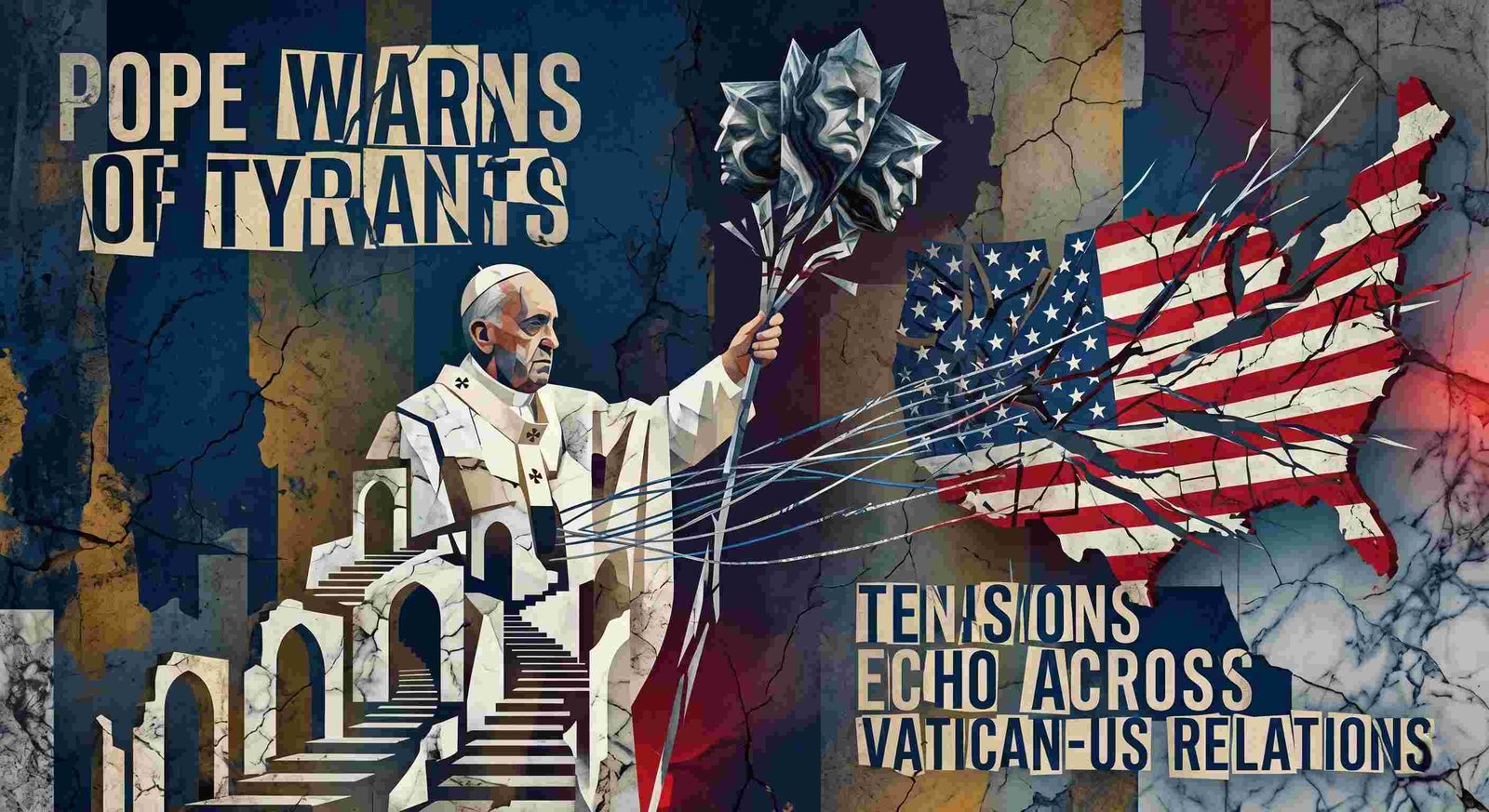
The phrase attributed to the Pope describing a world ‘ravaged by a handful of tyrants’ has landed in an already charged geopolitical atmosphere, where religious moral authority intersects with American political scrutiny. The timing matters. It collides with renewed attention on past tensions between the Vatican and the Trump-era White House, creating a symbolic flashpoint rather than a conventional policy dispute. What is really being contested here is not only language, but legitimacy itself.
The Situation
The reported remarks by the Pope frame global instability as concentrated in the actions of a limited number of powerful leaders, a framing that echoes earlier Vatican interventions in international affairs. Such statements, while not formal policy directives, carry weight due to the Holy See’s diplomatic reach across more than 180 states[1]. In parallel, discussions referencing past friction with the Trump administration re-emerge as contextual background rather than a new diplomatic rupture.
The structural drivers sit in the intersection of moral messaging and geopolitical interpretation. The Vatican has historically positioned itself as a normative voice on war, inequality, and governance, while US administrations tend to prioritize strategic autonomy and domestic political framing[2]. This creates an inevitable tension when religious language is interpreted through partisan lenses. The result is not policy collision but narrative competition.
Competing forces are clearly visible: the Holy See’s emphasis on ethical governance, segments of US political leadership emphasizing sovereignty, and global media ecosystems that amplify selective phrases. Each actor extracts different meaning from the same statement. The Pope’s framing of ‘tyrants’ becomes, in practice, a geopolitical Rorschach test. One interpretation sees moral clarity; another sees indirect political critique.
This moment matters because global political discourse is already fragmented by overlapping crises, including conflict zones, migration pressure, and institutional distrust. In such an environment, symbolic statements gain disproportionate influence. As one diplomatic analysis summary notes:
Religious diplomacy often shapes perception more than policy outcomes, especially in polarized geopolitical environments where symbolism travels faster than institutions can respond.
The ‘why now’ factor is rooted in accumulated tension. Recent years have intensified debates over authoritarian governance, democratic backsliding, and global leadership legitimacy. Against this backdrop, any papal framing of tyranny is interpreted not as abstract theology but as indirect commentary on current power structures. The Google Trends spike reflects that interpretive acceleration rather than a discrete event.
Power Dynamics / Stakeholder Map
The primary beneficiaries of this narrative environment include institutional religious actors such as the Vatican, which gains renewed visibility as a moral arbitrator in global affairs. Its incentive is continuity of influence in diplomatic conversations that extend beyond traditional statecraft. The Trump-era White House legacy, even after its term, continues to function as a reference point in political communication cycles, reinforcing its relevance in global discourse.
Primary pressure falls on political institutions that become implicitly referenced in moral critiques, particularly US executive frameworks that must constantly distinguish policy positions from perceived ideological labeling. Media ecosystems also absorb cost in the form of narrative amplification risk, where selective framing can distort original intent. The reputational sensitivity increases when moral language is translated into geopolitical inference.
The non-obvious power dynamic lies in audience interpretation systems. Neither the Vatican nor US political structures fully control how statements are decoded globally. Digital platforms, editorial ecosystems, and regional political cultures effectively become co-authors of meaning. This creates a distributed authority model where influence is fragmented. The paradox is that the less control any single actor has, the more viral symbolic statements become in global circulation.
Historical Precedent
A useful parallel can be drawn with Cold War-era Vatican diplomacy, particularly under Pope John Paul II during the late 20th century. At that time, papal messaging about human rights and authoritarian regimes intersected with US-Soviet tensions, where moral language carried indirect geopolitical implications. The Vatican was not a military actor, yet its statements influenced perception across ideological blocs.
The similarity today lies in the role of moral framing in geopolitical discourse. However, the difference is structural. During the Cold War, information flow was slower and more centralized. Today, digital amplification systems ensure that a single phrase can be globally reinterpreted within hours. This compresses diplomatic reaction time and increases interpretive volatility, making symbolic statements more consequential than in earlier eras.
Mainstream Consensus vs Reality
Mainstream Consensus vs Reality
| What The Market Assumes | What The Underlying Data Suggests |
|---|---|
| The Pope is directly engaging in political confrontation with US leadership through targeted criticism | The statement functions primarily as moral framing rather than structured diplomatic escalation or policy critique |
| Vatican–US relations are entering a new phase of active conflict | Historical patterns show episodic rhetorical tension without sustained institutional breakdown between actors |
| Global audiences interpret papal statements uniformly as political messaging | Interpretation varies significantly across regions, media systems, and ideological ecosystems worldwide |
| Such remarks directly influence policy decisions in major governments | Influence is indirect, shaping discourse rather than formal decision-making structures or legal frameworks |
Scenario Modeling
Base Case — 60% Probability
Key Assumption: The remarks remain within the realm of moral commentary without triggering formal diplomatic escalation between Vatican and US political institutions.
12-Month Indicator: Absence of official Vatican–White House statement exchanges referencing the remarks directly.
Structural Implication: The narrative stabilizes as recurring symbolic discourse in geopolitical commentary cycles.
Accelerated Case — 25% Probability
Key Assumption: Continued geopolitical instability amplifies religious moral framing as a tool of international soft power signaling.
12-Month Indicator: Increased citation of papal statements in diplomatic speeches or parliamentary debates.
Structural Implication: Religious institutions gain heightened indirect influence in global narrative construction.
Contraction Case — 15% Probability
Key Assumption: Political actors disengage from interpreting religious statements as geopolitical commentary due to audience fatigue.
12-Month Indicator: Decline in media pickup rates of papal geopolitical remarks across major outlets.
Structural Implication: The Vatican’s global messaging influence becomes more narrowly confined to theological discourse.
The Divergent View
The dominant narrative suggests that the Pope’s remarks are part of a broader escalation in rhetorical tension with US political leadership, particularly referencing the Trump-era White House as a symbolic anchor. In this reading, the Vatican is positioned as increasingly willing to enter geopolitical critique, with language interpreted as indirect confrontation rather than moral commentary.
A more structurally cautious interpretation argues that this framing overstates intent and underestimates institutional continuity in Vatican diplomacy. The Holy See has historically used moral language consistently across administrations and political systems, without aligning such statements with specific governments. The reference to ‘tyrants’ may reflect long-standing doctrinal language about governance rather than targeted political signaling. The amplification occurs externally through media systems rather than internally through policy shift.
Falsification test: If the Vatican issues a formal clarification within 90 days explicitly linking the remarks to specific governments or retracting the framing as geopolitical commentary, the divergent interpretation would be weakened and the consensus narrative of targeted political escalation would gain validity.
Second-Order Effects
One underexplored consequence is the impact on diplomatic communication norms. When religious language is repeatedly interpreted geopolitically, state actors may begin pre-filtering engagement with religious institutions, reducing informal diplomatic channels. This subtly reshapes soft power architecture over time.
A second chain involves media ecosystem adaptation. As symbolic statements gain traction, editorial systems may increasingly prioritize interpretive framing over factual reporting. This can shift competition among news outlets toward narrative speed rather than verification depth, affecting how global political information is consumed and trusted.
Watchlist
- Vatican Press Office Statements: Official Vatican communications monitoring — any clarification or reaffirmation within 30–90 days would signal escalation or stabilization of narrative framing.
- US State Department Briefings: US Department of State transcripts — explicit mention of papal remarks would indicate diplomatic sensitivity rising.
- Global Media Citation Index: Reuters and Associated Press tracking — spike above baseline coverage volume suggests narrative amplification cycle.
- Religious Diplomacy Reports: Pew Research and similar institutions — shifts in perceived religious influence in geopolitics indicate structural change.
- Geopolitical Risk Indices: World Bank governance indicators — deterioration in political stability metrics could contextualize increased moral framing intensity.
Bottom Line
The reported papal framing of global tyranny should be read less as direct confrontation and more as symbolic geopolitical signaling operating in a fragmented information environment. The real driver is not the phrase itself, but how quickly such language is absorbed into contested narratives about legitimacy and power. Over the next year, the key variable to watch is whether religious moral framing begins influencing formal diplomatic language in state institutions.
References
- Vatican diplomatic service — International relations — Provides baseline context for Holy See global diplomatic reach and influence.
- IMF World Economic Outlook — Global governance context — Supports macro framing of institutional legitimacy pressures in global systems.
- OECD Data — Governance indicators — Used to contextualize institutional trust and governance perception trends.
- World Bank Data — Political stability metrics — Supports discussion of structural governance environments influencing discourse.
- Pew Research Center — Religion and public life — Provides evidence base for interpretation of religious influence in political systems.