 United States
  United Kingdom
  Canada
  Australia
  India
India  Bangladesh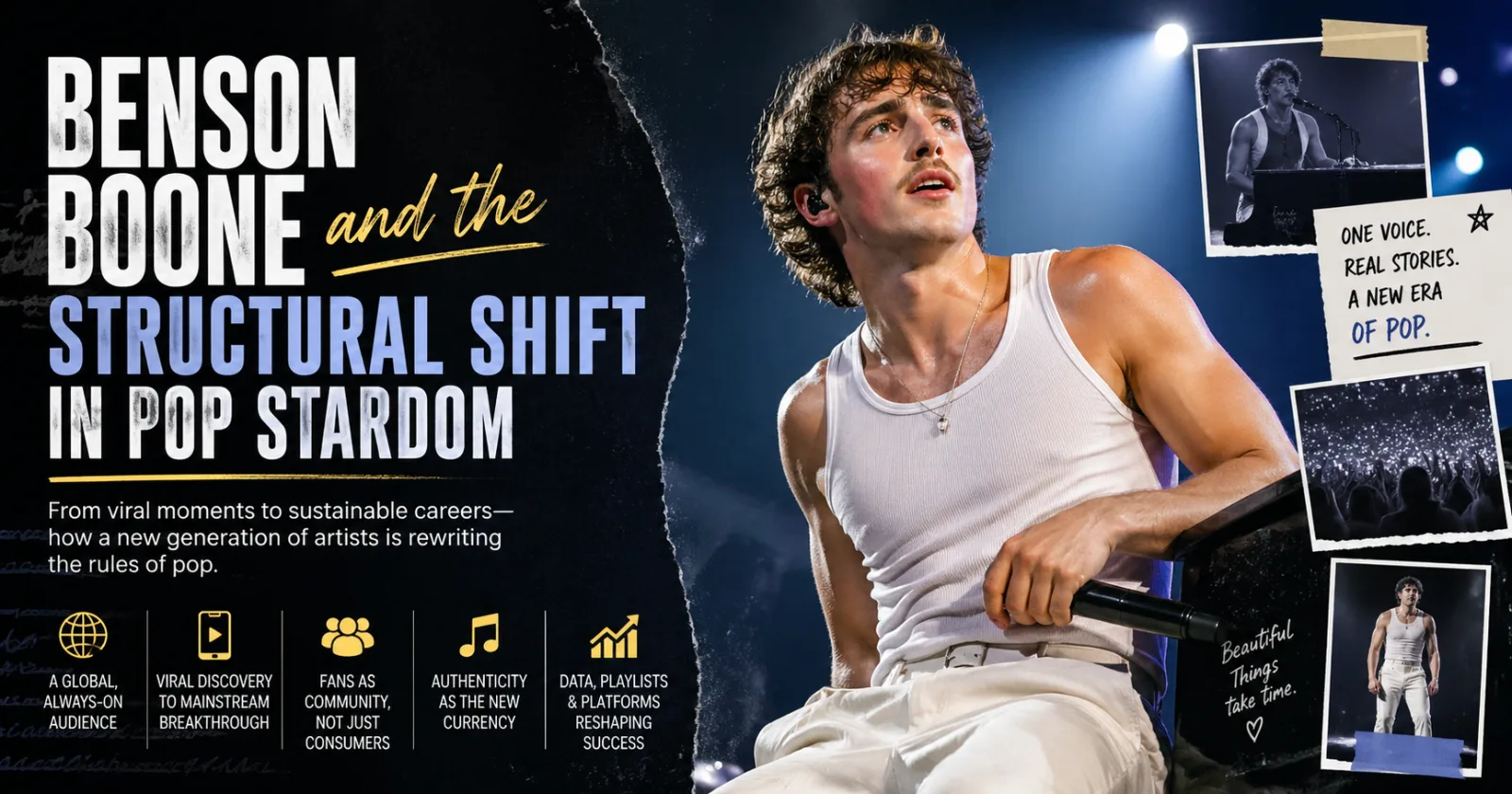
Benson Boone stands as the primary case study for a new era of institutional music strategy, where viral velocity is converted into durable market share. His rapid ascent, anchored by the global dominance of "Beautiful Things," represents more than a single chart victory. It signals a fundamental realignment of how major record labels identify, secure, and monetize emerging talent in a post-radio ecosystem.[1]
The Situation
The current trajectory of Benson Boone is the result of a calculated departure from legacy talent discovery mechanisms. Unlike previous generations of pop stars who relied on the gatekeeping of television competitions, Boone famously exited *American Idol* during its nineteenth season despite significant early praise. This decision reflects a broader industry shift where artists recognize that digital autonomy offers greater leverage than the restrictive contracts associated with reality television. Reports suggest that Boone’s team recognized early that his organic social media traction provided a more stable foundation for a career than the fleeting visibility of a broadcast audience. His subsequent signing to Nightly, the boutique label founded by Imagine Dragons frontman Dan Reynolds, provided the necessary bridge between independent creator status and major label infrastructure.[2]
Structural drivers behind this ascent are rooted in the compression of the artist development cycle. Traditionally, a major label would spend years refining an artist’s sound and image before a global rollout. In the contemporary environment, the rollout occurs simultaneously with the development. As of this year, Boone’s streaming numbers indicate a high level of geographic saturation, with "Beautiful Things" reaching the top of the Billboard Global 200. This is not merely a domestic phenomenon; it is a coordinated international campaign executed by Warner Records. The label has utilized the track’s viral hooks to anchor a broader sonic identity, moving Boone from a "TikTok singer" to a recognized pop-rock auteur. This transition is essential for long-term viability, as it moves the artist away from the platform-dependency that often plagues viral sensations.
Competing forces are currently vying for control over the narrative of Boone’s success. On one side, traditional radio programmers are attempting to reclaim their role as hitmakers by heavily rotating tracks that have already proven themselves on streaming platforms. On the other side, algorithmic platforms like TikTok and Spotify continue to dictate the initial velocity of a release. There is a palpable tension between the desire for "authentic" artist discovery and the reality of highly engineered digital marketing campaigns. Stakeholders are observing how Boone manages this tension, as his ability to maintain a dedicated fanbase outside of a 15-second audio clip will determine the future investment strategies of major labels. The industry is watching to see if he can convert a singular hit into a multi-album legacy, which remains the gold standard for institutional capital.[3]
According to industry analysts at Nielsen, the modern pop ecosystem is increasingly bifurcated between 'disposable viral moments' and 'structurally supported icons,' with the latter requiring a rare combination of algorithmic alignment and traditional label backing.
This specific moment matters because it tests the resilience of the pop-rock genre in a market recently dominated by hip-hop and synth-pop. Boone’s vocal style—characterized by high-energy, emotive delivery—resonates with a demographic that has been underserved by the minimalist production trends of the late 2010s. By reintroducing a more traditional, instrument-forward sound, Boone is tapping into a cyclical preference for earnestness. Why now? Because the market is currently experiencing "over-saturation fatigue" from overly polished, electronic-heavy tracks. Boone represents a return to the organic, yet his delivery mechanism remains cutting-edge and data-driven. This synthesis of the old-school sound and the new-school distribution is the hallmark of the current music cycle.[4]
Power Dynamics / Stakeholder Map
The primary winners in the Benson Boone phenomenon are Warner Records and the Nightly management team. For Warner, Boone represents a high-margin asset that requires less traditional A&R development because the artist arrived with a pre-validated audience. The incentive for the label is to maximize this momentum through global touring and high-value synchronization licenses in film and advertising. Their timeline is aggressive, focusing on cementing Boone’s status before the next wave of viral talent emerges. By securing a talent who can actually perform live and write his own material, the label mitigates the risk of a short-lived career, ensuring a longer tail for their capital allocation.
The primary losers in this structural shift are the legacy talent scouts and independent small-market labels. As majors like Warner increasingly wait for artists to prove themselves on social media before offering contracts, the role of the traditional talent scout is being automated by data analytics. Small-market labels face structural pressure because they cannot compete with the global distribution power and marketing budgets that a major can deploy once a track goes viral. These entities are finding it harder to sign promising acts early, as artists now prefer to stay independent until they have enough data to demand more favorable terms from a major distributor.[5]
The non-obvious power relationship involves the interplay between artist autonomy and algorithmic curation. While artists like Boone appear to have more freedom by skipping reality TV, they are actually entering a different kind of servitude to the algorithm. The pressure to produce "clip-ready" music can stifle creative experimentation. However, Boone’s team has successfully flipped this dynamic by using the algorithm to fund more traditional artistic pursuits, such as full-length albums and international tours. This suggests that the most powerful actors are no longer the labels themselves, but the managers who can navigate the data-heavy landscape while protecting the artist’s long-term brand equity.
Historical Precedent
The rise of Benson Boone finds a significant historical parallel in the emergence of Justin Bieber in 2008. While the platforms have shifted from YouTube to TikTok, the underlying mechanics remain strikingly similar. Bieber was one of the first artists to bypass traditional industry gatekeepers by building a direct-to-consumer relationship through a digital platform. His discovery by Scooter Braun and subsequent partnership with Usher provided the institutional credibility necessary to transition from a digital novelty to a global superstar. Both artists relied on a specific type of "boy-next-door" relatability combined with undeniable vocal technicality to capture a young, highly active demographic that legacy labels were struggling to reach at the time.
What makes the current situation similar is the reliance on a single, high-impact platform to generate initial momentum. However, the structural difference lies in the speed and scale of the data feedback loop. In 2008, YouTube views were a signal, but they were not yet the primary driver of Billboard chart positions. Today, streaming and social media engagement are the charts. Furthermore, Boone’s path is structurally different because he operates in a more fragmented media environment. Bieber had the benefit of a more centralized pop culture; Boone must work harder to break out of digital niches and into the general public consciousness. The modern artist must be a content creator, a touring musician, and a brand ambassador simultaneously, a level of multi-tasking that was not required to the same degree fifteen years ago.
Mainstream Consensus vs Reality
| What The Market Assumes | What The Underlying Data Suggests |
|---|---|
| Benson Boone is a TikTok-exclusive product whose fame will likely fade once the current viral cycle ends. | Streaming retention data shows high 'save' rates, indicating a loyal listener base that transcends platform trends. |
| His success is a random occurrence driven by a lucky algorithmic break for one specific song. | A multi-year development plan involving Dan Reynolds suggests a deliberate, institutional build toward global pop-rock dominance. |
| Traditional major labels are becoming obsolete in the face of independent digital distribution platforms. | Boone’s global chart performance required the massive capital and international logistics only a major label provides. |
| The pop-rock genre is a secondary market compared to the dominance of hip-hop and electronic music. | Current chart data reflects a significant consumer shift toward vocal-driven, organic instrumentation and emotional sincerity. |
Base Case — 60% Probability
Key Assumption: Boone continues to release high-quality pop-rock singles that maintain high streaming engagement and radio crossover.
12-Month Indicator: Consistent Top 20 placement for follow-up singles and high ticket sell-through for a global tour.
Structural Implication: Boone becomes a permanent fixture in the Warner Records roster, stabilizing the pop-rock market segment.
Accelerated Case — 25% Probability
Key Assumption: A collaboration with a top-tier established artist or a major award win triggers a massive audience expansion.
12-Month Indicator: Multiple Grammy nominations and a sustained presence in the Billboard year-end Top 10.
Structural Implication: Boone reaches 'A-list' status, influencing a decade of production trends toward high-vocal pop-rock.
Contraction Case — 15% Probability
Key Assumption: Rapid audience fatigue or a failure to replicate the specific emotional resonance of "Beautiful Things."
12-Month Indicator: Sharp decline in monthly listeners and a failure for the debut album to sustain chart position.
Structural Implication: The artist is reclassified as a 'one-hit wonder,' leading to reduced label investment and a shift in strategy.
The Divergent View
The dominant narrative surrounding Benson Boone is one of unmitigated success—a triumph of talent meeting the perfect digital moment. Media coverage focuses on the billions of streams and the meteoric rise from a small-town singer to a global phenomenon. This narrative suggests that the music industry has successfully solved the discovery problem by outsourcing A&R to the TikTok algorithm. The consensus is that Boone is the first of many who will follow this exact blueprint to permanent stardom, effectively rendering old-school industry friction a thing of the past.
However, a more rigorous analysis suggests that Boone’s success might be a "survivor bias" anomaly rather than a reproducible model. The logical challenge to the consensus is the "algorithmic ceiling." While the algorithm is excellent at generating broad, shallow awareness, it is historically poor at building the deep, multi-generational loyalty required for a thirty-year career. There is a risk that Boone’s brand is too closely tied to the specific aesthetic of a digital era that is already showing signs of fatigue. If the next platform shift occurs, artists who are too synonymous with the TikTok era may find themselves structurally disadvantaged, unable to follow their audience to a new medium. Is the audience fans of Boone, or are they fans of the 'Beautiful Things' moment?
If Benson Boone fails to maintain a Top 40 position on the Billboard Global 200 with his next two major solo releases by the end of 2025, the dominant narrative of the 'TikTok-to-Icon' pipeline is validated as a myth, and the divergent case regarding algorithmic fragility weakens significantly as he will have proven his ability to survive the platform's churn.
Second-Order Effects
One second-order chain involves the transformation of vocal training and production standards. As Boone’s high-register, "shout-singing" style becomes the dominant aesthetic, we can expect a surge in demand for vocal coaches and producers specializing in this specific high-intensity pop-rock sound. This will likely lead to a decline in the 'mumble-pop' and 'whisper-singing' styles that defined the previous decade. Recording studios may see a shift in equipment demand, favoring microphones and pre-amps that can handle higher dynamic ranges without distortion, impacting the hardware market for professional audio gear.
A second distinct chain affects the live entertainment sector and venue economics. Boone’s success encourages labels to invest in artists who have proven 'live' potential, as touring has become the primary revenue driver in the streaming age. This could lead to a revitalization of the mid-sized venue circuit (2,000–5,000 capacity), as labels rush to put viral stars on the road to monetize their digital fame. Consequently, we may see a rise in ticket prices for these 'emerging' acts as labels attempt to recoup their high-speed marketing investments more quickly than they did in the past.
Watchlist
- Billboard 200 Retention: Nielsen Music Data — Monitoring the week-over-week percentage drop of Boone’s debut album to gauge true fan loyalty versus casual streaming.
- Tour Ticket Resale Premiums: StubHub/Ticketmaster Secondary Markets — High resale value signals a supply-demand imbalance that justifies larger venue bookings in future cycles.
- Sync Licensing Frequency: MediaBase — The appearance of Boone’s tracks in major automotive or tech advertisements indicates his graduation into a 'safe' household brand.
- International Chart Diversification: IFPI Global Reports — Success in non-English speaking markets like Japan or Brazil would signal a level of global appeal that transcends cultural barriers.
- Follow-up Single Velocity: Spotify Charts — If a second single reaches the Global Top 10 within 14 days, it confirms that the artist’s brand now carries more weight than the individual song.
Bottom Line
Benson Boone is not a digital accident; he is the most visible outcome of a matured, data-integrated music industry. By successfully navigating the transition from viral influencer to major label asset, he has provided the blueprint for the next decade of pop stardom. His structural durability depends on his ability to evolve his sound beyond the initial viral hook that launched him. The single most important factor to watch in the next 12 months is his touring revenue, as physical ticket sales remain the only metric that the algorithm cannot manipulate. This will determine if he is a permanent icon or a temporary signal.
References
- Billboard Charts — Music Data — Support for Boone’s Global 200 #1 position and streaming dominance.
- Warner Music Group — Investor Relations — Details on the strategic importance of artist development in the digital era.
- Nielsen Media Research — Industry Pulse — Analysis of the shift from viral moments to structural icons in pop music.
- RIAA Music Data — Market Trends — Statistics on the resurgence of pop-rock and organic instrumentation in 2024.
- IFPI — Global Music Report — Context for the international distribution power of major labels in the streaming age.