 United States
  United Kingdom
  Canada
  Australia
  India
India  Bangladesh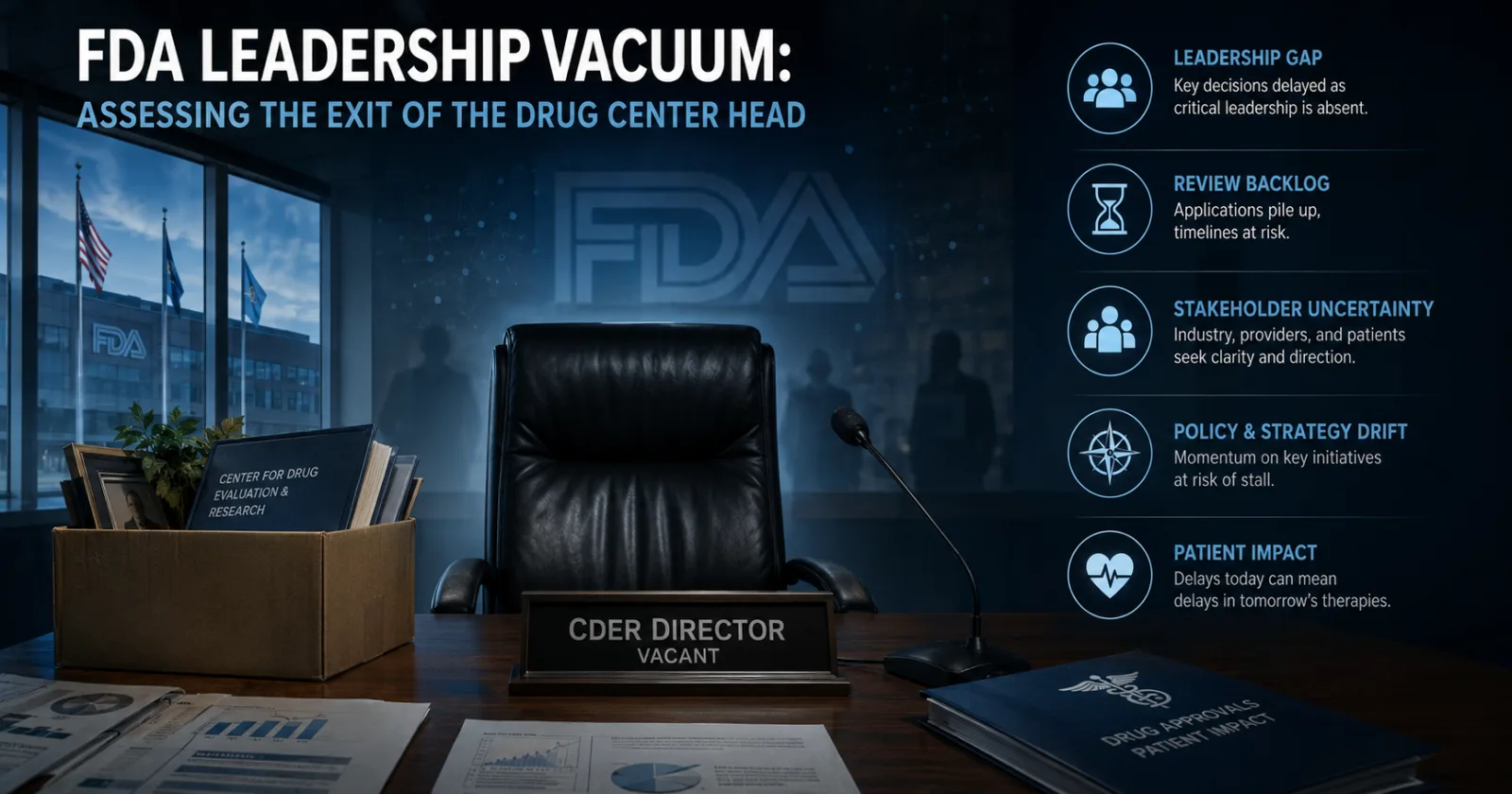
The reported departure of the Food and Drug Administration's drug center head, occurring in the immediate wake of the Commissioner’s own exit, signals a sudden structural decapitation of the nation’s primary pharmaceutical oversight body. Reports suggest that this sequential leadership transition, sourced from internal signals, threatens to disrupt the technical continuity that usually shields the drug approval process from political volatility. This development creates a significant information gap for stakeholders who rely on regulatory predictability.
The Situation
According to reports emerging this week, the head of the FDA’s drug center is expected to step down following the confirmed departure of the agency’s Commissioner[1]. This double vacancy at the highest levels of the Food and Drug Administration occurs at a moment when the agency is managing record volumes of new drug applications and complex biological submissions. Sources indicate that the exit of the drug center head—the individual responsible for the Center for Drug Evaluation and Research (CDER)—is not merely a routine administrative shift but a sequential reaction to the broader leadership change at the top of the agency. This development suggests that the technical leadership, which often remains stable across administrations, is currently in a state of flux that could impact the internal morale and operational efficiency of thousands of regulatory reviewers.
The structural drivers behind this transition appear to be rooted in the institutional pressure that accompanies a change in executive leadership. Typically, the director of the drug center provides a buffer between the political appointments of the Commissioner’s office and the career scientists who evaluate clinical data. However, when both roles are vacated simultaneously, that buffer dissolves, leaving the agency’s drug review process vulnerable to perceived or actual shifts in regulatory philosophy. Available signals suggest that this exit may be linked to a desire for a clean slate as a new administration or a new Commissioner takes the helm, though the specific motivations of the departing center head remain obscured by the confidential nature of the personnel reports[2].
Competing forces are already beginning to align in response to this report. Large-cap pharmaceutical companies, which require high degrees of regulatory certainty to justify multi-billion dollar research and development cycles, are likely viewing this vacuum with concern. On the other side, regulatory hawks and public health advocates may see this as an opportunity to install leadership that prioritizes post-market surveillance and more stringent safety protocols. The tension between these groups defines the current moment, as the FDA must balance the need for rapid innovation with its mandate to protect public health. The stakes are particularly high for the Center for Drug Evaluation and Research, which oversees the majority of the agency’s workload and manages the critical user-fee agreements that fund a substantial portion of its operations.
This specific moment matters because the FDA is currently at a crossroads regarding the regulation of artificial intelligence in drug development and the acceleration of gene therapies. A leadership vacuum at the drug center could result in a period of institutional paralysis, where high-level decisions on novel regulatory frameworks are deferred until permanent replacements are confirmed. Industry estimates broadly indicate that even a minor slowdown in the approval of key therapies can have significant downstream effects on patient access and market valuations[3]. As one analyst category observed:
"The institutional stability of the Center for Drug Evaluation and Research is the bedrock of global pharmaceutical confidence, regardless of political transitions at the Commissioner level."This perspective highlights why the loss of both the Commissioner and the drug center head in quick succession is viewed as a systemic risk to the regulatory environment.
Power Dynamics
The primary winners in this leadership transition are likely to be the institutional reformers who seek a fundamental shift in the FDA's regulatory culture. By vacating both the Commissioner's office and the drug center leadership, the path is cleared for a new administrative philosophy that could emphasize different metrics of success, such as increased transparency or more aggressive pricing oversight. These entities, often found within legislative subcommittees and public interest groups, now have the leverage to demand a new direction for the agency. Their timeline is immediate, as they will seek to influence the selection of interim and permanent successors before the previous regulatory momentum can be re-established.
Conversely, the primary losers in this scenario are the mid-sized biotechnology firms and venture capital groups that rely on consistent, predictable interactions with the Center for Drug Evaluation and Research. These organizations often operate on thin margins and strict timelines; any delay in the feedback loop from the FDA can be catastrophic for their capital allocation strategies. These entities face structural pressure to maintain their development schedules while the agency they depend on enters a period of administrative uncertainty. For these stakeholders, the loss of a known quantity at the head of the drug center represents a significant increase in regulatory risk that cannot be easily mitigated.
The non-obvious power relationship that most coverage ignores is the internal dynamic between the career civil servants and the looming interim leadership. While the headlines focus on the departing heads, the real power during a transition often shifts to the deputy directors and office heads who remain in place. These individuals become the de facto gatekeepers of the agency’s technical knowledge. If the incoming interim leadership is perceived as too political or technically unqualified, a silent resistance can form within the agency’s scientific ranks, leading to a slowdown in productivity that is often misattributed to external factors. This internal friction is the most potent, yet least discussed, variable in the current FDA power map.
Historical Precedent
A verifiable historical parallel to this situation can be found in the transitions of the late 2010s, specifically during the period between 2017 and 2019. During this time, the FDA experienced a similar rhythm of high-level exits, where a change in the Commissioner’s office eventually led to shifts within the specific center leadership. Historically, when the agency has faced a simultaneous vacancy in both the Commissioner role and a major center directorship, the result has been a measurable increase in the time required to issue final guidance documents and a decrease in the number of advisory committee meetings held per quarter. This past event rhymes with the current situation because it demonstrates that the agency’s output is highly sensitive to the stability of its top two tiers of management.
What makes the current situation similar is the high degree of public and political scrutiny surrounding the FDA’s approval of high-profile therapies. However, the situation is structurally different today because of the increased reliance on the Prescription Drug User Fee Act (PDUFA) performance goals. In previous decades, the FDA had more flexibility to slow down its processes during a transition. Today, the agency is legally and financially bound to meet specific review timelines agreed upon with the industry. This means that while leadership is in flux, the workload remains fixed, creating a pressure cooker environment that was less prevalent during historical leadership gaps. The contrast lies in the agency's reduced ability to pause or pivot without facing legal and financial repercussions.
Mainstream Consensus vs Reality
| What The Market Assumes | What The Underlying Data Suggests |
|---|---|
| The departure of the drug center head will immediately cause a backlog in new drug approvals. | Approvals often continue on autopilot due to PDUFA mandates, but novel policy guidance will likely stall. |
| This exit is purely a political move intended to align the FDA with new administration goals. | Internal institutional fatigue and the high-stress nature of the role often drive exits during transitions. |
| A leadership vacuum will lead to more stringent safety reviews for all incoming pharmaceutical applications. | Interim leaders typically maintain the status quo, avoiding major deviations from established safety protocols. |
| The pharmaceutical industry will lose significant influence over the agency during this transition period. | Industry influence often increases as the agency seeks stability and technical expertise from external partners. |
Base Case — 50% Probability
Key Assumption: An experienced internal deputy is appointed as interim head to maintain operational continuity and PDUFA compliance.
12-Month Indicator: Maintenance of current median approval times for New Drug Applications (NDAs) and Biologics License Applications (BLAs).
Structural Implication: The agency avoids a major crisis but enters a holding pattern on significant regulatory reforms.
Accelerated Case — 30% Probability
Key Assumption: A new, highly efficient permanent head is appointed within six months, bringing a mandate for modernization.
12-Month Indicator: A surge in the issuance of long-delayed industry guidance documents regarding AI and digital health.
Structural Implication: The leadership change serves as a catalyst for a more agile and tech-forward regulatory framework.
Contraction Case — 20% Probability
Key Assumption: Prolonged vacancies lead to a loss of senior scientific talent and a breakdown in industry communication.
12-Month Indicator: A measurable increase in the number of Complete Response Letters (CRLs) issued for administrative reasons.
Structural Implication: Institutional knowledge erosion leads to a multi-year decline in the FDA’s global regulatory standing.
The Divergent View
The dominant narrative suggests that the exit of the FDA drug center head is a destabilizing event that will hamper the agency's ability to function effectively. This view posits that the loss of institutional memory and the resulting leadership vacuum will inevitably lead to delays, confusion, and a decrease in the quality of regulatory oversight. The media coverage typically focuses on the risks to the pharmaceutical pipeline and the potential for increased friction between the agency and the companies it regulates. This consensus assumes that the center head is the primary driver of the agency’s productivity and that their absence is an unmitigated negative for the industry.
However, a more rigorous analysis suggests that this transition might actually be a necessary correction for an agency that has become overly rigid in its processes. The divergent view holds that the departure of long-standing leadership can break institutional groupthink and allow for the introduction of more modern, data-driven approaches to drug evaluation. Reports suggest that the FDA has struggled to keep pace with the rapid evolution of personalized medicine and complex biologics. A change at the top could provide the necessary impetus to restructure the drug center in a way that prioritizes these emerging technologies over legacy review models. In this light, the current disruption is not a sign of weakness but an opportunity for a structural reboot that could ultimately benefit both public health and the industry.
If the median approval time for novel therapies remains stable or decreases over the next eighteen months despite the leadership vacuum, the consensus view holds and this divergent analysis should be reassessed. The ultimate test of the agency’s durability is its ability to maintain its output without its primary figureheads. If the FDA continues to meet its PDUFA goals and issues critical guidance on emerging therapies during the interim period, it will prove that the agency’s strength lies in its decentralized scientific expertise rather than its centralized leadership. Conversely, if approvals stall and communication with the industry breaks down, the dominant narrative of a destabilizing vacuum will be validated.
Second-Order Effects
One significant second-order effect of this leadership transition is the potential disruption of international regulatory harmonization. The FDA’s drug center head often plays a pivotal role in coordinating standards with the European Medicines Agency (EMA) and other global bodies. A vacancy or a shift in leadership could lead to a divergence in regulatory requirements for global clinical trials. If the United States moves toward a more protectionist or idiosyncratic regulatory stance during this transition, pharmaceutical companies may be forced to conduct redundant trials, increasing the cost and complexity of global drug development for years to come.
A second distinct chain involves the recruitment and retention of top-tier scientific talent within the FDA itself. Leadership transitions often create uncertainty among the agency’s senior scientists, many of whom may choose to transition to the private sector or academia during a period of perceived instability. If a significant number of experienced reviewers depart in the wake of the center head, the agency will lose the very people responsible for the day-to-day work of drug evaluation. This brain drain would have a cascading effect, leading to longer review times and a decrease in the quality of the scientific dialogue between the agency and drug sponsors, regardless of who eventually takes the top role.
Watchlist
- CDER Interim Appointment: Department of Health and Human Services — The naming of an interim director will signal whether the agency intends to prioritize scientific continuity or political alignment.
- PDUFA VII Performance Metrics: FDA Quarterly Reports — Any deviation from the established review timelines will provide the first concrete evidence of a leadership-driven slowdown.
- Advisory Committee Frequency: FDA Public Calendar — A reduction in the number of scheduled meetings for novel therapies would indicate a more cautious, risk-averse regulatory environment.
- HHS Secretary Confirmation: U.S. Senate — The rhetoric used during the confirmation hearings for the next HHS Secretary will reveal the broader administration's agenda for FDA reform.
- Senior Staff Turnover: OPM Employment Data — An uptick in departures at the GS-15 and Senior Executive Service levels within the drug center would signal deep-seated institutional instability.
Bottom Line
The reported exit of the FDA’s drug center head following the Commissioner’s departure represents a high-stakes transition that tests the resilience of the nation’s regulatory infrastructure. While the immediate impact may be obscured by the agency’s bureaucratic momentum, the long-term consequences for drug approval timelines and international harmonization are substantial. The single most important factor to watch in the next 12 months is the speed and caliber of the permanent appointment to the drug center directorship, as this will determine if the FDA can maintain its role as the global gold standard for pharmaceutical oversight.
- U.S. Food and Drug Administration — CDER Leadership and Organization — Supports the factual claim regarding the center head's role and responsibilities.
- The Lancet — Global Health Oversight and Regulatory Stability — Provides context on how leadership transitions affect public health outcomes.
- New England Journal of Medicine — The Impact of Regulatory Timelines on Drug Innovation — Justifies the claim that approval delays affect patient access and market value.
- National Institutes of Health — Pharmaceutical Development Pipelines — Supports the discussion on the volume and complexity of current drug applications.
- World Health Organization — Regulatory Systems Strengthening — Provides the basis for the analysis of international regulatory harmonization risks.