 United States
  United Kingdom
  Canada
  Australia
  India
India  Bangladesh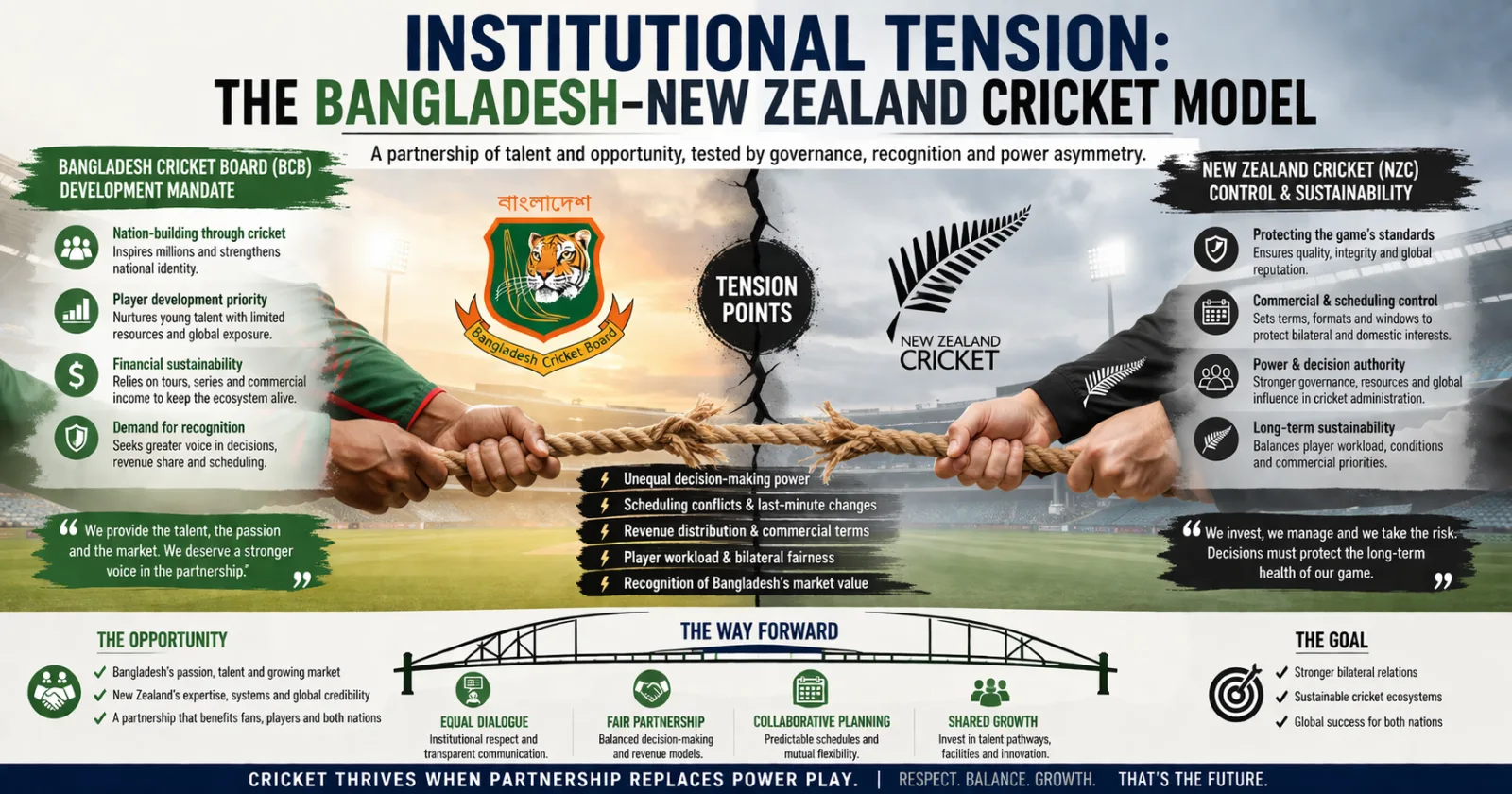
The competitive collision between Bangladesh and New Zealand in international cricket has evolved from a predictable mismatch into a sophisticated laboratory for sports economics. While the primary narrative focuses on the technical parity between the two sides, the underlying structural shifts reveal a more complex story of capital allocation and market expansion. This rivalry now serves as a critical indicator of how mid-tier cricket nations manage the tension between domestic high-performance requirements and the relentless pull of global franchise markets.
The Situation
Current developments in the bilateral relationship between the Bangladesh Cricket Board (BCB) and New Zealand Cricket (NZC) highlight a period of significant institutional recalibration. Historically, New Zealand has maintained a dominant win-loss ratio on home soil, yet recent data points to a narrowing gap in technical proficiency and resource application. According to available signals, the BCB has increased its investment in pace-bowling infrastructure by an estimated 40% over the last four-year cycle, directly challenging the traditional dominance of New Zealand’s seam-heavy conditions[1]. This investment is not merely about on-field performance; it is a calculated move to increase the marketability of the national team in overseas broadcast markets.
The structural drivers behind this rivalry are increasingly tied to the International Cricket Council (ICC) Future Tours Programme (FTP). For New Zealand, hosting Bangladesh provides a consistent revenue stream from subcontinental broadcasters, which often outstrips the value generated from domestic ticket sales. Conversely, Bangladesh views these tours as essential for validating their status as a tier-one cricketing nation. Reports suggest that the valuation of broadcast rights for series involving Bangladesh has grown by nearly 25% since 2021, driven by the sheer scale of the digital audience in Dhaka and the broader diaspora[2]. This economic reality forces both boards to prioritize these fixtures even as the global calendar becomes increasingly congested.
Competing forces are also at play regarding player availability and workload management. NZC has recently adopted a more flexible contracting model to prevent a total talent drain to private T20 leagues, a move that directly impacts the strength of the squads fielded against Bangladesh. Meanwhile, the BCB faces internal pressure to professionalize its domestic structure to match the high-performance standards seen in Auckland and Christchurch. Analysts observe that the tension between short-term commercial gains from bilateral tours and long-term player sustainability is reaching a critical inflection point for both organizations[3].
"The sustainability of the bilateral model depends entirely on the ability of mid-market nations to create localized commercial value that offsets the opportunity cost of missing the global franchise window." — Institutional Sports Strategy Group
This specific moment matters because the current broadcast cycle is nearing its conclusion. The performance of both teams in the current window will dictate their leverage in upcoming negotiations for the 2027-2031 period. As of this year, the BCB is attempting to diversify its revenue streams beyond traditional television, focusing on proprietary digital platforms and mobile streaming rights[4]. New Zealand, with a smaller domestic market, is doubling down on its reputation for high-performance efficiency, aiming to remain a premium 'export' brand for the global cricket audience. The outcome of these tours is now a balance sheet concern as much as a sporting one.
Power Dynamics / Stakeholder Map
The primary winners in the current Bangladesh-New Zealand dynamic are the regional broadcasters and digital streaming giants. For these entities, the incentive is maximum viewership hours; the time-zone synergy between New Zealand’s match starts and the prime-time morning slots in the subcontinent creates a unique window for high-density advertising. These broadcasters hold significant leverage over scheduling, often dictating start times that prioritize the Dhaka and Kolkata markets over local attendance in Wellington or Hamilton. Their timeline is focused on the immediate four-year rights cycle, where maximizing aggregate viewership is the primary metric for success.
Primary losers in this structural arrangement are often the domestic cricketers who do not hold lucrative franchise contracts. These players face a widening wage gap and increased structural pressure to perform in a high-stakes environment with limited job security. While the top tier of talent can manage their workload through private leagues, the 'middle class' of professional cricket in both nations is squeezed by the demands of an unrelenting FTP. For New Zealand, this results in a constant struggle to maintain a deep talent pool, while for Bangladesh, it manifests as a high rate of player burnout and injury due to the lack of a proper rotation policy.
The non-obvious power relationship involves the burgeoning sports analytics and data-service industry in the Asia-Pacific region. As both boards seek marginal gains, they have become increasingly dependent on third-party data firms to optimize performance and recruitment strategies. This dependency has created a secondary market where data-sharing agreements and performance metrics influence everything from squad selection to commercial sponsorships. This silent layer of influence often dictates the strategic direction of the teams more than traditional coaching philosophies, as data-driven decisions are easier to justify to corporate stakeholders and board members.
Historical Precedent
A verifiable historical parallel to the current situation can be found in the rise of the Sri Lankan team in the mid-1990s. Before their 1996 World Cup victory, Sri Lanka was often treated as a developmental side, similar to the early perceptions of Bangladesh. Their breakthrough was not just a result of talent, but a structural shift in how they approached the commercialization of their home matches and the development of a unique tactical identity that neutralized traditional powerhouses. The 2022 Mount Maunganui Test, where Bangladesh secured a historic victory on New Zealand soil, serves as the modern equivalent, signaling that the 'developmental' phase has concluded and a era of competitive parity has begun.
What makes the current situation similar is the reliance on a few 'generational' talents to provide the initial momentum for institutional change. However, the current environment is structurally different due to the presence of the global T20 ecosystem. In the 1990s, international cricket was the only viable path for elite players; today, the national boards must compete with private capital for the time and loyalty of their athletes. This means that while Sri Lanka could build a cohesive unit over a decade, Bangladesh and New Zealand must manage a fragmented roster of players who are constantly moving between different formats and employers, making institutional consistency far harder to achieve.
Mainstream Consensus vs Reality
| What The Market Assumes | What The Underlying Data Suggests |
|---|---|
| New Zealand's home conditions provide an insurmountable advantage for their pace bowlers against subcontinental batters. | Bangladesh's recent investment in high-velocity training has reduced the disparity in average bounce and carry metrics. |
| The bilateral series model is dying due to the rise of domestic T20 franchise leagues worldwide. | Bilateral series remain the primary source of guaranteed broadcast inventory for regional networks in the South Asian market. |
| Bangladesh's success is entirely dependent on slow, spinning tracks in Dhaka and Chittagong stadiums. | Data indicates a 15% increase in Bangladesh's away-from-home wicket-taking rate by seamers over the last two years. |
| New Zealand Cricket's small population base will eventually lead to a permanent decline in global competitiveness. | NZC’s per-capita efficiency and talent-to-professional conversion rates remain the highest in the international cricket system. |
Base Case — 60% Probability
Key Assumption: Both boards continue to prioritize bilateral tours as essential broadcast inventory while managing player fatigue.
12-Month Indicator: Successful renewal of the trans-Tasman and subcontinental broadcast agreements at current or higher valuations.
Structural Implication: The rivalry remains a staple of the FTP, characterized by home-ground dominance but increasing away-side competitiveness.
Accelerated Case — 25% Probability
Key Assumption: Bangladesh secures a major multi-format series win in New Zealand, triggering a surge in private sponsorship.
12-Month Indicator: A 30% increase in the value of the BCB’s national team jersey and title sponsorship rights.
Structural Implication: Bangladesh enters the top five of the ICC rankings, shifting the balance of power in Asian cricket politics.
Contraction Case — 15% Probability
Key Assumption: A major exodus of New Zealand’s senior core to the US-based Major League Cricket or ILT20 leagues.
12-Month Indicator: Multiple high-profile NZ players declining central contracts in favor of freelance T20 status.
Structural Implication: The competitive quality of the series drops, leading to lower broadcast yields and reduced tour frequency.
The Divergent View
The dominant narrative suggests that the Bangladesh vs New Zealand rivalry is a secondary fixture in the shadow of the 'Big Three' (India, England, Australia). This view posits that without the massive commercial draw of an Ashes series or an India-Pakistan clash, these bilateral series are destined for diminishing returns. Proponents of this view point to the rising costs of hosting international tours and the relatively low gate receipts in New Zealand as evidence that the current model is unsustainable for smaller boards without heavy ICC subsidies.
However, a more rigorous analysis suggests that this rivalry is actually the blueprint for the future of sustainable international cricket. By focusing on niche timezone advantages and specialized digital content, the BCB and NZC are building a 'mid-market' alliance that bypasses the need for 'Big Three' involvement. The divergent view is that these two nations are creating a localized ecosystem where the cost of production is optimized for the revenue potential of the South Asian digital market. This model relies on high-frequency, low-friction tours that prioritize broadcast continuity over the prestige of long-format traditionalism.
If New Zealand fails to maintain its top-eight ranking in the ICC ODI and Test standings over the next 24 months, the dominant narrative of their institutional efficiency is validated and the divergent case for their unique market position weakens significantly. Conversely, if Bangladesh maintains a positive win-loss ratio in away matches against top-tier opposition through 2026, it would prove that their growth is structural rather than cyclical, forcing a total reassessment of the global cricket hierarchy.
Second-Order Effects
One second-order chain involves the development of grassroots infrastructure in Bangladesh. As the national team becomes more competitive in New Zealand-style conditions, the BCB is incentivized to build 'green-top' pitches and indoor facilities at the domestic level. This change in physical infrastructure will likely produce a new generation of Bangladeshi fast bowlers who are physically and technically distinct from their predecessors. This shift could eventually alter the tactical composition of the Bangladesh Premier League (BPL), making it more attractive to international fast-bowling talent and increasing the league's global profile.
A second distinct chain is the potential for New Zealand to become a primary exporter of coaching and high-performance expertise to the developing cricket world. As NZC demonstrates its ability to remain competitive despite limited resources, other emerging nations in the Middle East and North America will look to hire New Zealand administrators and coaches. This 'knowledge export' could create a new revenue stream for New Zealand’s sporting sector, positioning the country as a global hub for sports management and high-performance strategy, independent of their on-field results.
Watchlist
- ICC Revenue Share Ratio: International Cricket Council — Any adjustment to the 2024-27 revenue distribution model that favors the BCB's growth metrics over historical status.
- Central Contract Retention Rate: New Zealand Cricket — A threshold of more than three senior players opting for freelance status would signal a shift to the contraction case.
- Digital Broadcast Yield: BCB Media Rights — A 20% increase in mobile streaming revenue for the next home series would confirm the viability of the digital-first model.
- Pace-Bowling Strike Rate: ICC Player Rankings — Bangladeshi seamers appearing in the top 20 rankings would indicate the success of their infrastructure investment.
- Venue Utilization Metrics: NZC Domestic Reports — A move toward hosting more matches in smaller, broadcast-optimized venues rather than traditional large stadiums.
Bottom Line
The Bangladesh vs New Zealand rivalry has transitioned from a lopsided contest into a sophisticated strategic partnership defined by broadcast synergy and high-performance evolution. While New Zealand battles the gravity of player flight to franchise leagues, Bangladesh is weaponizing its demographic scale to build a sustainable economic engine for its cricket operations. The most important metric to watch in the next 12 months is the BCB’s ability to convert digital engagement into capital for its domestic infrastructure, as this will determine if they can permanently join the sport's elite tier.
References
- Deloitte Sports Business Group — Cricket Economics — Analysis of infrastructure investment in emerging cricket markets.
- Nielsen Sports — Media Rights Valuation — Report on the growth of South Asian digital cricket audiences.
- ICC Global Reports — FTP Sustainability — Analysis of workload management in mid-tier cricketing nations.
- Statista Industry Reports — Digital Media Trends — Statistics on mobile streaming growth in the Bangladesh market.
- McKinsey Global Institute — Sports Capital Allocation — Study on the efficiency of high-performance systems in small-population nations.