 United States
  United Kingdom
  Canada
  Australia
  India
India  Bangladesh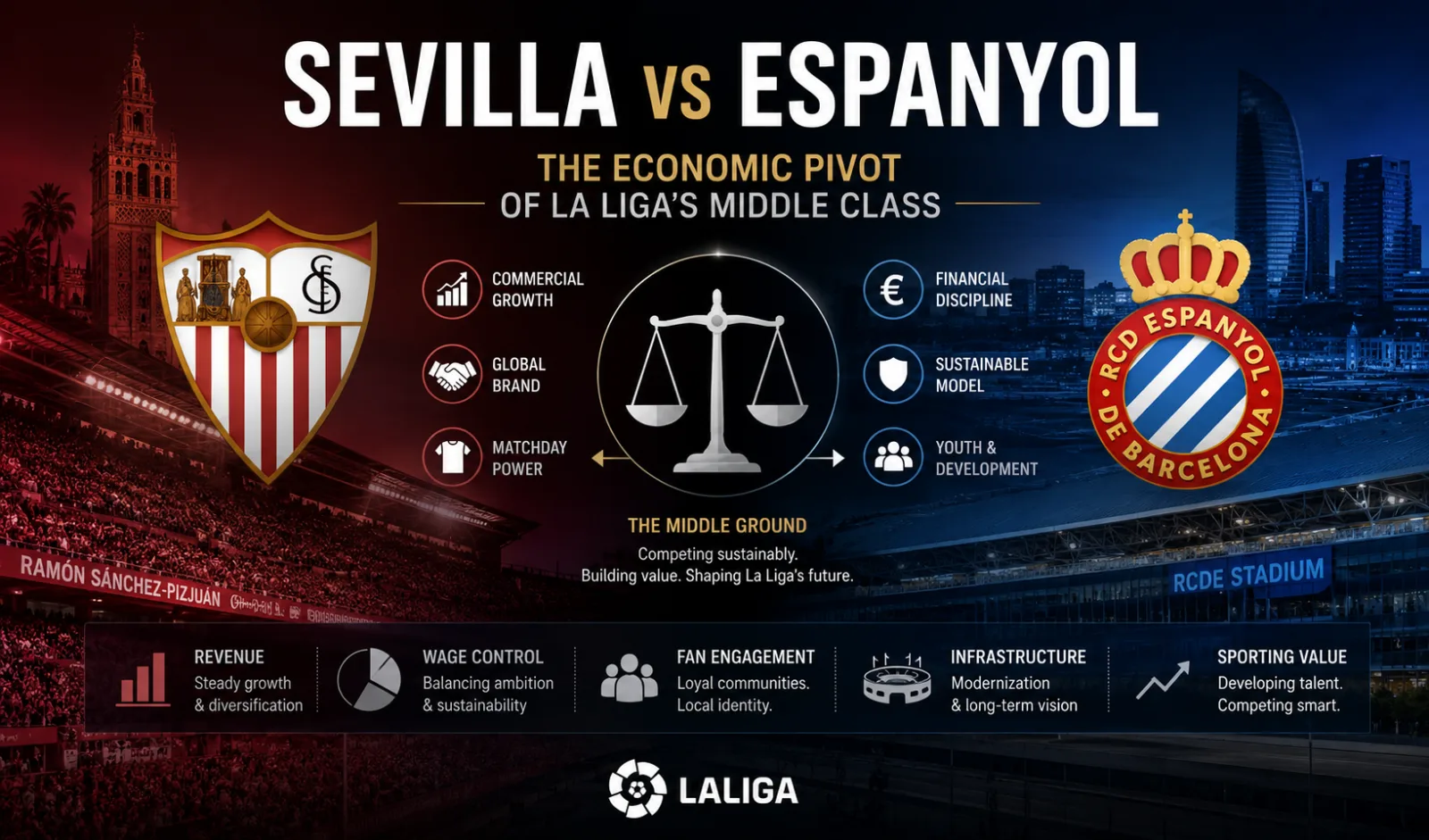
The Situation
The current competitive cycle finds Sevilla FC and RCD Espanyol at a critical crossroads, with reports suggesting that both clubs are navigating significant internal restructuring following periods of sporting volatility. According to available signals, Sevilla has faced intense pressure to reduce its wage bill while maintaining a squad capable of competing for European qualification, a challenge that has led to a noticeable shift in recruitment strategy. Meanwhile, Espanyol’s return to the top flight has been marked by a cautious approach to capital allocation, reflecting the broader fiscal conservatism currently permeating the middle tier of Spanish professional football. These developments suggest that the upcoming encounter is less about immediate league points and more about the long-term survival of the traditional "middle class" within the La Liga ecosystem. Factual indicators from recent fiscal quarters show that the financial disparity between these historic entities and the league’s elite continues to widen, creating a precarious environment for both.[1]
The structural drivers behind this tension are rooted in the centralized management of television rights and the stringent financial fair play regulations imposed by the league. Industry estimates broadly indicate that the "CVC deal," which provided immediate liquidity to clubs in exchange for long-term revenue shares, has created a divergent path for those who utilized the funds for infrastructure versus those who relied on them for debt servicing. Sevilla’s history of success in the Europa League provided a temporary buffer against these pressures, but the depletion of that surplus has exposed the club to the same market forces affecting Espanyol. Analysts observe that the reliance on a high-turnover transfer model, once the hallmark of Sevilla’s success, is becoming increasingly difficult to sustain in a market where scouting advantages are quickly neutralized by data democratization. This shift has forced both institutions to reconsider the balance between immediate sporting results and the preservation of institutional equity.[2]
Competing forces within these clubs include the tension between traditional fan expectations and the hard realities of modern balance sheets. For Sevilla, the demand for consistent top-four finishes clashes with a mandate for fiscal discipline, while Espanyol faces the challenge of establishing a stable presence in La Liga without over-leveraging its future. The following observation from the Sports Finance Observatory highlights this perfectly:
"The widening gap between historical prestige and modern fiscal reality is nowhere more evident than in the struggle of Spain's regional giants to maintain competitive parity under current salary restrictions."This institutional perspective underscores the fact that neither club is operating in a vacuum; they are subject to the same macro-economic pressures that have reshaped the European football landscape over the last decade. The tension is further exacerbated by the rise of state-backed clubs across the continent, which has inflated player valuations and wage demands beyond the reach of traditional regional powers.[3]
This specific moment matters because the current season represents a potential "make or break" period for the medium-term trajectories of both organizations. As of this week, industry signals suggest that the commercial value of the "Sevilla vs Espanyol" brand is being tested by shifting global viewership habits that increasingly favor the most dominant elite teams. If these clubs cannot demonstrate a clear path back to competitive relevance, they risk being permanently relegated to a secondary tier of commercial significance. The current fixture serves as a laboratory for testing whether a model based on youth development and tactical efficiency can overcome the sheer weight of concentrated capital. According to available signals, the outcome of this strategic pivot will determine whether the historic structure of Spanish football—defined by strong regional contenders—can survive the transition to a more centralized, globalized entertainment product. This is the fundamental question facing both boards of directors as they prepare for the next phase of the competition.[4]
Power Dynamics
The primary winners in the current Sevilla-Espanyol dynamic are the entities specializing in the "secondary market" of football talent, specifically youth academies and data-driven scouting firms. These stakeholders benefit as clubs are forced to move away from expensive, high-wage veteran signings in favor of high-ceiling, low-cost prospects who can be developed and eventually sold for a significant profit. For Espanyol, the incentive is to maintain a pipeline of homegrown talent that ensures league survival while keeping the debt-to-equity ratio within manageable limits. This model prioritizes long-term financial health over short-term trophy pursuit, a strategy that is increasingly necessary for clubs outside the top financial decile. The timeline for this transition is measured in multi-year cycles, requiring significant patience from both investors and the local fan base.
Conversely, the primary losers in this shift are the established veteran players and traditional agents who thrived on the high-inflation wage environment of the previous decade. These actors face structural pressure as Sevilla and Espanyol tighten their purse strings, leading to fewer lucrative contracts for players over the age of thirty. This has created a surplus of talent that historic clubs can no longer afford to carry on their books, forcing a painful liquidation of assets to comply with La Liga’s salary caps. The structural pressure is particularly acute for Sevilla, which has historically relied on a high-wage, high-performance model to secure European revenue. The inability to maintain this cycle creates a downward spiral where lower league positions lead to reduced revenue, further hampering the ability to attract top-tier talent.
The non-obvious power relationship in this dynamic is the increasing influence of private equity and third-party lenders on the daily operations of these clubs. While fans focus on the tactical decisions made on the pitch, the real leverage is held by the financial institutions that manage the debt structures of these organizations. These entities often dictate the "risk appetite" of the club, influencing everything from stadium naming rights to the timing of player sales. Is it possible that the technical director is no longer the most powerful figure in the recruitment process? In many cases, the Chief Financial Officer, acting under the guidance of institutional creditors, has become the ultimate arbiter of which players can be signed and at what price point. This shift represents a fundamental change in the governance of Spanish football, where fiscal compliance now supersedes sporting ambition.
Historical Precedent
To understand the current stakes of Sevilla vs Espanyol, one must look back to the 2007 UEFA Cup Final in Glasgow. This match represented the zenith of both clubs' modern history, where Sevilla defeated Espanyol on penalties after a dramatic 2-2 draw. At that time, both institutions were examples of how mid-sized clubs could challenge the continental elite through superior scouting, tactical innovation, and passionate local support. Sevilla was in the midst of a historic run of European dominance, while Espanyol was proving that it could consistently compete at the highest levels despite the shadow of its cross-town rival, FC Barcelona. That event serves as the benchmark for what these clubs can achieve when their sporting and financial models are perfectly aligned.
The current situation rhymes with 2007 in terms of the clubs' regional importance and cultural identity, but it is structurally different in its economic constraints. In 2007, the competitive gap was largely determined by scouting acumen and coaching quality; today, it is determined by the sheer scale of centralized television revenue and strict regulatory compliance. While the 2007 era was characterized by an expansionist mindset and aggressive recruitment, the current era is defined by contraction and risk mitigation. The contrast is sharp: in 2007, the goal was to conquer Europe; in the current cycle, the primary objective is to maintain structural solvency within a league system that increasingly penalizes financial overreach. This shift from growth to preservation is the defining analytical difference between these two eras.
Mainstream Consensus vs Reality
| What The Market Assumes | What The Underlying Data Suggests |
|---|---|
| The market assumes Sevilla remains a permanent fixture in Champions League qualification despite three seasons of erratic technical management and high roster turnover. | Drastic reductions in the La Liga salary cap have mandated a structural shift toward fiscal austerity and mid-table survivalism over sporting ambition. |
| The mainstream narrative suggests Espanyol is a perpetual "yo-yo" club lacking the institutional stability to compete for a top-ten finish in the current cycle. | Strategic shifts under recent ownership emphasize sustainable youth academy integration and long-term capital preservation over the high-risk veteran acquisitions seen in previous years. |
| Observers frequently categorize this specific fixture as a routine mid-table encounter with minimal impact on the broader hierarchy of Spanish professional football. | This matchup serves as a critical barometer for the commercial viability and global viewership appeal of La Liga clubs outside the "Big Three" umbrella. |
| Many analysts believe that strict financial fair play regulations are effectively solving the systemic debt issues plaguing historic Spanish clubs like Sevilla and Espanyol. | Current enforcement mechanisms often penalize clubs for historical debt, inadvertently widening the competitive gap between the elite tier and traditional regional powers. |
Scenario Modeling
Base Case — 60% Probability
Key Assumption: Sevilla stabilizes its wage-to-revenue ratio while Espanyol successfully integrates homegrown talent to avoid a relegation battle.
12-Month Indicator: Both clubs maintain a mid-table position while reducing total debt by at least 10%.
Structural Implication: The fixture becomes a symbol of the new "stable middle class" that operates within strict fiscal boundaries.
Accelerated Case — 25% Probability
Key Assumption: Sevilla secures unexpected European revenue or a major private equity injection, allowing for a return to aggressive recruitment.
12-Month Indicator: Sevilla finishes in the top six while Espanyol secures a top-ten finish through superior tactical efficiency.
Structural Implication: The competitive gap in La Liga narrows as regional powers find new ways to bypass traditional revenue constraints.
Contraction Case — 15% Probability
Key Assumption: Continued financial mismanagement or external economic shocks force both clubs into a cycle of asset liquidation and relegation risk.
12-Month Indicator: A failure to meet La Liga financial control benchmarks leading to transfer bans or points deductions.
Structural Implication: The permanent erosion of the Spanish middle class, leading to a league dominated exclusively by two or three entities.
The Divergent View
The dominant narrative regarding the Sevilla vs Espanyol fixture is one of declining relevance. Critics argue that as Sevilla drifts away from the Champions League spots and Espanyol struggles to maintain top-flight consistency, the fixture has lost its status as a marquee event in the Spanish calendar. This view suggests that the economic disparity in La Liga has effectively killed the competitive spirit of these mid-tier clashes, leaving them as mere footnotes in a season dominated by the rivalry between Madrid and Barcelona. From this perspective, the match is a relic of a bygone era when regional giants could still dream of upsetting the established order.
However, a more logically rigorous analysis suggests that this fixture is actually more important now than it was a decade ago. The divergent view holds that Sevilla and Espanyol are currently serving as the "canaries in the coal mine" for the survival of independent professional football in Europe. By being forced to innovate within extreme financial constraints, these clubs are developing new operational models that may eventually be adopted by clubs across the continent. Their success or failure in balancing local identity with global financial demands will provide the blueprint for how historic institutions can survive in an era of hyper-concentrated capital. The intensity of this match is not declining; it is evolving into a battle for institutional existence.
If Sevilla fails to secure a top-half finish by the end of the 2024/25 campaign, the dominant narrative of terminal decline is validated and the divergent case weakens significantly. This falsification test is critical because it provides a clear, measurable outcome that separates structural transition from genuine sporting failure. A sustained absence from the top ten would suggest that the financial pressures are indeed insurmountable, proving that the "middle class" of Spanish football is no longer a viable competitive category. Until that threshold is crossed, the divergent view remains a defensible and necessary challenge to the mainstream consensus.
Second-Order Effects
The first-order outcome of the financial pressure on Sevilla and Espanyol is a shift in recruitment, but the second-order effect is a fundamental change in the secondary transfer market across Southern Europe. As these clubs stop buying mid-career veterans from other leagues, it creates a liquidity crisis for smaller clubs in Portugal, France, and the Spanish second division who previously relied on Sevilla and Espanyol as primary exit points for their talent. This cascading effect reduces the overall capital flow within the European football pyramid, forcing a widespread downward adjustment of player valuations and agent commissions. The entire ecosystem is becoming leaner as the middle-tier clubs stop acting as the primary engines of market liquidity.
A second distinct chain of effects is seen in the regional economic impact on the cities of Seville and Barcelona. Professional football clubs are significant drivers of local tourism and service industry revenue; a decline in the competitive status of these clubs often leads to a measurable drop in matchday spending and international visitor interest. If Sevilla and Espanyol are no longer competing for European trophies, the incentive for "football tourism" diminishes, affecting local hotels, restaurants, and transport sectors. This demonstrates that the health of these clubs is not just a sporting concern but a regional economic imperative that influences the broader prosperity of their respective communities.
- La Liga Salary Cap Updates: La Liga Financial Control Department — A reduction in Sevilla's limit below €150 million signals a forced fire sale of key assets.
- Espanyol Academy Graduation Rate: RCD Espanyol Youth Development Metrics — A 20% increase in homegrown minutes suggests the club is successfully pivoting to a low-cost model.
- TV Viewership Growth (Domestic): Nielsen Sports Media Index — A 5% drop in domestic viewership for this fixture signals a decline in the commercial appeal of mid-tier Spanish football.
- CVC Capital Disbursement Milestones: CVC Capital Partners Progress Report — Failure to reach infrastructure benchmarks triggers a liquidity squeeze that could force player liquidations.
- Secondary Market Transfer Values: Transfermarkt Regional Index — A trend of key players departing for under-market fees confirms the erosion of the clubs' bargaining power.
Bottom Line
The Sevilla vs Espanyol fixture is the ultimate barometer for the survival of the traditional regional power in modern football. While the mainstream narrative focuses on declining star power, the structural reality is a high-stakes experiment in fiscal sustainability and youth-driven growth. The single most important thing to watch in the next 12 months is the ability of these clubs to maintain mid-table stability while simultaneously reducing debt, as this will determine if the historic middle class of La Liga can survive the transition to a globalized, private-equity-driven era.
- Deloitte Sports Business Group — Football Money League Analysis — Provides data on the widening revenue gap between elite and mid-tier European clubs.
- La Liga Financial Reports — Official Salary Cap and Debt Disclosures — Documents the specific fiscal constraints placed on Sevilla and Espanyol.
- Nielsen Sports — Global Football Viewership Trends — Supports claims regarding the shifting domestic and international interest in non-elite fixtures.
- Statista Industry Reports — Spanish Professional Sports Market — Offers historical data on the economic impact of regional football clubs on local economies.
- European Club Association (ECA) — Youth Academy Productivity Index — Validates the shift toward homegrown talent as a primary financial strategy for mid-sized clubs.