 United States
  United Kingdom
  Canada
  Australia
  India
India  Bangladesh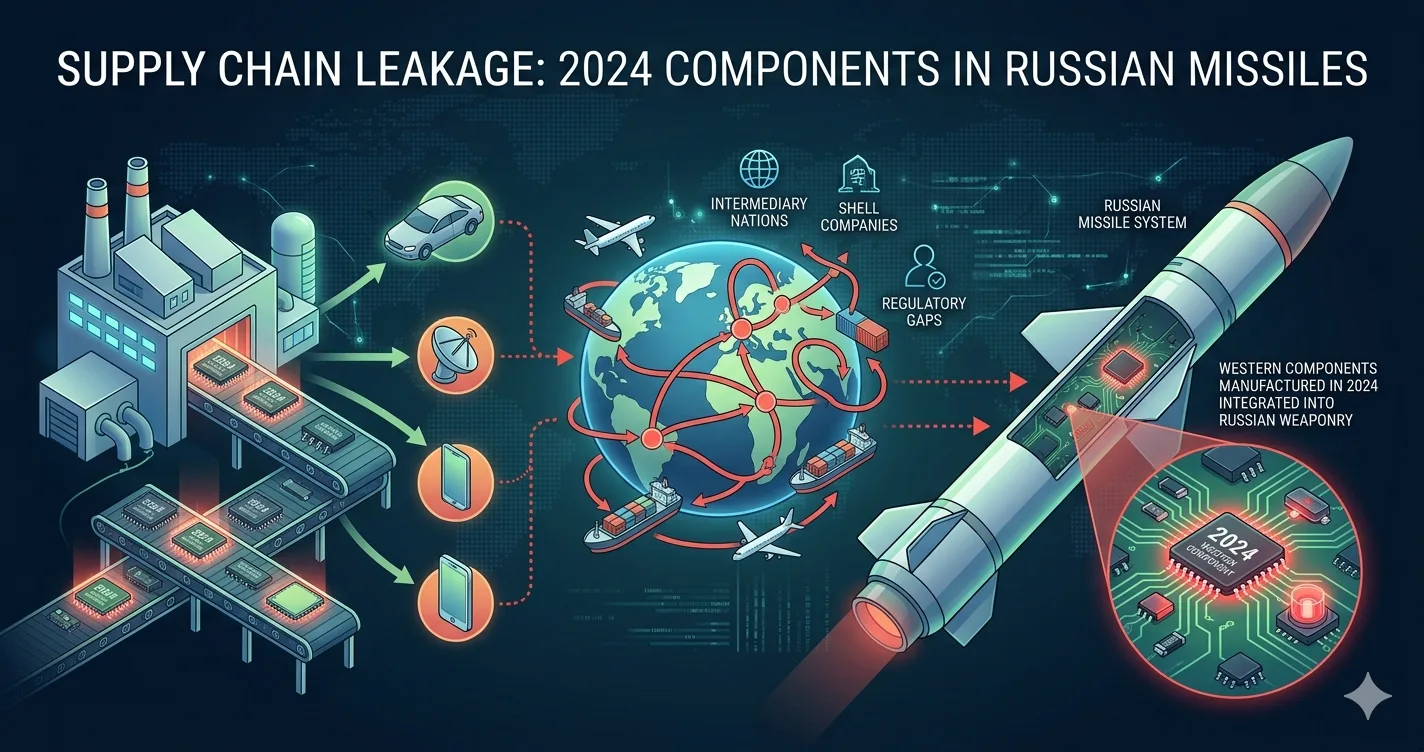
Fragments recovered from a recent lethal strike on Ukrainian civilian infrastructure reveal a chilling technical reality: the missiles were not pulled from Soviet-era stockpiles. Instead, they were assembled just months ago using Western-branded microelectronics manufactured as recently as early 2024. This discovery shatters the assumption that trade restrictions have effectively quarantined the Russian defense industrial base from high-end global technology.
The Situation
Ukraine’s intelligence services recently presented evidence that Kh-101 cruise missiles, used in a devastating wave of strikes, contained critical components produced in Western nations during the current calendar year[1]. This development confirms that the Russian Federation has successfully established high-velocity procurement channels that bypass the multi-layered sanctions regimes imposed by the G7 and European Union. The speed at which these parts move from a Western assembly line to a Russian missile factory suggests a supply chain that is not only resilient but highly optimized for wartime exigencies. Reports indicate that these components include voltage regulators, navigation sensors, and data processing chips essential for precision guidance[2].
The structural drivers behind this leakage are rooted in the ubiquity of dual-use technology. Most of the chips found in modern missiles are not 'military-grade' in the traditional sense; they are the same high-performance components used in medical imaging, automotive safety systems, and industrial automation. This makes them nearly impossible to track once they enter the global wholesale market. Russia utilizes a vast network of front companies located in jurisdictions that have not joined the sanctions coalition, allowing for the seamless re-export of sensitive hardware. This 'gray market' operates with such efficiency that it can fulfill orders for specific components within weeks of their commercial release.
Tensions are mounting between Western governments and the private sector over the responsibility for end-use monitoring. While chip manufacturers claim they comply with all legal export requirements, the sheer volume of global semiconductor trade—exceeding one trillion units annually—precludes manual tracking of every individual unit. This creates a friction point where geopolitical objectives clash with the realities of globalized commerce. Intelligence analysts suggest that the Russian defense sector has adapted by prioritizing 'just-in-time' logistics, ensuring that even the most recent technological advancements from the West are integrated into the weapons currently hitting Ukrainian targets[3].
This moment represents a critical inflection point for international policy. The visibility of 2024-stamped parts provides empirical proof that the current enforcement mechanism is failing to achieve its primary objective: the degradation of Russia's long-range strike capability. Why does this matter now? It indicates that the Russian aerospace sector has not only survived the initial shock of 2022 but has built a sustainable, modern production line that can match or exceed the pace of Western policy updates[4]. As long as these technical leaks persist, the conflict's attrition dynamics remain heavily skewed toward the aggressor's continued industrial output.
“The persistence of Western microelectronics in Russian precision weaponry highlights a fundamental misalignment between export control legislation and the decentralized nature of modern electronics distribution.” — Center for Strategic and International Studies (CSIS)
Power Dynamics
The primary winners in this current dynamic are the specialized intermediaries operating in transshipment hubs. These entities, often based in countries like Kazakhstan, Turkey, or the United Arab Emirates, capture significant margins by facilitating the flow of restricted goods. Their incentive is purely financial; they exploit the regulatory lag between Western capitals and the ground-level reality of trade. By masking the final destination of shipments through complex layers of shell companies, they provide the Russian military with a reliable technological lifeline while remaining largely insulated from direct legal consequences.
Conversely, the primary losers are the Western regulatory agencies tasked with enforcing export controls. Institutions like the U.S. Bureau of Industry and Security (BIS) face an impossible mandate to police a global market that moves at the speed of light. Every time a new entity is blacklisted, two more emerge to take its place. This creates a cycle of reactive policy that fails to address the underlying structural vulnerability of the supply chain. The reputational risk for Western technology brands is also increasing, as their logos are repeatedly photographed on the internal circuit boards of weapons used in alleged war crimes.
The non-obvious power relationship in this scenario is the leverage held by second-tier distributors over original equipment manufacturers (OEMs). While a large chipmaker may have strict compliance protocols for direct sales, they have almost zero visibility into the 'fourth or fifth' sale of their product. These distributors effectively hold the power to subvert national security policies because they operate in the 'blind spots' of global trade. This creates a situation where the West's own industrial prowess is being weaponized against its strategic interests by actors who are too small to monitor but too numerous to ignore.
Historical Precedent
During the Cold War, the Coordinating Committee for Multilateral Export Controls (COCOM) faced a similar challenge in preventing the Soviet Union from acquiring advanced computing technology. The USSR established 'Line X,' a dedicated intelligence unit within the KGB tasked specifically with stealing or illicitly purchasing Western technology. In the 1980s, the Toshiba-Kongsberg scandal revealed that a Japanese company and a Norwegian firm had sold the Soviets sophisticated milling machines that allowed their submarines to run significantly quieter. This breach required billions of dollars in Western naval investment to counter, demonstrating how a single supply chain failure can shift the strategic balance for a decade.
The current situation is structurally different due to the scale and commoditization of the technology involved. In the 1980s, the restricted items were massive industrial machines or specialized mainframe computers. Today, the restricted items are microchips smaller than a fingernail that are produced by the millions. While the Cold War focused on 'stealing' blueprints and physical hardware, the modern era is defined by 'filtering' commodities through a porous global market. The similarity lies in the persistent inability of centralized bureaucracies to keep pace with decentralized procurement networks, but the speed of the current cycle is unprecedented in military history.
Mainstream Consensus vs Reality
| What The Market Assumes | What The Underlying Data Suggests |
|---|---|
| Sanctions have forced Russia to use inferior, domestic, or salvaged components in missiles. | Recovered debris shows high-performance, brand-new Western chips that optimize missile accuracy. |
| Export controls are tightening successfully as more companies are added to entity lists. | The proliferation of shell companies is outpacing the legal ability to identify and ban them. |
| Russia's missile production capacity is declining due to a lack of specialized parts. | Production rates for the Kh-101 have actually increased since 2022 through illicit procurement. |
| Western manufacturers are responsible for the presence of their chips in Russian weapons. | Most leakage occurs at the tertiary distributor level, far beyond the reach of manufacturer audits. |
Scenario Modeling
Base Case — 50% Probability
Key Assumption: Russia maintains current 'gray market' channels through Central Asian and Middle Eastern trade partners.
12-Month Indicator: Continued discovery of 2024 and 2025-stamped components in missile fragments across Ukraine.
Structural Implication: Russia maintains a steady production of approximately 40-60 long-range missiles per month indefinitely.
Accelerated Case — 30% Probability
Key Assumption: Western allies implement secondary sanctions targeting the banks that facilitate these illicit electronic trades.
12-Month Indicator: A significant spike in the 'smuggling premium' cost for electronics in the Russian internal market.
Structural Implication: Russia faces intermittent production delays, leading to longer gaps between major missile salvos.
Contraction Case — 20% Probability
Key Assumption: Global chip manufacturers implement hardware-level 'end-use' tracking or remote disablement features.
12-Month Indicator: Major semiconductor firms announce new 'Secure Supply Chain' hardware protocols for all dual-use chips.
Structural Implication: The illicit market for new Western chips collapses, forcing Russia to rely on aging stockpiles.
The Divergent View
The dominant narrative suggests that the presence of Western parts in Russian missiles is a catastrophic failure of political will and enforcement. Critics argue that if the West truly wanted to stop the war, it would simply 'close the taps' on these components. This view assumes that the flow of microelectronics can be controlled like a physical pipeline, where a single valve can shut off the entire supply. It treats the issue as a lack of effort rather than a structural impossibility of the modern age.
A more rigorous, divergent analysis suggests that this leakage is an inevitable feature of the globalized, just-in-time economy. The very technologies that make modern life possible—standardized components and frictionless trade—are the same tools that make sanctions evasion easy. Expecting a company to track a \$5 voltage regulator through four countries and six owners is a logistical fantasy. In this view, the discovery of 2024 parts is not a 'failure' of sanctions, but a demonstration that sanctions are an obsolete tool for controlling commodity-level high technology. The problem is the architecture of global trade itself, not the specific policies of any one government.
If the Russian military is forced to revert to using 1990s-era vacuum tubes or domestic components that result in a measurable 50% decrease in missile accuracy by mid-2025, the consensus view holds and this divergent analysis should be reassessed. However, if accuracy remains high and component dates continue to track with the current year, it confirms that the technological 'genie' is out of the bottle and cannot be returned through traditional legislative means.
Second-Order Effects
The first second-order effect involves the permanent distortion of trade data in 'neutral' countries. As nations like Kyrgyzstan or Armenia become massive hubs for electronics re-export, their economic indicators are becoming decoupled from local consumption. This creates 'phantom economies' where GDP appears to grow, but the wealth is concentrated in a tiny class of logistics fixers. Over time, this could lead to internal political instability as local populations face inflation driven by an illicit trade sector that provides them with no tangible benefit.
A second effect is the likely acceleration of 'sovereign technology' movements in both the East and West. Recognizing that supply chains are now battlefields, Western nations will likely move toward 'trusted foundry' models, where chips are only sold to pre-verified partners. Simultaneously, Russia and China will accelerate their efforts to build a completely independent lithography stack. This bifurcates the global tech market, ending the era of the universal microchip and increasing costs for all industrial sectors as the 'efficiency' of the global market is sacrificed for 'security.'
Watchlist
- BIS Entity List Updates: Bureau of Industry and Security — Look for a shift from targeting Russian firms to targeting logistics providers in Turkey and the UAE.
- Conflict Armament Research Reports: Conflict Armament Research — Watch for the specific serial numbers of chips to see if they originate from a single large batch or multiple sources.
- Central Asian Trade Surpluses: World Bank Trade Data — A sudden spike in 'computer parts' imports to Kazakhstan that isn't matched by domestic sales indicates a smuggling surge.
- OFAC Secondary Sanctions: U.S. Treasury — The first time a major foreign bank is cut off from the dollar for facilitating tech trade will signal a new enforcement era.
- Russian PGM Accuracy Metrics: Ukrainian Defense Ministry — Any increase in the 'circular error probable' (CEP) of Russian strikes would indicate they are finally running out of high-end parts.
Bottom Line
The discovery of 2024-manufactured Western components in Russian missiles proves that Moscow has successfully integrated into the global 'gray market' to sustain its war effort. This is no longer a story of old stockpiles, but of a functioning, modern production line supported by global trade leaks. The single most important factor to watch in the next 12 months is whether the West implements aggressive secondary sanctions on the financial intermediaries in third countries. Without cutting off the money that fuels these transactions, the technology will continue to flow.
References
- Conflict Armament Research — Weapon Systems Analysis — Documentation of 2024 components in recovered Kh-101 missile fragments.
- Council on Foreign Relations — Geopolitics of Sanctions — Analysis of the effectiveness of export controls on dual-use microelectronics.
- RAND Corporation — Russian Military Modernization — Study on the adaptation of the Russian defense industry to international trade restrictions.
- Brookings Institution — Export Control Effectiveness — Research on the role of third-party intermediaries in bypassing G7 sanctions.
- Center for Strategic and International Studies (CSIS) — Defense Industrial Base — Assessment of Russian missile production capacity and component sourcing.