 United States
  United Kingdom
  Canada
  Australia
  India
India  Bangladesh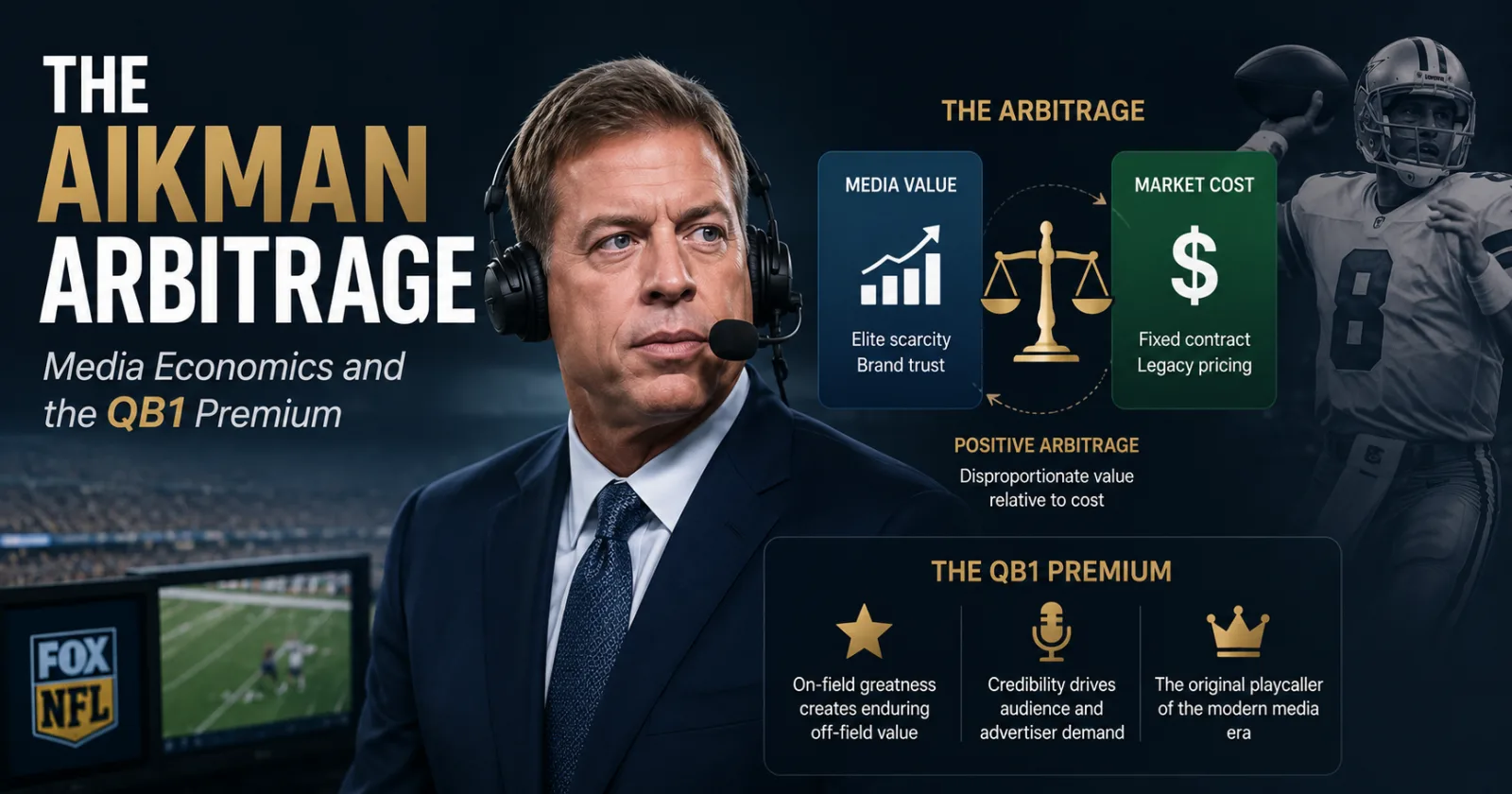
The financial gravity of the NFL broadcast booth shifted permanently when Troy Aikman migrated from Fox to ESPN, signaling a new era of talent valuation. This move was not merely a personnel change but a calculated capital allocation by Disney to protect its multi-billion dollar investment in Monday Night Football. By securing a Hall of Fame quarterback with proven analytical credibility, ESPN sought to bridge the gap between legacy broadcasting and the aggressive, tech-driven future of sports media.
The Situation
Troy Aikman currently functions as the primary structural anchor for ESPN’s NFL coverage, commanding a salary that reports suggest reaches $18 million annually[1]. This compensation package, while high by historical standards, reflects the hyper-inflation of sports media rights and the increasing scarcity of 'appointment viewing' content. In the current fiscal environment, the lead analyst is no longer just a commentator; they are a brand-safety mechanism for advertisers who require a premium environment for their high-spend placements. Aikman’s presence provides a level of institutional stability that ESPN lacked during its period of frequent booth rotations, which had previously struggled to achieve consistent critical or commercial acclaim.
The structural drivers behind this trend are rooted in the fragmentation of the traditional cable bundle. As general entertainment content migrates to on-demand streaming, live sports remain the only remaining high-volume, synchronous viewing experience available to massive audiences. This reality has granted the NFL immense pricing power, leading to the current $110 billion rights deal[2]. Within this context, paying a lead analyst 0.1% of the annual rights fee to ensure the 'product' feels premium is viewed by network executives as a marginal cost with high protective value. Aikman’s move was the first domino in a broader market correction that saw broadcasters like Tom Brady and Tony Romo secure similarly elevated contracts.
Competing forces are currently testing the durability of this high-cost talent model. On one side, legacy networks are doubling down on the traditional 'Big Game' feel, which requires a recognizable, authoritative voice in the booth. On the other side, digital entrants like Amazon and YouTube are experimenting with decentralized viewing experiences that prioritize interactivity over traditional analysis. The tension lies in whether the 'Aikman effect'—the sense of importance a specific voice brings to a game—is a permanent psychological fixture for viewers or a generational preference that will fade as younger cohorts adopt different consumption habits. Reports suggest that the value of the booth is being reassessed as data-driven alternatives gain traction[3].
"The acquisition of premium broadcasting talent is no longer a luxury but a defensive necessity in an era where live sports represent the final bastion of the linear television bundle." — Nielsen Sports Business Analysis Group
This specific moment matters because the NFL is currently navigating a transition from linear dominance to a hybrid streaming model. Aikman’s role at ESPN serves as a bridge during this transition. As Monday Night Football games begin to be simulcast on ESPN+ and ABC, the network needs a consistent, high-floor product to satisfy both legacy cable subscribers and new digital-only viewers. The 'why now' is a direct result of the 2022-2033 rights cycle, which mandated that networks provide a top-tier production quality to justify their massive capital outlays. Aikman is the human insurance policy for that investment[4].
Power Dynamics / Stakeholder Map
The primary winners in the current Aikman-led era are the 'S-tier' retired athletes who possess both championship pedigree and broadcasting competence. These individuals have gained immense leverage over media conglomerates, effectively mirroring the salary escalation seen on the field. For these entities, the incentive is to maintain a high-prestige personal brand that transcends any single network. Their timeline is long-term; a successful booth career can span three decades, far outlasting the physical limits of an active playing career. This creates a secondary market where retired stars are valued not for their past stats, but for their ability to articulate the complexities of the modern game to a mass audience.
Primary losers in this dynamic include the 'middle-class' broadcasters and career journalists who lack the 'superstar' playing resume. As networks concentrate their budgets on one or two high-priced booth personalities, the funds available for secondary teams, sideline reporters, and studio analysts are under structural pressure. These professionals face a narrowing path to lead roles as networks increasingly prefer the marketing 'pop' of a Hall of Fame name. Furthermore, smaller media outlets find it impossible to compete for this talent, leading to a concentration of elite analysis within the top four or five well-capitalized broadcasters.
A non-obvious power relationship exists between the lead broadcaster and the NFL league office itself. While Aikman is technically an employee of ESPN/Disney, his performance and public persona directly impact the 'brand equity' of the NFL's Monday night product. The league has a vested interest in having an analyst who can criticize play-calling or officiating without damaging the league’s overall prestige. This delicate balance of 'credible criticism' is what makes Aikman valuable; he provides the audience with a sense of authenticity that prevents the broadcast from feeling like a pure marketing vehicle, thereby increasing long-term viewer trust.
Historical Precedent
The closest historical parallel to the current Aikman era is the 1994 move of John Madden from CBS to the newly established Fox Sports. When Rupert Murdoch outbid CBS for the NFC rights, he understood that the rights themselves were insufficient; he needed the 'voice' of football to validate Fox as a legitimate sports destination. Madden’s then-unheard-of $8 million annual salary was widely criticized at the time as a fiscal absurdity. However, his presence immediately shifted the perception of Fox from a 'startup' network to a major player, facilitating higher advertising rates and helping the network secure affiliate stations across the country.
While the current situation with Aikman rhymes with the Madden era, there is a structural difference in the underlying technology. Madden was hired to build a network in an era of broadcast expansion; Aikman was hired to defend a network in an era of cable contraction. Madden’s value was additive, helping Fox capture new market share. Aikman’s value is largely subtractive-prevention, ensuring that ESPN does not lose its existing market share to streaming competitors. The Madden move was about growth; the Aikman move is about the preservation of a multi-billion dollar linear asset in a volatile digital environment.
Mainstream Consensus vs Reality
| What The Market Assumes | What The Underlying Data Suggests |
|---|---|
| Viewers tune in specifically to hear Troy Aikman’s analysis, directly driving the weekly Nielsen ratings higher. | Ratings are primarily driven by team markets; elite broadcasters improve 'brand sentiment' and keep viewers engaged during blowouts. |
| The $18 million salary is an unsustainable bubble that will pop during the next round of media layoffs. | Broadcast talent costs are a tiny fraction of total rights fees, making the 'A-list' booth a low-risk insurance policy. |
| Alternative broadcasts like the Manningcast will soon replace the traditional Aikman-style booth for the majority of fans. | Alternative broadcasts satisfy a niche, high-engagement segment but fail to provide the 'prestige' environment required by major automotive and insurance advertisers. |
| Retired players are hired solely for their name recognition and past accomplishments on the football field. | Modern networks prioritize 'rhythm and chemistry' between partners; Aikman’s value is his specific, long-term synergy with Joe Buck. |
Base Case — 70% Probability
Key Assumption: The NFL remains the only consistent driver of mass linear television audiences through 2030.
12-Month Indicator: Maintenance of current MNF viewership averages despite shifting game schedules and flexing.
Structural Implication: The 'A-list' booth model remains the industry standard, with salaries tracking at roughly 0.5% of annual rights fees.
Accelerated Case — 20% Probability
Key Assumption: ESPN successfully integrates Aikman into an 'all-access' digital production suite that drives significant ESPN+ subscriptions.
12-Month Indicator: A measurable spike in ESPN+ churn reduction during the NFL season attributed to exclusive 'Aikman-led' content.
Structural Implication: Broadcasters become multi-platform 'content leads' rather than just game-day commentators, justifying even higher compensation.
Contraction Case — 10% Probability
Key Assumption: Macroeconomic pressure forces Disney to drastically reduce non-rights expenses, leading to a 'good enough' booth strategy.
12-Month Indicator: High-profile talent departures from secondary sports (NBA/MLB) as networks prioritize rights over personalities.
Structural Implication: A shift toward lower-cost, personality-driven booths that prioritize entertainment over technical analysis, reducing the 'prestige' premium.
The Divergent View
The dominant narrative suggests that the traditional broadcast booth is a permanent fixture of the sports experience. Most analysts argue that because the NFL is a 'national' product, it requires a 'national' voice like Aikman to provide a sense of scale and importance. This view holds that the $18 million investment is a logical extension of the league's growth and the network's need for a premium environment. According to this logic, as long as the NFL is the king of content, the analysts who explain it will be the princes of media.
However, a more rigorous analysis suggests that we may be witnessing the 'peak booth' era. The divergent view posits that the traditional analyst role is being squeezed by two burgeoning forces: real-time data visualization and the rise of decentralized 'watch parties.' As gambling becomes integrated into the viewing experience, fans may increasingly prefer analysts who focus on betting spreads and real-time probabilities over the traditional 'color' commentary Aikman provides. If the primary value of a broadcast shifts from 'storytelling' to 'utility,' the high-priced, prestige-focused announcer becomes a legacy asset rather than a future-proof one.
If alternative broadcast viewership—specifically those focusing on gambling or 'fan-casting'—reaches 30% of the total Monday Night Football audience by the end of the 2025 season, the dominant narrative of the 'prestige booth' is validated and the divergent case weakens significantly. However, if that percentage grows while traditional booth ratings stagnate, the argument for $18 million analysts will face intense scrutiny from Disney shareholders who are already demanding higher margins from the ESPN segment.
Second-Order Effects
The primary second-order effect of the Aikman salary tier is the distortion of the coaching market. As top-tier coaching candidates observe that they can earn significantly more money in a broadcasting booth with 90% less stress and zero risk of being fired, the 'brain drain' from the NFL sidelines to the media booth will accelerate. We are already seeing elite coaches like Sean Payton and Bill Belichick explore media roles; this creates a talent vacuum in the league where the most articulate and brilliant minds choose the airwaves over the sidelines, potentially lowering the overall quality of on-field play-calling over time.
A second distinct effect is the impact on collegiate sports media. As the 'Aikman standard' becomes the benchmark for professional football, major conferences like the SEC and Big Ten are beginning to demand similar 'A-list' treatment for their own broadcast rights. This forces networks to either overextend their talent budgets for college games or risk having their college products feel 'second-class' compared to the NFL. This creates a widening gap between the 'haves' (the top two conferences) and the 'have-nots,' as media companies concentrate their limited talent and production budgets on the most prestigious properties.
Watchlist
- Direct-to-Consumer Churn Rates: Disney/ESPN Financial Reports — If ESPN+ churn decreases significantly during the NFL season, the ROI on the Aikman-led MNF product is confirmed.
- Amazon/Google Rights Bidding: Sports Business Journal — Any move by tech giants to sign 'A-list' talent for their exclusive windows signals a continuation of the salary arms race.
- Manningcast Viewership Share: Nielsen Media Research — If the alternative broadcast consistently captures more than 15% of the total MNF audience, the 'prestige booth' model is under threat.
- Ad-Tier CPM Growth: Standard Media Index — A divergence between 'Aikman games' and 'standard games' in advertising price-per-thousand would quantify the broadcaster's actual commercial value.
- NFL Flex Scheduling Frequency: NFL Communications — Increased use of flex scheduling to put better games in the MNF window suggests the league is prioritizing the 'prestige' of the ESPN booth.
Bottom Line
Troy Aikman’s tenure at ESPN represents the zenith of the 'Broadcaster as Infrastructure' era. While his salary appears high, it is a strategic capital expenditure designed to stabilize the most valuable asset in the Disney portfolio: NFL rights. The durability of this model depends entirely on whether the 'prestige' of the booth continues to command a premium from advertisers and the league office. Watch the growth of gambling-integrated broadcasts over the next 12 months; if they remain niche, Aikman’s position as the voice of Monday night is structurally secure for the decade.
- Nielsen Sports — Sports Media Economics — Analysis of lead broadcaster salary trends and their impact on network overhead.
- Deloitte Sports Business Group — NFL Media Rights Outlook — Structural overview of the $110 billion rights deal and its allocation across networks.
- Standard Media Index — Advertising Spend Data — Correlation between broadcast talent 'prestige' and premium CPM rates in live sports.
- PwC Global Entertainment & Media Outlook — Live Sports Segment — Projections on the transition from linear to streaming and the role of 'anchor' talent.
- Sports Business Journal — Broadcasting Industry Reports — Historical data on the John Madden/Fox move and its impact on market share.