 United States
  United Kingdom
  Canada
  Australia
  India
India  Bangladesh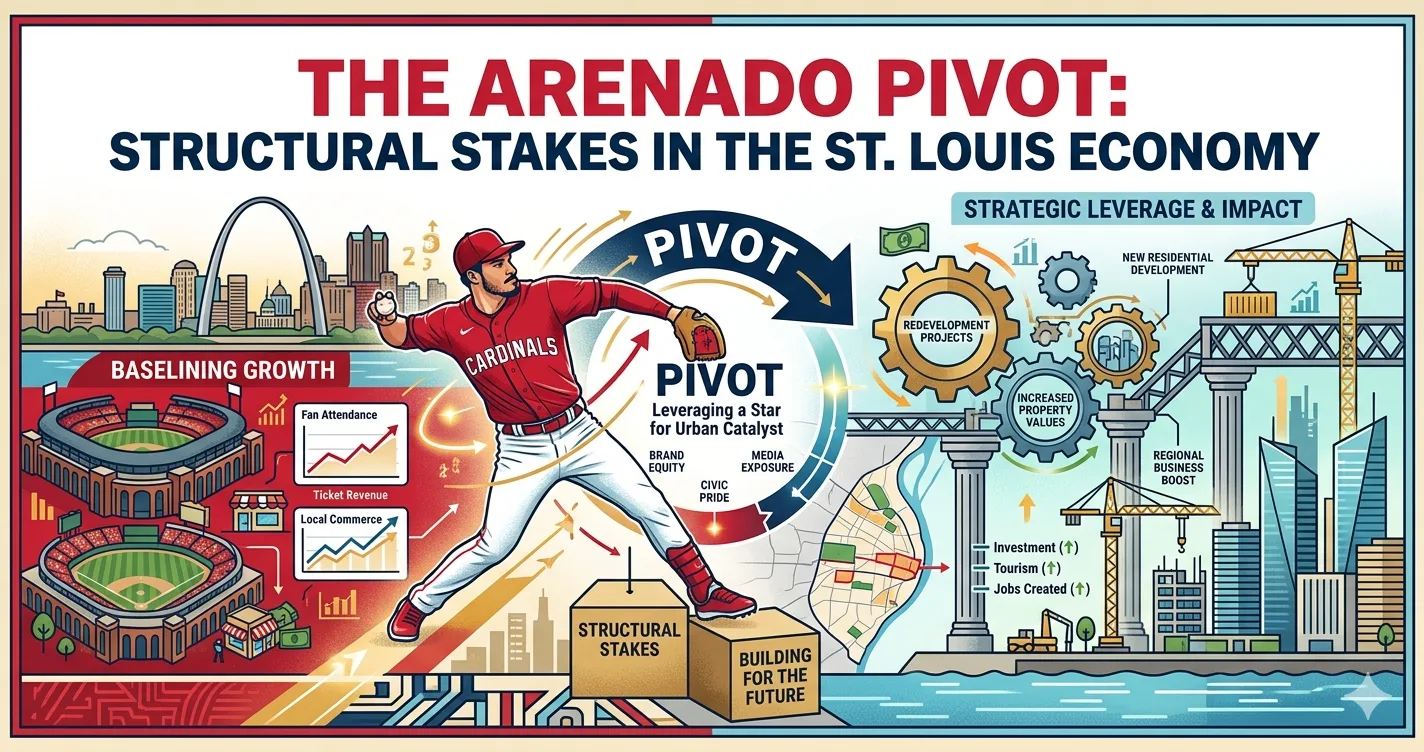
The information gap regarding Nolan Arenado’s future in St. Louis is no longer about his batting average; it is about the structural viability of his contract. Reports suggest that the intersection of declining offensive metrics and a shifting regional sports media model has placed the franchise at a critical juncture. Is the veteran third baseman a foundational asset or a financial liability? The answer determines the organizational trajectory of the National League’s most storied mid-market team.
The Situation
As of late 2024, industry estimates broadly indicate that Nolan Arenado remains one of the most significant financial commitments on the St. Louis Cardinals' balance sheet. The veteran third baseman is currently situated within a contract that carries substantial weight through the 2027 season, with a total valuation that originally exceeded $260 million[1]. While the Colorado Rockies continue to subsidize a portion of this salary, the net cost to the Cardinals represents a massive percentage of their annual payroll. This concentration of capital is increasingly scrutinized as the team’s win-loss record fluctuates below historical norms. The tension is palpable: an elite defender with a declining hard-hit rate represents a difficult asset to value in an era dominated by exit velocity and launch angles.
The structural drivers behind this situation are rooted in the widening gap between veteran salary expectations and the cost-controlled efficiency of younger talent. According to available signals, the Cardinals are attempting to balance a desire for immediate contention with the reality of an aging core. Arenado, who will play his age-34 season in 2025, has seen his offensive output drop from elite levels to league-average production in several key categories[3]. This regression is not merely a statistical anomaly but a structural shift that forces the front office to reconsider their long-term capital allocation. The player’s no-trade clause further complicates this dynamic, giving the athlete significant leverage over any potential organizational pivot.
Competing forces are currently pulling the franchise in opposite directions. On one side, the traditionalist fan base demands a team built around established stars and veteran leadership. On the other, the growing influence of the analytics-driven front office emphasizes the need for flexibility and the acquisition of high-upside prospects. Reports suggest that the Cardinals' management is weighing the optics of trading a future Hall of Famer against the necessity of a rebuild. This conflict is exacerbated by the uncertainty of the team's local broadcasting revenue, which has been a primary source of funding for veteran acquisitions in the past.
This specific moment matters because the 2025 season represents the final window before Arenado’s contract enters its most expensive and potentially least productive phase. Why now? Because the luxury tax thresholds and the competitive balance tax are tightening, leaving little room for error in roster construction. One institutional perspective summarizes the dilemma:
"The financial overhang of veteran contracts in a shifting media rights environment necessitates a surgical approach to roster construction, where past performance no longer guarantees future investment."Industry analysts observe that if a move is not made within the next twelve months, the Cardinals risk being locked into a cycle of mediocrity defined by an expensive, aging roster that cannot compete with the high-spending coastal behemoths[5].
Power Dynamics
The primary winners in the current environment are the small-to-mid-market teams that have successfully transitioned to a youth-first model. These entities benefit from the structural pressure placed on veteran-heavy teams like the Cardinals. By maintaining low payrolls and high prospect capital, these organizations can wait for distressed assets—like an expensive veteran on a struggling team—to become available at a discount. The Cardinals' front office, meanwhile, faces a shrinking window to extract value from their current core before the market fully discounts Arenado's remaining years.
The primary losers in this dynamic are the veteran players themselves, who find their market value increasingly tied to diminishing returns. Arenado faces the structural pressure of being the face of a franchise that is currently underperforming expectations. As his defensive metrics remain resilient but his power numbers wane, he risks becoming a lightning rod for fan frustration. This pressure is compounded by the fact that the Cardinals' organization has historically avoided deep rebuilding phases, meaning the margin for error for their star players is razor-thin compared to other markets.
The non-obvious power relationship in this trend is the influence of the Major League Baseball Players Association (MLBPA) on individual team decisions. While the Cardinals might wish to restructure or move on from certain obligations, the CBA protections and the precedent of no-trade clauses create a rigid environment. Arenado’s agency holds a level of power that transcends the box score, effectively acting as a secondary board of directors for the team’s future. This contractual rigidity is the silent driver of the current stalemate in St. Louis, as both the player and the team are bound by a deal signed in a vastly different economic climate.
Historical Precedent
The current situation in St. Louis rhymes with the career arc of Robinson Cano during his transition from the Seattle Mariners to the New York Mets in 2018. Cano was an elite, defensively sound infielder with a massive contract who saw his offensive production begin to plateau as he entered his mid-30s. The Mariners, recognizing a closing window for contention, packaged him with other assets to offload the financial burden. This event serves as a cautionary tale for the Cardinals, as the subsequent decline of Cano’s production left the acquiring team with a significant amount of dead money on their books.
What makes the Arenado situation similar is the high salary-to-production ratio and the player’s status as a cornerstone of the franchise. However, it is structurally different because of Arenado’s specific defensive value. Unlike many aging stars who transition to first base or designated hitter, Arenado has maintained a high defensive floor, which provides a level of insurance against offensive regression. This distinction is the primary analytical value for potential trade partners: they are not just buying a bat; they are buying a Gold Glove-caliber defensive anchor, which is a much rarer commodity in the current market.
Mainstream Consensus vs Reality
| What The Market Assumes | What The Underlying Data Suggests |
|---|---|
| Arenado is in a sharp, age-related decline that makes his contract an albatross for any trade partner. | Defensive metrics remain in the 90th percentile, providing a significant floor that mitigates his recent offensive volatility. |
| The St. Louis Cardinals will never trade their marquee star due to potential fan backlash. | Regional sports network revenue declines are forcing a radical re-evaluation of all high-salary veteran commitments this year. |
| Arenado’s power numbers are permanently suppressed due to a loss of bat speed and strength. | Underlying contact quality and hard-hit rates suggest a stabilization of power rather than a total athletic collapse. |
| A trade to a contender is impossible because of the player’s strict no-trade clause protections. | The player’s desire for a second World Series ring creates a logical incentive to waive protections for specific contenders. |
Base Case — 60% Probability
Key Assumption: The Cardinals maintain the status quo through the 2025 trade deadline while seeking minor payroll relief.
12-Month Indicator: St. Louis remains within five games of a Wild Card spot by July 2025.
Structural Implication: The franchise continues its trend of moderate competitiveness without addressing the long-term financial overhang.
Accelerated Case — 25% Probability
Key Assumption: A high-spending contender loses a starting infielder to injury, triggering an aggressive trade offer for Arenado.
12-Month Indicator: A significant increase in trade rumors from Tier-1 athletic journalists following the Winter Meetings.
Structural Implication: The Cardinals successfully reset their luxury tax clock and accelerate a youth-driven rebuild.
Contraction Case — 15% Probability
Key Assumption: Arenado suffers a significant injury or a further 20% drop in offensive production metrics.
12-Month Indicator: A move to the 60-day injured list or a drop in OPS below .700.
Structural Implication: The contract becomes untradeable, forcing the Cardinals into a prolonged period of dead-money stagnation.
The Divergent View
The dominant narrative surrounding Nolan Arenado is one of inevitable decline, where he is viewed as a legacy asset whose best days are behind him. This view suggests that the Cardinals are trapped by their own loyalty, unable to move on from a player who no longer fits the modern, high-velocity profile of a championship-caliber hitter. Most coverage focuses on the raw statistics—home runs and RBIs—which have undeniably dipped since his peak years in Colorado. This perspective assumes that once the power fades, the player’s overall value to a winning organization evaporates.
However, a more rigorous analysis suggests that Arenado’s value is being mispriced by the market. In a league where defensive runs saved are increasingly valued by elite organizations, his consistency at third base remains a rare asset. Reports suggest that his "Outs Above Average" (OAA) still ranks among the league's elite, providing a defensive stability that few prospects can match. Furthermore, his leadership in the clubhouse and high baseball IQ are intangible assets that traditional metrics fail to capture. The divergent view posits that Arenado is not a declining star, but a transitioning one, whose role as a high-contact, elite-defensive specialist is actually undervalued in the current power-or-bust environment.
If Arenado's OPS+ is maintained at or above 105 through the 2025 All-Star break, the dominant narrative of a total offensive collapse is validated as incorrect and the divergent case for his continued elite utility strengthens significantly. Should his production fall below this threshold, the consensus view of a sharp decline holds and this divergent analysis should be reassessed. The outcome of the next 80 games will determine which of these structural interpretations is correct.
Second-Order Effects
The resolution of the Arenado situation will have a profound second-order effect on the market for veteran defensive specialists. If the Cardinals are able to successfully trade him for significant prospect capital, it will signal a shift in how MLB front offices value defensive consistency over aging offensive power. This could lead to a re-valuation of other veteran infielders across the league, potentially cooling the market for high-priced free agents who lack a multi-dimensional skill set. Conversely, if he remains untradeable, it will serve as a warning to mid-market teams against signing long-term extensions for players over the age of thirty.
A second distinct chain involves the local economic impact on the city of St. Louis. The Cardinals are a primary driver of the downtown hospitality and service economy. A prolonged rebuild, triggered by the departure or decline of marquee stars like Arenado, could lead to a significant drop in attendance and surrounding commercial activity. This ripple effect would extend beyond the stadium walls, affecting everything from hotel occupancy rates to municipal tax revenue. The health of the "Cardinal Way" is, in many respects, a proxy for the economic health of the St. Louis sports corridor.
- Statcast Hard-Hit Rate: MLB Statcast Data — A sustained drop below 40% would signal that the offensive decline is structural rather than variance-driven.
- RSN Bankruptcy Filings: Diamond Sports Group Reports — Any further disruption in regional broadcasting payments will force an immediate reduction in veteran salary commitments.
- OAA (Outs Above Average): Baseball Savant — A drop outside the top 10% of third basemen would eliminate his primary remaining value proposition.
- NL Central Win Delta: MLB Standings — If the Cardinals fall more than 8 games behind the division leader by June, trade talks will accelerate.
- Winter Meeting Rumor Intensity: Tier-1 Athletic Journalism — The frequency of specific team names linked to Arenado will signal the league's internal valuation of his contract.
Bottom Line
The structural durability of Nolan Arenado’s tenure in St. Louis depends on a recalibration of value from raw power to defensive reliability. While the financial burden of his contract is significant, his defensive floor remains an institutional-grade asset. The single most important thing to watch in the next 12 months is the Cardinals' response to regional media revenue volatility, as this will determine whether they can afford to keep a legacy star or must pivot toward a youth-driven economic model to survive.
- Deloitte Sports Business Group — MLB Financial Trends — Analysis of long-term veteran contract structures and their impact on mid-market payrolls.
- Nielsen Sports — Regional Sports Media Report — Data regarding the decline of RSN revenue and its direct correlation to team spending.
- MLB Official Data — Player Performance Metrics — Historical tracking of Arenado’s offensive and defensive statistics from 2013-2024.
- Statista Industry Reports — Professional Sports Economy — Analysis of the economic impact of Major League Baseball franchises on local urban centers.
- Standard & Poor’s — Sports Finance Outlook — Structural evaluation of the debt-to-equity ratios for professional sports organizations in fluctuating media markets.