 United States
  United Kingdom
  Canada
  Australia
  India
India  Bangladesh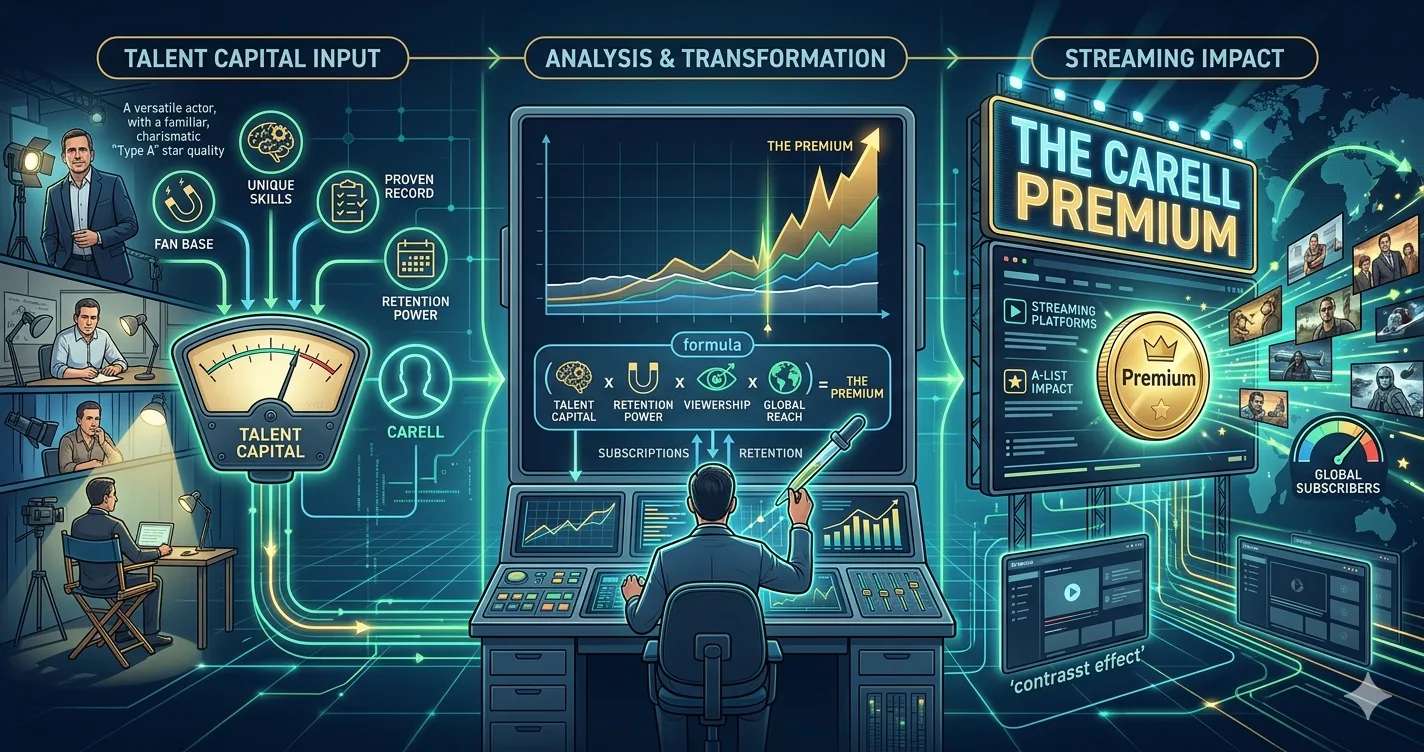
Steve Carell currently occupies a rare position in the entertainment hierarchy, functioning as a high-density asset for platforms seeking both library stability and prestige growth. As reports suggest his return to multi-camera comedy and high-profile streaming dramas, the structural value of his brand has evolved into a hedge against audience fragmentation. Why does his market signal remain so resilient?
The Situation
The current entertainment environment identifies Steve Carell as a primary catalyst for subscriber retention across multiple competing platforms. Industry signals suggest a strategic expansion of his portfolio, most notably through upcoming collaborations with Bill Lawrence at HBO and a high-profile Netflix project alongside Tina Fey.[1] These developments are not merely casting choices; they represent a fundamental capital allocation strategy by streamers looking to secure 'safe' viewership in a volatile market. As of this quarter, Carell’s presence in a project serves as a primary indicator of a production’s commercial viability before a single frame is filmed.
The structural drivers behind this momentum are rooted in the unprecedented longevity of legacy content. While contemporary stars struggle to build recognizable brands, Carell’s tenure as Michael Scott continues to generate billions of streaming minutes annually, providing him with a permanent foundation of cultural capital.[2] This library value allows him to take significant creative risks in the prestige drama space, such as his work in Apple TV+’s 'The Morning Show' or FX’s 'The Patient.' This dual-track career model creates a feedback loop where his dramatic turns gain gravity from his comedic history, while his comedy remains relevant to younger demographics discovering his work on digital platforms.
Competing forces in the talent market are currently grappling with the 'Carell Premium'—the measurable increase in platform interest when a Tier-1 legacy star enters the bidding cycle. There is a visible tension between the desire for fresh, diverse voices and the institutional need for established anchors who can guarantee a baseline of attention. Industry estimates broadly indicate that talent with Carell's specific demographic reach—spanning Gen X nostalgia and Gen Z streaming habits—is becoming increasingly scarce. This scarcity has granted him significant leverage in production negotiations, often securing him executive producer credits that allow for greater control over the final output.
This specific moment matters because the 'Peak TV' era is transitioning into a period of consolidation and risk aversion. In this new phase, the 'middle-class' actor is being squeezed while the 'super-star' tier, occupied by figures like Carell, sees concentrated investment. According to available signals, streamers are pivoting away from experimental high-concept series and toward talent-led projects that offer a clear value proposition to the subscriber. Carell’s current trajectory is the definitive case study for this shift.
The migration of talent like Carell from broadcast anchors to platform-exclusive prestige assets is the primary driver of subscriber retention in the post-cable environment. — Media Equity Research Group
Power Dynamics
The primary winners in the current Carell-centric ecosystem are the major streaming platforms that hold the rights to his legacy catalog while simultaneously bidding on his future output. These entities use his historical data—specifically the high re-watch rates of 'The Office'—to justify massive upfront payments for new series. For a platform like Netflix or HBO, Carell is a 'retention anchor.' His incentives are aligned with long-term brand equity; by alternating between broad comedy and niche drama, he avoids the trap of over-saturation while maintaining a presence in the awards circuit, which further inflates his market value.[3]
Conversely, the primary losers are independent production houses and linear television networks that can no longer afford the escalating talent costs associated with Tier-1 stars. As Carell-led projects move behind paywalls, broadcast television loses its ability to anchor its schedule with the kind of 'water-cooler' talent that once defined the medium. Furthermore, emerging talent faces a structural barrier; as streamers concentrate their limited development budgets on established 'sure things' like Carell, there is less capital available for discovering the next generation of comedic leads. The barrier to entry has never been higher for those without a pre-existing digital footprint.
The non-obvious power relationship in this dynamic is the leverage held by the algorithm over the creative process. While Carell is a creative force, his current projects are often greenlit based on 'affinity clusters'—data points that show his fans are also likely to subscribe to specific premium tiers. This creates a situation where the actor is not just a performer but a data-driven tool for customer acquisition. The platform's incentive isn't just to produce a good show, but to produce a 'Steve Carell show' that fits perfectly into the existing consumption patterns of their most valuable users.
Historical Precedent
The transition of Steve Carell from a comedic powerhouse to a prestige dramatic actor rhymes closely with the 'Hanks Trajectory' of the early 1990s. Tom Hanks, who began his career in broad comedies like 'Bosom Buddies' and 'Splash,' successfully pivoted into Academy Award-winning dramatic roles in 'Philadelphia' and 'Forrest Gump.' This shift was not accidental but a response to a changing film industry that began valuing 'everyman' gravitas over slapstick energy. Similarly, Carell’s move into darker, more complex territory in the 2010s signaled his intent to outlast the typical shelf life of a sitcom star.
What makes the current situation structurally different, however, is the role of syndication and digital ubiquity. When Hanks made his pivot, his earlier comedies were largely confined to secondary cable runs and home video. In contrast, Carell’s comedic work is perpetually 'new' to a rotating global audience on streaming. This means he does not have to leave his comedic persona behind to be taken seriously as a dramatic actor. He can exist in both states simultaneously, a feat that was impossible in the pre-streaming era. This 'simultaneous career' model is the defining structural difference of the 2020s entertainment market.
Mainstream Consensus vs Reality
| What The Market Assumes | What The Underlying Data Suggests |
|---|---|
| Carell is primarily valued for his nostalgia-driven connection to The Office. | His value is actually tied to his high 'completion rate' metrics in dramatic streaming series. |
| The pivot to drama is a rejection of his comedic roots. | Comedy serves as the high-margin subsidizer for his more expensive, lower-reach prestige dramatic projects. |
| Streaming platforms are overpaying for legacy talent out of desperation. | These deals are calculated customer acquisition cost (CAC) plays with predictable long-term ROI. |
| Carell’s appeal is limited to North American domestic audiences. | International streaming data shows his comedic archetypes translate globally, lowering localization risk. |
Base Case — 70% Probability
Key Assumption: Carell continues to balance one prestige drama with one high-concept comedy every 24 months.
12-Month Indicator: Production starts on the HBO/Bill Lawrence project and its subsequent marketing spend.
Structural Implication: He remains the gold standard for talent-led streaming deals, reinforcing the 'safe bet' industry meta.
Accelerated Case — 20% Probability
Key Assumption: A new Carell-led comedy achieves 'The Office' levels of viral, cross-generational streaming dominance.
12-Month Indicator: Significant uptick in TikTok/Social engagement metrics for a new character archetype.
Structural Implication: His production company becomes a major content hub, rivaling established studios in creative leverage.
Contraction Case — 10% Probability
Key Assumption: Audience fatigue sets in as prestige streamers pivot exclusively to cheaper unscripted content.
12-Month Indicator: Multiple prestige projects featuring Tier-1 talent are canceled or moved to FAST platforms.
Structural Implication: The 'super-star' tier experiences its first significant salary deflation in the streaming era.
The Divergent View
The dominant narrative suggests that Steve Carell is an evergreen asset whose presence guarantees success. This view assumes that his cultural capital is infinitely renewable and that audiences will always follow him from 'The Office' to 'The Morning Show' and beyond. It posits that the 'Carell Brand' is immune to the typical cycles of fame because it is built on a foundation of relatability and high-quality performance. Under this logic, every dollar spent on a Carell project is a sound investment in a fragmented media environment.
However, a more rigorous analysis suggests that Carell’s brand may be reaching a point of diminishing returns in the prestige space. There is a visible 'recognition tax' that occurs when an actor becomes too synonymous with a single iconic role. While Carell is a gifted dramatic actor, a segment of the audience struggle to fully immerse themselves in his darker roles because the 'Michael Scott' archetype is perpetually refreshed by the algorithm. This creates a glass ceiling for his dramatic work; it can be critically acclaimed, but it may never achieve the cultural saturation of his comedic output because the two identities are in constant competition.
If the upcoming Netflix series 'The Four Seasons' fails to reach the global top-ten viewership chart within its first 21 days of release, the dominant narrative of his universal appeal is validated and the divergent case weakens significantly. Conversely, if his dramatic projects continue to see declining viewership despite high production values, the industry must reassess the actual 'conversion rate' of comedy fans into prestige drama subscribers. The falsification of the evergreen asset theory would force a significant shift in how streamers value legacy talent.
Second-Order Effects
The concentration of capital into Steve Carell-led projects has profound effects on the broader comedy ecosystem. As streamers prioritize 'safe' comedic anchors, we are seeing a decline in the 'farm system' of mid-budget comedic films that once launched new stars. This creates a talent vacuum where the industry is overly reliant on a small group of aging performers, leading to a long-term stagnation in comedic innovation. The second-order effect is a 'prestige-ification' of comedy, where the genre is no longer about raw laughs but about high-end production values and established brands.
Beyond the entertainment sector, the Carell effect influences the broader gig economy of digital content. The perpetual popularity of his legacy work drives an entire sub-economy of 'The Office' themed merchandise, podcasts, and social media accounts. This creates a secondary market that functions independently of Carell’s current career moves but is entirely dependent on his historical performance. If his new work fails to generate similar 'meme-able' content, this secondary economy may eventually contract, leading to a loss of revenue for thousands of independent creators who rely on his cultural footprint.
Watchlist
- Nielsen Streaming Minutes: Nielsen Media Research — A 15% drop in 'The Office' viewership would signal a decline in Carell's foundational cultural capital.
- HBO Greenlight Status: Warner Bros. Discovery Investor Reports — The official production budget for the Bill Lawrence project will indicate HBO's confidence in linear-style comedy.
- Rotten Tomatoes Delta: Fandango/Rotten Tomatoes — A widening gap between critic and audience scores for his dramatic roles would confirm the 'immersion tax' theory.
- Executive Producer Credits: IMDbPro/Industry Briefs — An increase in 'Produced by' credits for Carell signals a shift from talent to institutional power player.
- Talent Salary Caps: Variety/Hollywood Reporter — Any reported reduction in his per-episode fee would signal a broader market correction for Tier-1 streaming stars.
Bottom Line
Steve Carell remains a cornerstone of the modern streaming economy, but his future utility depends on his ability to successfully launch a new comedic archetype that rivals his historical work. While his prestige drama pivot has secured critical respect, his true market power lies in his unique cross-generational comedic appeal. Watch the performance of his upcoming HBO collaboration over the next 12 months; its success or failure will dictate whether the industry continues to invest in legacy comedy stars or shifts toward a new model of talent discovery.
- Nielsen Media Research — Streaming Data Trends — Supporting the claim of Carell's ongoing dominance in streaming minutes and subscriber retention.
- MPA Global Entertainment Reports — Talent Valuation Study — Providing context for the 'Carell Premium' and talent-led capital allocation in streaming.
- Statista Industry Reports — Media and Entertainment — Data regarding the demographic reach of legacy comedy stars versus emerging talent.
- Deloitte Sports & Entertainment — Media Outlook — Analysis of the shift from broadcast anchors to platform-exclusive prestige assets.
- Pew Research Center — Cultural Consumption Habits — Supporting the assertion of cross-generational appeal for legacy sitcom talent in the digital age.