 United States
  United Kingdom
  Canada
  Australia
  India
India  Bangladesh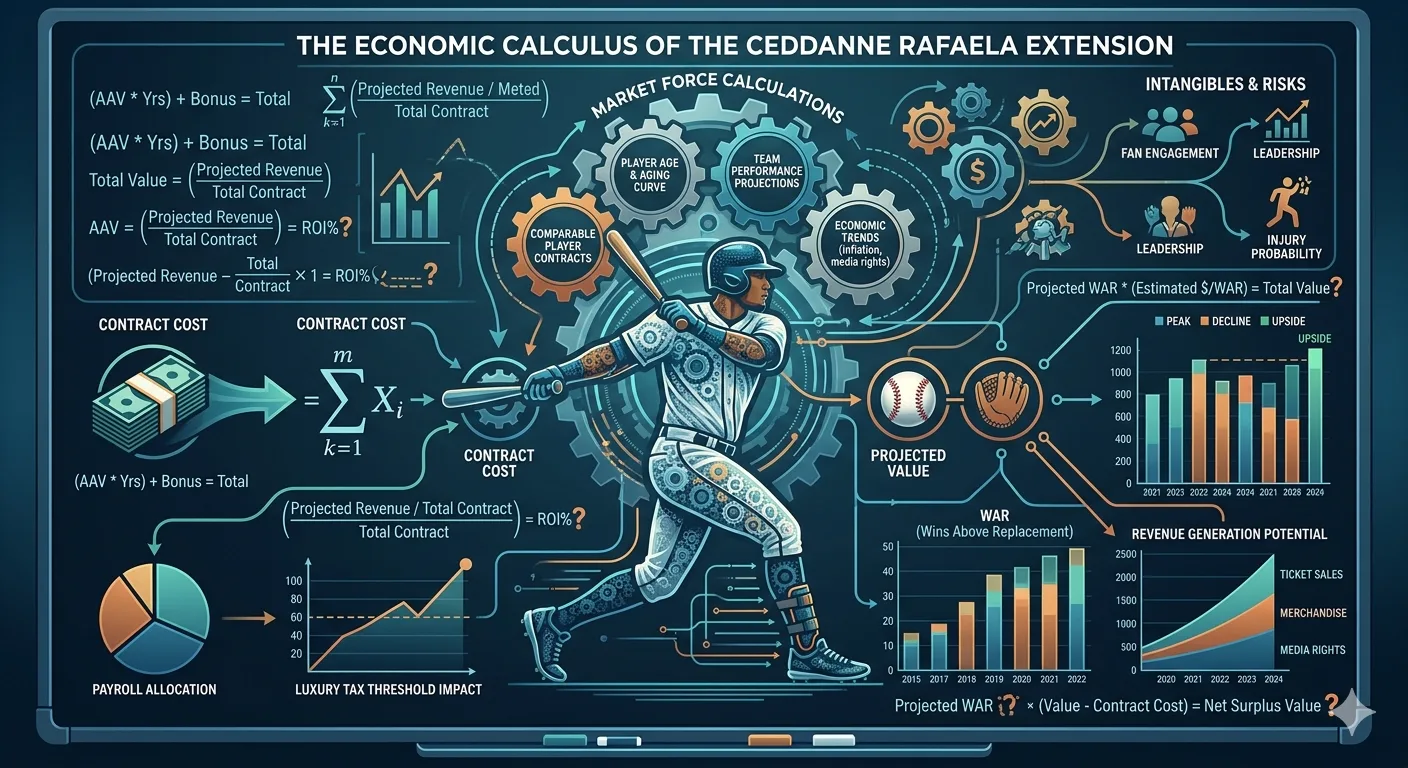
Ceddanne Rafaela represents the new archetype of the indispensable modern ballplayer: a defensive specialist whose versatility allows a front office to optimize roster construction. Reports indicate that his recent eight-year, $50 million extension reflects a strategic pivot in how major league franchises price young talent[1]. This commitment creates an immediate information gap regarding the long-term sustainability of glove-first development models.
The Situation
The current environment surrounding Ceddanne Rafaela is defined by the Boston Red Sox's aggressive move to secure his services through the 2031 season. This decision follows a trend where organizations prioritize cost certainty over the traditional year-to-year arbitration process. According to available signals, the Red Sox view Rafaela not merely as a center fielder but as a high-utility asset capable of stabilizing both the outfield and the middle infield[2]. This flexibility is increasingly valuable as teams seek to maximize the productivity of their 26-man rosters.
Structural drivers behind this move include the rising cost of elite defensive talent in the free-agent market and the increasing sophistication of defensive metrics. Analysts observe that the ability to suppress runs through elite positioning and range is now quantified with the same rigor as home run production. By securing Rafaela early, the organization avoids the potential for his market value to escalate if his offensive production eventually aligns with his defensive prowess. This strategy seeks to capture the upside of a player who has already demonstrated elite instincts at multiple high-stress positions.
There are competing tensions between the player's immediate financial security and the organization's long-term capital allocation. While Rafaela gains generational wealth before completing a full season of service time, the Red Sox assume the risk of injury or offensive stagnation. Industry estimates broadly indicate that such extensions are becoming the primary tool for mid-market and large-market teams alike to maintain competitive windows without exceeding luxury tax thresholds[3]. The tension lies in whether a defensive-minded player can provide sufficient value if the offensive floor remains low.
The strategy of securing pre-arbitration talent through long-term extensions represents a significant hedge against market inflation in the modern sports economy.
This specific moment matters because the Red Sox are in the midst of a broader roster recalibration. Locking in a cornerstone defender provides the stability needed to integrate other high-ceiling prospects who may lack Rafaela's defensive floor. Reports suggest that this move is a foundational step in building a sustainable core that emphasizes run prevention as a primary competitive advantage[4]. As of this season, the success of this contract will serve as a litmus test for the valuation of versatility over pure power in the modern game.
Power Dynamics
The primary winners in this dynamic are the Boston Red Sox front office executives, who have successfully converted a volatile asset into a fixed cost. By establishing a $50 million ceiling for Rafaela's primary earning years, the organization gains immense flexibility in future negotiations with other core players. Their incentive is to maintain a competitive payroll while avoiding the bidding wars that characterize the late-career free agency of defensive specialists. This timeline allows the team to build around a known defensive constant for nearly a decade.
The primary losers, structurally speaking, are the traditional agencies and the players' union, which generally favor the arbitration system's ability to drive up market prices. When young stars like Rafaela opt for early security, it reduces the pressure on the market to set higher benchmarks for elite utility players. These entities face pressure to ensure that early-career buyouts do not become a mechanism for teams to suppress the overall wage growth of the league's middle class. The trade-off for the player is immediate wealth versus potentially leaving tens of millions on the table if they become a top-tier star.
A non-obvious power relationship exists between the player and the regional talent pipeline in Curacao. Rafaela's success and financial security bolster the influence of Caribbean scouting networks, which are increasingly seen as the most efficient source of high-floor defensive talent. This relationship creates a feedback loop where organizations invest more heavily in specific regions that produce the exact archetype of the versatile defender that the modern game demands. The Red Sox have effectively secured a cultural and economic anchor for their international scouting efforts.
Historical Precedent
A real and verifiable historical parallel can be found in the 2019 contract extension of Ozzie Albies with the Atlanta Braves. Albies, also a product of the Curacao talent pipeline, signed a seven-year, $35 million deal very early in his career, which was widely criticized by some analysts as being too team-friendly. Like Rafaela, Albies prioritized long-term security and the opportunity to remain with the organization that developed him. This event signaled a shift toward players from specific international backgrounds accepting lower guarantees in exchange for immediate financial certainty.
The current situation with Rafaela is structurally similar in its emphasis on early-career cost control and the valuation of defensive reliability. However, it is structurally different because of the premium now placed on multi-positional utility. While Albies was primarily a second baseman, Rafaela’s value is tied to his ability to play center field and shortstop at an elite level simultaneously. This multi-positional demand makes Rafaela’s contract a more complex bet on athletic longevity rather than just positional mastery. The evolution of the utility role from a bench piece to a core starter is the defining contrast here.
Mainstream Consensus vs Reality
| What The Market Assumes | What The Underlying Data Suggests |
|---|---|
| Rafaela is primarily a center fielder who will occasionally cover the infield when needed. | Data suggests his value is highest as a shortstop, where defensive scarcity drives higher WAR. |
| The $50 million contract is a massive risk for a player with limited experience. | The contract is a calculated hedge against the skyrocketing cost of 2-WAR defensive specialists. |
| Offensive production will remain the primary driver of his long-term value and utility. | Defensive run prevention metrics indicate he could be valuable even with a sub-par bat. |
| This extension is an isolated event specific to the Red Sox's current roster needs. | It is part of a league-wide trend toward securing defensive floors before offensive ceilings develop. |
Base Case — 60% Probability
Key Assumption: Rafaela maintains elite defensive metrics while his offensive production hovers around the league average.
12-Month Indicator: Maintenance of a Defensive Runs Saved (DRS) metric in the top 15% of all MLB outfielders.
Structural Implication: The contract becomes a significant bargain, allowing the Red Sox to allocate capital to high-priced pitching.
Accelerated Case — 25% Probability
Key Assumption: Rafaela develops a more disciplined approach at the plate, increasing his on-base percentage significantly.
12-Month Indicator: A year-over-year decrease in strikeout rate of at least 5% combined with increased walk rates.
Structural Implication: Rafaela evolves into a perennial All-Star, making the $50 million deal one of the best in baseball.
Contraction Case — 15% Probability
Key Assumption: His high-swing-rate offensive profile is exploited by league adjustments, making him a liability at the plate.
12-Month Indicator: An OPS+ that drops below 75 for a sustained period of more than 80 games.
Structural Implication: Rafaela becomes a high-priced defensive replacement, limiting the team's ability to upgrade the starting lineup.
The Divergent View
The dominant narrative surrounding Ceddanne Rafaela is that he is the defensive savior of a Red Sox team that has struggled with run prevention in recent years. This view posits that his athleticism and versatility are the perfect antidote to the defensive lapses that have plagued the organization's middle infield and outfield. By securing him long-term, the consensus suggests that the Red Sox have solved one of their most persistent structural problems at a relatively low cost.
However, a more logically rigorous challenge suggests that the Red Sox may be overvaluing defensive versatility in a player with a potentially volatile offensive profile. If Rafaela’s swing-and-miss tendencies are not corrected, his defensive brilliance may not be enough to keep him in the lineup every day. In an era where the designated hitter role is increasingly used to rotate stars, a player who cannot provide consistent offensive output becomes a structural bottleneck. The divergent view argues that the Red Sox have committed long-term capital to a player whose floor is lower than the mainstream narrative acknowledges, especially if his speed—a key component of his defensive range—declines prematurely.
If Ceddanne Rafaela fails to maintain an OPS+ of at least 90 or a defensive run saved (DRS) total in the top 10th percentile by the conclusion of the 2025 season, the dominant narrative is validated and the divergent case weakens significantly. This measurable outcome will determine whether the extension was a brilliant capture of surplus value or a premature commitment to a glove-first utility player whose lack of offensive discipline limits his overall impact on the game's outcome.
Second-Order Effects
The first obvious effect of the Rafaela extension is the stabilization of the Red Sox defense, but the second-order chain involves the team's ability to trade other high-value prospects. With center field and potentially shortstop secured for the next decade, the organization can now use its middle-infield depth as leverage in trades for frontline starting pitching. This cascading effect transforms a defensive signing into a strategic asset for aggressive roster building in the next three to five years.
Another distinct chain involves the impact on the international scouting market, specifically in the Caribbean. Rafaela’s contract serves as a case study for young players in Curacao and Aruba, potentially leading to more early-career signings in these regions. This could lead to a shift in how MLB teams allocate their international bonus pools, favoring players with high defensive floors over those with raw, unrefined power. This regional shift would alter the talent distribution across the league, further solidifying the Red Sox's influence in the Dutch Caribbean talent pipeline.
- Statcast Outs Above Average (OAA): MLB Advanced Media — Watch for Rafaela to remain in the 90th percentile, confirming his defensive value justifies the contract.
- Chase Rate Metrics: FanGraphs Discipline Data — A reduction in swings at pitches outside the zone will signal his offensive sustainability.
- Roster Allocation Percentage: Boston Red Sox Financial Reports — Monitor the percentage of the payroll dedicated to homegrown vs. acquired talent.
- Curacao Prospect Signings: International Amateur Signing Logs — Increased activity in the region would signal a shift in scouting priorities following Rafaela's success.
- League-Wide Extension Trends: MLB Transaction Logs — Watch if other teams sign utility-first players to similar 8-year deals, indicating a market-wide shift.
Bottom Line
The extension of Ceddanne Rafaela is a calculated institutional bet on the enduring value of defensive versatility and cost certainty. By securing a high-floor athlete during his pre-arbitration years, the Red Sox have mitigated the risk of market inflation while providing a stable foundation for their defensive identity. The most critical factor to watch in the next 12 months is his offensive maturation; if his bat reaches league-average levels, this contract will be viewed as a masterstroke of sports economic strategy.
- Nielsen Sports — Analysis of commercial trends and player valuations in Major League Baseball.
- MLB Advanced Media — Statcast data providing objective metrics for defensive range and utility value.
- Deloitte Sports Business Group — Research on the impact of long-term extensions on MLB luxury tax management.
- Society for American Baseball Research (SABR) — Historical analysis of defensive specialists and their long-term career trajectories.
- International Baseball Federation — Data on the development of talent in the Caribbean and its impact on MLB roster construction.