 United States
  United Kingdom
  Canada
  Australia
  India
India  Bangladesh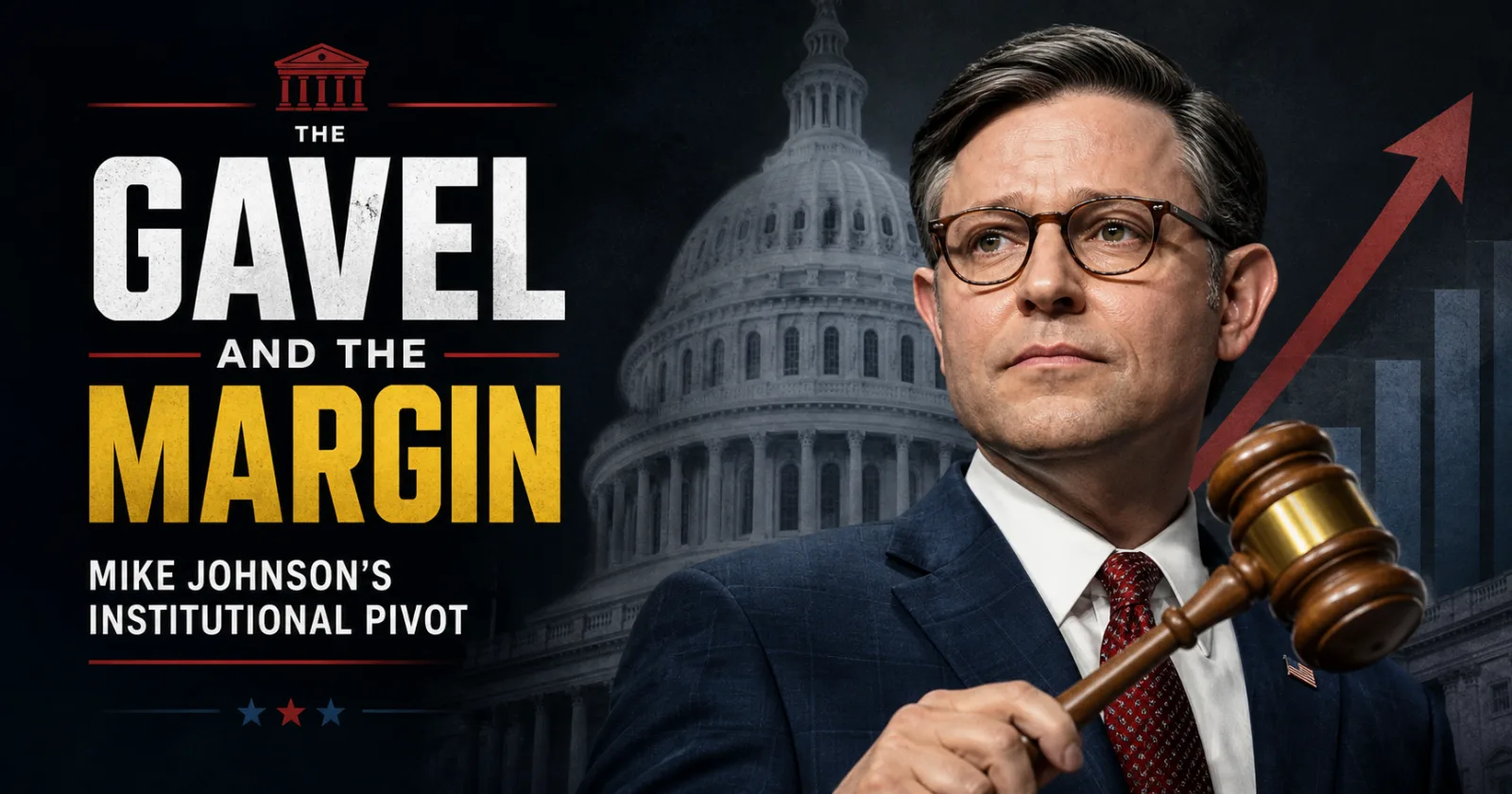
The gavel in Mike Johnson’s hand represents more than procedural authority; it signifies the precarious balance of a fractured legislative body. As the 118th Congress progresses, his survival as Speaker of the House depends less on ideological purity and more on the mastery of razor-thin margins. Current signals suggest that his leadership style, once dismissed as accidental, is becoming a case study in institutional survivalism.
The Situation
Since assuming the speakership in October 2023, Mike Johnson has operated within one of the narrowest majorities in modern American history. Reports suggest that the functional margin of error for the Republican conference has frequently dwindled to a single vote, forcing a reliance on complex procedural maneuvers to pass essential funding bills[1]. This structural constraint has defined his tenure, moving him away from the rigid ideological stances of his earlier career toward a more fluid, pragmatic role as a consensus builder. The necessity of keeping the federal government operational while managing a restive right flank has created a permanent state of legislative tension.
The primary driver behind this tension is the 'Motion to Vacate' rule, a procedural sword of Damocles that allows any single member to force a vote on the Speaker's removal. According to available signals, this mechanism has effectively decentralized power, granting outsized leverage to small groups of ideological holdouts. Johnson must navigate this environment by balancing the demands of the House Freedom Caucus against the legislative realities of a Democratic-controlled Senate and White House. This environment has led to the frequent use of the 'Suspension of the Rules' calendar, which requires a two-thirds majority but bypasses the often-obstructed Rules Committee[2].
Competing forces are currently vying for control over the House agenda, particularly regarding foreign aid and domestic discretionary spending. While some factions demand deep cuts and strict border policy attachments, others emphasize the geopolitical risks of legislative paralysis. Johnson sits at the center of this storm, attempting to synthesize these conflicting incentives into a coherent strategy. This moment matters because it represents a fundamental test of whether a polarized House can still perform its most basic constitutional duties, such as the power of the purse, under extreme internal pressure.
Industry estimates broadly indicate that the Speaker’s ability to manage the upcoming appropriations cycle will determine the fiscal trajectory of the nation through the next election cycle. The stakes are heightened by a calendar filled with looming deadlines for both defense and social spending. As one institutional analyst observed:
“The speakership of Mike Johnson is a continuous negotiation between the possible and the preferred, where the math of the floor dictates the limits of the agenda.”
This dynamic has turned the House into a laboratory for bipartisan 'coalition government' in all but name, as Johnson frequently relies on Democratic votes to pass significant legislation that his own conference cannot unanimously support[3].
Power Dynamics
The primary winners in the current power structure are, paradoxically, the House Democrats. Because the Republican majority is so slim, Democratic leadership holds a functional veto over any bill that requires a two-thirds majority or a bipartisan coalition to pass. This has granted Minority Leader Hakeem Jeffries significant leverage over the final form of major spending packages. According to institutional signals, this dynamic has allowed Democrats to protect key priorities that would otherwise be targeted by a more unified Republican majority.
The primary losers are the hardline fiscal conservatives who initially sought to use the speakership as a blunt instrument for radical spending reform. While they have successfully delayed certain processes, the structural reality of the Senate and the White House has consistently forced Johnson toward compromise. These members face intense pressure from their base to deliver results, yet they find themselves increasingly sidelined as the Speaker turns to 'Suspension of the Rules' to avoid the procedural traps they set in the Rules Committee.
The non-obvious power relationship in this environment is the growing influence of the 'Main Street' and 'Governance Group' Republicans. While the loudest voices often come from the fringes, the Speaker's survival depends on the quiet support of these centrist-leaning members. They provide the floor votes necessary for stability and serve as a buffer against the Motion to Vacate. This relationship is often ignored by media coverage focused on conflict, but it is the actual engine that prevents the total collapse of the House majority.
Historical Precedent
A significant historical parallel can be found in the speakership of John Boehner in 2015. Like Johnson, Boehner faced a rebellious right wing that frequently used the threat of removal to influence his decisions. The 'fiscal cliff' negotiations and the constant battles over the debt ceiling created a similar atmosphere of legislative brinkmanship. Boehner eventually chose to resign rather than continue the cycle of internal warfare, a move that paved the way for Paul Ryan and eventually the current era of leadership volatility.
The current situation is structurally similar in its internal party divisions, but it is fundamentally different in its math. Boehner had a much larger majority, allowing him to lose dozens of votes and still pass legislation within his own conference. Johnson lacks this luxury. Every single vote is a potential crisis. The modern era is also defined by a much faster information cycle, where social media sentiment can turn a routine procedural vote into a litmus test for 'betrayal' within hours, making the Speaker's job exponentially more complex than it was a decade ago.
Mainstream Consensus vs Reality
| What The Market Assumes | What The Underlying Data Suggests |
|---|---|
| Johnson is a temporary placeholder with little actual influence over long-term policy or party strategy. | He has successfully passed more significant bipartisan legislation than his predecessor, solidifying a new procedural norm. |
| The House is in a state of total paralysis and cannot function effectively. | Legislative output remains consistent through the use of the suspension calendar, bypassing traditional committee bottlenecks. |
| Hardline conservatives hold total control over the Speaker's daily decision-making process and schedule. | The Speaker has repeatedly defied the far-right wing on foreign aid and government funding when necessary. |
| A Motion to Vacate is inevitable and will likely succeed before the current term ends. | The political cost of a second leadership vacancy is viewed as prohibitive by a majority of the conference. |
Base Case — 60% Probability
Key Assumption: Johnson continues to pass essential funding bills using bipartisan 'Suspension' votes while avoiding a formal floor vote on his removal.
12-Month Indicator: Successful passage of the final FY2025 appropriations bills without a government shutdown or leadership change.
Structural Implication: The House adopts a 'coalition' model where major policy is dictated by the center-left and center-right.
Accelerated Case — 25% Probability
Key Assumption: A major external event or electoral shift forces the Republican conference to unify behind Johnson to protect the majority.
12-Month Indicator: A significant increase in Republican fundraising and a decrease in public internal conference criticism.
Structural Implication: Johnson emerges as a strengthened leader with a mandate to pursue a more traditional conservative agenda.
Contraction Case — 15% Probability
Key Assumption: A single controversial vote triggers a Motion to Vacate that gains enough momentum to force Johnson out.
12-Month Indicator: A failed procedural vote on a major rule that signals a total loss of floor control.
Structural Implication: The House enters a period of prolonged vacancy, leading to significant market and policy instability.
The Divergent View
The dominant narrative suggests that Mike Johnson is a weak Speaker, hamstrung by his own members and forced into a reactive posture. This view posits that his reliance on Democrats is a sign of failure and that his speakership is a period of managed decline for the Republican majority. Critics argue that his inability to force the Senate into concessions on border policy or spending levels proves that the House has lost its leverage in the tri-cameral negotiation process.
However, a more rigorous analysis suggests that Johnson’s perceived 'weakness' is actually a sophisticated form of institutional adaptation. By allowing the minority party to share in the 'ownership' of difficult votes, he is shielding his most vulnerable members from the political fallout of unpopular decisions. This strategy prevents the majority from being blamed for government shutdowns or defaults, which would be electorally disastrous. In this light, Johnson is not failing to lead; he is leading by managing the reality of a divided government with a surgical precision that his predecessors lacked.
If the Republican party maintains or expands its House majority in the next general election while Johnson remains Speaker, the consensus view holds and this divergent analysis should be reassessed. A failure to retain the majority would validate the 'weakness' narrative, while a successful defense of the House would suggest that Johnson's pragmatic survivalism was the correct structural response to a historically difficult political environment.
Second-Order Effects
The first second-order effect of Johnson’s leadership style is the fundamental alteration of the 'Hastert Rule' (the informal principle that a Speaker should only bring bills to the floor that have the support of a 'majority of the majority'). By repeatedly breaking this rule to pass bipartisan funding, Johnson is normalizing a more collaborative legislative process. This could lead to a long-term shift where the Speaker acts less as a party general and more as a multi-party administrator, fundamentally changing the nature of congressional leadership for future sessions.
A second distinct chain involves the impact on the 2025 tax reform negotiations. The procedural precedents Johnson is setting now—specifically the use of bipartisan coalitions to bypass committee hardliners—will likely be the blueprint for the massive tax battles ahead. This shift pulls the corporate and financial sectors into a new lobbying environment, where they must build broader, bipartisan support rather than relying on a single party's ideological alignment. This change in the lobbying ecosystem will have lasting effects on how capital is allocated in response to federal policy.
Watchlist
- Discharge Petition Thresholds: Congressional Record — If a discharge petition reaches 218 signatures, it signals a total loss of Speaker control over the floor agenda.
- Suspension Calendar Frequency: House Clerk Records — A ratio of suspension bills to regular order bills exceeding 4:1 indicates a permanent shift to bipartisan governance.
- RNC Fundraising Metrics: FEC Filings — A drop in small-dollar donations below 2022 levels would signal base dissatisfaction with Johnson’s pragmatic pivot.
- Rules Committee Failures: House Rules Committee Votes — Three or more failed 'rules' in a single month would likely trigger a leadership challenge.
- Senate Cross-Over Support: Senate Vote Tallies — If more than 20 Republican Senators oppose Johnson-led House compromises, his leverage in bicameral negotiations will effectively evaporate.
Bottom Line
Mike Johnson has transformed the speakership from a pulpit of ideological purity into a mechanism for institutional survival. While his methods draw fire from the extremes, they have maintained the basic functions of government under historically difficult conditions. The structural durability of this model will be tested by the 2024 fiscal deadlines. The single most important thing to watch in the next six months is the Speaker's ability to pass a unified budget resolution, as this will determine if he can transition from a crisis manager to a long-term strategist.
References
- Congressional Research Service — House Leadership Dynamics — Documentation of the impact of narrow majorities on procedural choices in the 118th Congress.
- Brookings Institution — Legislative Process Analysis — Analysis of the increased use of 'Suspension of the Rules' as a primary governing tool.
- Pew Research Center — Congressional Polarization Studies — Data supporting the widening gap between party leadership and ideological factions.
- Federal Reserve Economic Data (FRED) — Fiscal Policy Indicators — Context for the economic stakes of government funding and debt ceiling negotiations.
- OECD Data — Institutional Governance Trends — Comparative analysis of legislative stability in fractured parliamentary and presidential systems.