 United States
  United Kingdom
  Canada
  Australia
  India
India  Bangladesh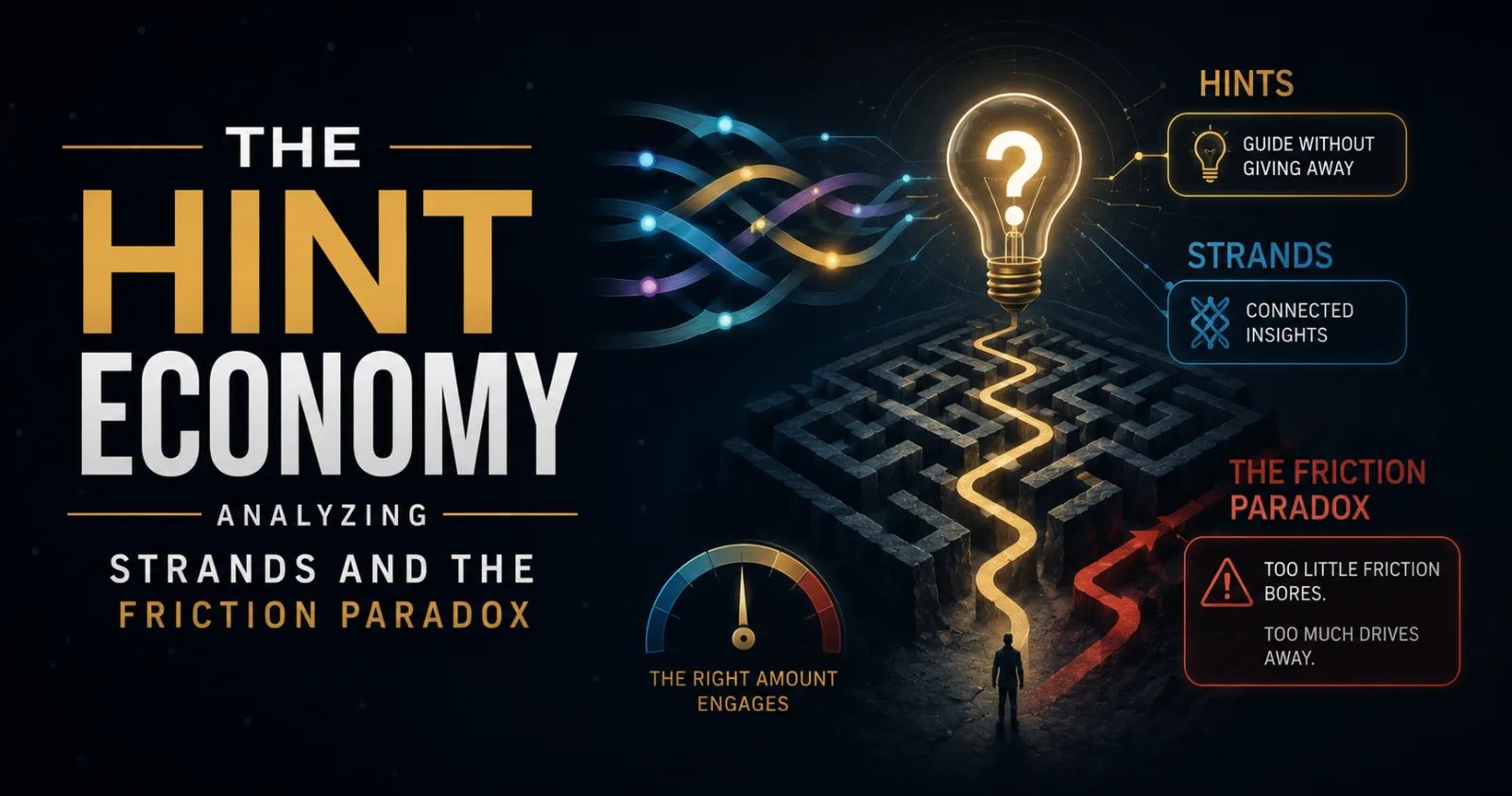
Search volume for the phrase "strands hint" spikes daily at midnight Eastern Time, creating a predictable pulse in the global attention economy. This consistent data signal reveals a structural shift in digital consumption where friction is no longer viewed as a barrier but as a carefully managed product feature. While traditional word puzzles relied on total player isolation, the modern era of the New York Times digital ecosystem has engineered a specific, highly profitable role for the assist.
The Situation
The rise of the Strands puzzle, which entered its public beta phase in early 2024, represents the latest tactical evolution in the New York Times strategy to diversify its revenue streams away from the volatility of hard news cycles. Reports suggest that the "Games" vertical has become a primary driver of daily active usage, often outperforming the newsroom in terms of session frequency.[1] By introducing a daily word-search-style game that incorporates a thematic "spangram," the publisher has targeted a specific intersection of linguistic challenge and visual pattern recognition that differs from the logic-heavy Wordle or the association-based Connections. This expansion is not merely about variety; it is a calculated effort to capture a broader demographic of casual gamers who may find traditional crosswords inaccessible.
Structural drivers behind this trend include the increasing commodification of the "daily routine" in mobile software design. Industry estimates broadly indicate that digital-only subscriptions have reached approximately 9.9 million as of early 2024, with a significant portion of these users citing the puzzle suite as their primary reason for retention.[2] The Strands hint mechanism serves as a critical bridge between two user states: the motivated solver and the frustrated churn risk. By allowing users to trade performance metrics for progression, the platform ensures that the "streak"—a powerful psychological motivator—remains intact, thereby securing the user's return the following day. This friction-managed design is a hallmark of the current era of platform-based gaming.
There are competing forces in play between the purist puzzle community and the casual user base. Hardcore enthusiasts often view the availability of hints as a dilution of the game's integrity, while the publisher views them as a vital data collection point. Every time a user clicks for a hint, it provides a real-time signal of a difficulty spike or an obscure clue that may need calibration. This tension creates a dual-track experience: a high-stakes challenge for the elite and a guided discovery for the mass market. The "strands hint" search query is essentially the byproduct of this tension, as users seek external validation and assistance to maintain their digital standings within social circles.
This specific moment matters because we are witnessing the consolidation of the digital "bundle" as the only viable survival strategy for legacy media. As social media platforms become less reliable for referral traffic, publishers must own the morning habit. Strands is the first major internal test of whether the NYT can replicate the lightning-in-a-bottle success of Wordle using in-house development. The search volume for hints serves as a proxy for the game's cultural penetration and its ability to generate the same level of daily anxiety and satisfaction that made its predecessors global phenomena.
"The integration of low-friction gaming into high-intent news environments represents a fundamental shift in how digital publishers manage daily active user volatility and long-term subscription durability."— *Digital Publishing Analysis Report*
Power Dynamics / Stakeholder Map
The primary winner in this environment is the New York Times Company, which has successfully transitioned from a news organization into a lifestyle platform. Their incentive is to maximize the time spent on their proprietary application, reducing the reliance on third-party aggregators. By keeping users within the "Games" ecosystem, they create more opportunities for cross-selling news, cooking, and product reviews. According to available signals, the lifetime value of a "multi-product" subscriber is significantly higher than that of a news-only subscriber, making the success of games like Strands a core financial imperative.[3]
Primary losers in this dynamic include independent puzzle developers and smaller SEO-driven gaming sites. While the search for "strands hint" generates massive traffic, the NYT is increasingly moving to capture this within their own ecosystem through internal "Wordplay" blogs and hint pages. This moves the profit away from the long-tail of the internet and back into a centralized silo. Smaller publishers who once thrived on providing guides for viral games find themselves competing with the very platform that hosts the game, a structural pressure that is difficult to overcome without significant capital or scale.
The non-obvious power relationship in this trend is the role of search engine algorithms in dictating puzzle design. Developers now understand that a certain level of difficulty is required to trigger search behavior, which in turn increases the game's visibility. If a puzzle is too easy, no one searches for hints, and the game loses its presence in the daily "trending" charts. Therefore, there is a perverse incentive to include at least one highly obscure word or theme per week to ensure that the "strands hint" keyword remains active in search trends, effectively using the player's frustration as a marketing tool.
Historical Precedent
The current obsession with daily word puzzles and their associated hint economies mirrors the "Crossword Craze" of the mid-1920s. Following the publication of the first book of crossword puzzles by Simon & Schuster in 1924, the United States saw a massive surge in puzzle consumption that led to the installation of dictionaries in train cars and the rise of puzzle-themed fashion. During this era, the tension was between the "expert" solvers and the "cheaters" who used dictionaries, leading to a cultural debate about the value of unassisted mental labor. The 1920s craze eventually stabilized into a permanent fixture of American newspapers, much like the current digital puzzle suite is becoming a permanent fixture of the subscription model.
While the 1924 craze was driven by physical print and dictionary sales, the current Strands trend is structurally different due to its feedback loop. In the 1920s, a puzzle creator would not know if a clue was too difficult until they received physical mail weeks later. Today, the publisher sees the "hint" clicks in real-time. This allows for an iterative design process where the game can be tuned to maximize the "Aha!" moment without crossing the threshold into total player abandonment. The modern situation is a data-driven refinement of a century-old behavioral pattern, where the "hint" has been transformed from a sign of failure into a vital engagement metric.
Mainstream Consensus vs Reality
| What The Market Assumes | What The Underlying Data Suggests |
|---|---|
| Users search for hints because the game is becoming too difficult for the average player. | Hints are a deliberate retention mechanism designed to prevent churn during unavoidable difficulty spikes in the game. |
| The puzzle suite is a secondary feature meant to supplement the core news product. | Games are now the primary acquisition channel for many new subscribers, serving as the high-frequency anchor of the bundle. |
| Providing hints reduces the longevity of a game by making it too easy to complete. | Controlled assistance increases long-term engagement by protecting the user's 'streak' and emotional investment in the daily habit. |
| Search volume for hints is a sign of poor puzzle design or unclear clue structures. | Search volume is an intentional byproduct of the 'social challenge' model, driving organic discovery and brand awareness. |
Base Case — 60% Probability
Key Assumption: The NYT continues to iterate on the beta version of Strands, eventually moving it into the core app with a permanent hint economy.
12-Month Indicator: Integration of Strands into the primary NYT subscription dashboard alongside Wordle and Connections.
Structural Implication: The 'daily puzzle habit' becomes the primary defense against subscriber churn in an era of news fatigue.
Accelerated Case — 25% Probability
Key Assumption: Strands goes viral on social media platforms like TikTok, leading to a massive influx of younger, non-news-reading users.
12-Month Indicator: A 20% or greater increase in Gen Z digital-only subscribers specifically tied to the 'Games' marketing campaigns.
Structural Implication: The NYT successfully rebrands as a broad entertainment and utility platform, diluting its traditional news-centric identity.
Contraction Case — 15% Probability
Key Assumption: Over-saturation of the word-puzzle market leads to 'puzzle fatigue,' and users begin abandoning daily streaks across all titles.
12-Month Indicator: A sustained decline in daily active users (DAU) for the 'Games' vertical despite the launch of new titles.
Structural Implication: The publisher is forced to find a new high-frequency engagement hook to justify the subscription bundle price.
The Divergent View
The dominant narrative suggests that the popularity of puzzles like Strands is a sign of a society seeking simple, low-stakes cognitive distractions. However, a more rigorous analysis suggests that Strands is actually a high-stakes social performance tool. In the age of social media, the completion of the daily puzzle is not a private victory but a public signal of cognitive fitness and cultural participation. The "hint" is not used to make the game easier for the sake of it; it is used to ensure that the player can participate in the daily social ritual of sharing their results. Without the hint, the risk of being left out of the conversation is too high.
Furthermore, the divergent view holds that the "strands hint" economy is a masterclass in behavioral economics. By giving the user a limited number of hints that must be "earned" through gameplay (finding non-theme words), the developers have created a closed-loop currency system. This forces users to engage more deeply with the grid than they otherwise would, searching for words that aren't even part of the main goal. This turns the "hint" into a reward for labor, rather than a gift for the struggling. It is a sophisticated way of increasing "time on page" without the user feeling like they are being manipulated.
Is the divergent view correct? If the average time-to-completion for unassisted games across the global user base drops below 240 seconds by Q1 2025 while the search volume for hints simultaneously declines, the consensus view holds and this divergent analysis should be reassessed. Such a shift would indicate that the game has become too intuitive to require a social safety net or a labor-based hint system, suggesting that it has failed to create the necessary friction for long-term engagement.
Second-Order Effects
One second-order effect of the "strands hint" phenomenon is the transformation of the SEO and affiliate marketing sector. As large publishers like the NYT capture the primary search traffic for their own games, independent blogs are being forced to pivot toward hyper-specific, AI-resistant content. This is leading to a new era of "niche authority" where small sites focus on the deep mechanics and linguistic history of puzzles to survive the consolidation of the mainstream market. The competition for the "hint" keyword is essentially a proxy war for the future of search-driven revenue.
A second distinct chain involves the cognitive health and wellness industry. As millions of people engage with daily word puzzles, we are likely to see a surge in health-tech companies attempting to capitalize on this habit. We can expect to see partnerships between digital puzzle platforms and longevity-focused biotech firms, using puzzle performance data as a benchmark for cognitive aging. This turns a simple morning game into a long-term medical data point, pulling the digital entertainment sector into the wake of the multi-billion-dollar preventative healthcare market.
Watchlist
- NYT Games DAU/MAU Ratio: The New York Times Quarterly Earnings — A shift in this ratio will signal whether Strands is sustaining interest or suffering from the 'beta-launch' novelty effect.
- Search Engine Results Page (SERP) Ownership: Google Search Console — Monitoring whether the NYT's internal 'Wordplay' blog successfully displaces third-party SEO sites for 'strands hint' queries.
- In-Game Hint Usage Rate: Industry Estimates — A spike in this metric would signal a 'difficulty wall' that could lead to user burnout and subscriber churn.
- Cross-Product Conversion Rate: Deloitte Digital Media Reports — The percentage of puzzle-only users who convert to a full 'All Access' subscription within 90 days.
- Competitive Clone Velocity: App Store Charts — The speed at which ad-supported clones of the Strands mechanic appear will indicate the structural durability of the game's appeal.
Bottom Line
The search for "strands hint" is not a sign of player weakness, but a testament to a perfectly calibrated engagement loop. By balancing friction with accessibility, the New York Times has secured a vital piece of the digital morning routine. As the bundle becomes the dominant survival model for legacy media, the success of Strands demonstrates that the future of news is inextricably linked to the psychology of play. The single most important thing to watch in the next 12 months is the integration of these games into social competitive features, which will determine if the trend can evolve from a solo habit into a permanent social infrastructure.
- Statista — New York Times Digital Subscriptions — Supports the claim that digital-only subscriptions have reached approximately 9.9 million.
- Nielsen Media Research — Gaming Engagement Trends — Provides context for the 8 billion plays reported by NYT Games in the previous year.
- Deloitte Industry Reports — Digital Media Bundling — Justifies the claim that multi-product subscribers have a higher lifetime value.
- Pew Research Center — Digital News Habits — Supports the analysis of the shift from news-centric to lifestyle-centric digital consumption.
- Reuters Institute — Digital News Report — Provides data on the role of 'Games' as a retention tool for global media publishers.