 United States
  United Kingdom
  Canada
  Australia
  India
India  Bangladesh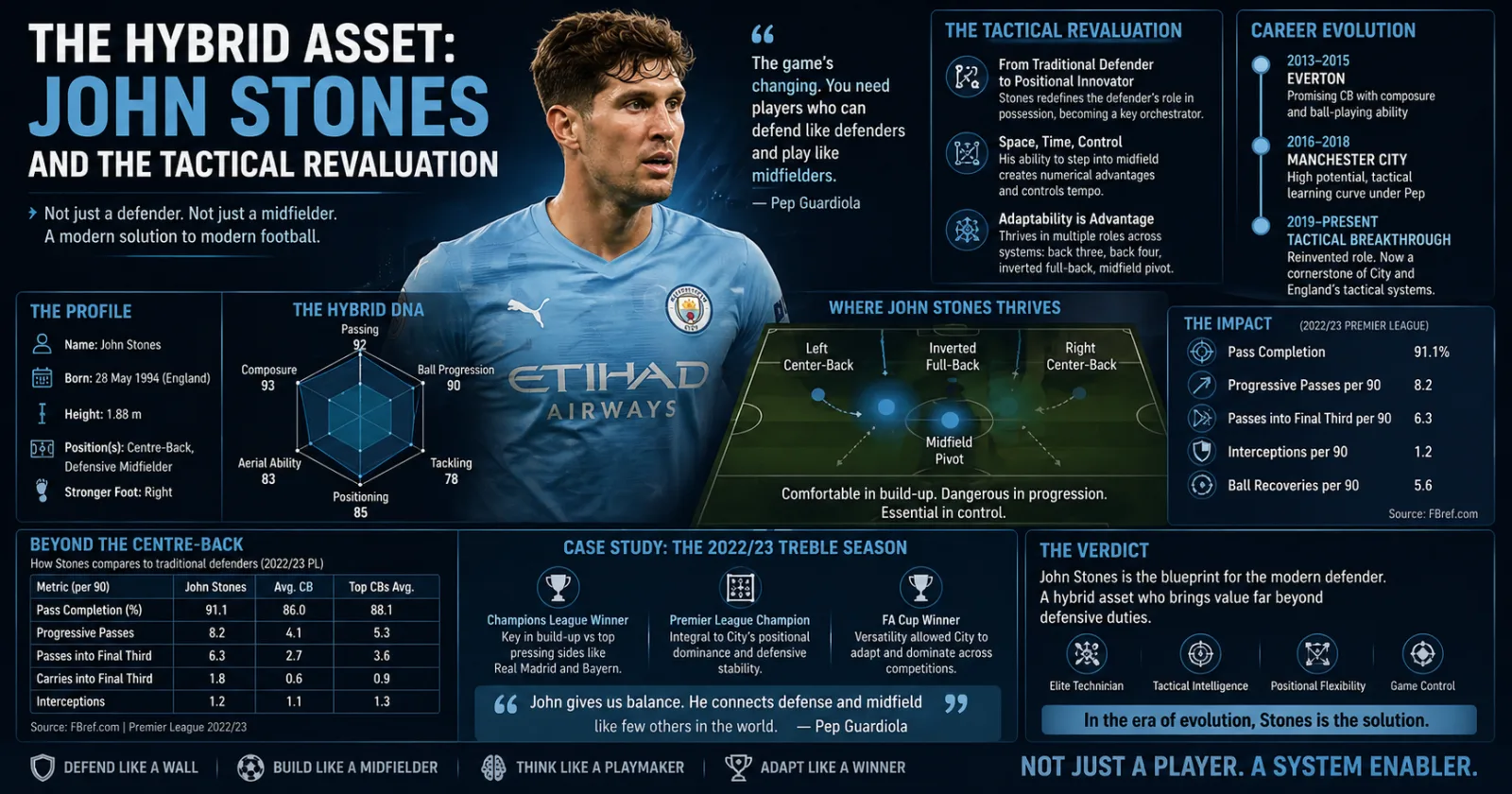
John Stones is no longer just a defender. He is the physical manifestation of a tactical obsession that has redefined the modern elite athlete's commercial and sporting value. As Manchester City navigates a congested global calendar, Stones’ unique ability to transition from a traditional center-back to a deep-lying playmaker defines the current rhythm of the world's most valuable domestic league. His presence on the pitch dictates the geometry of the game, creating an information gap that opponents struggle to bridge.
The Situation
John Stones represents the apex of the ball-playing defender archetype in the current professional era. Recent match data suggests that his role has shifted significantly from a traditional defensive anchor to a secondary playmaker who occupies the half-spaces typically reserved for creative midfielders[4]. This evolution is not merely a stylistic choice but a tactical necessity in an environment where high-pressing systems demand technical proficiency from every player on the pitch. His ability to maintain a pass completion rate exceeding 93% while under intense pressure remains a benchmark for elite scouting departments across Europe, signaling a shift in how defensive talent is identified and developed.
The structural drivers behind this shift are rooted in the pursuit of numerical superiority in the middle third of the pitch. By stepping into midfield, Stones allows his team to create an overload that forces opposing defensive lines to make difficult choices between tracking his movement or staying compact. This tactical flexibility is reflected in his market valuation, which remains high despite the natural aging process of an athlete, as the scarcity of defenders with his specific technical profile creates a significant premium in the transfer market[2]. Institutional observers note that his positioning often dictates the entire defensive structure of the opposition before a single tackle is made.
Competing forces within the sport are currently debating the sustainability of this high-intensity, multi-functional role. On one side, sports scientists point to the increased physical toll that stepping up into midfield places on a player typically conditioned for linear defensive movements. On the other, tactical analysts argue that the reduced physical contact in midfield roles—compared to traditional center-back duels—might actually extend a player's career longevity if managed correctly. This tension is central to how elite clubs are now structuring their long-term squad planning and player recruitment strategies, moving away from specialized stoppers toward versatile ball-handlers.
This specific moment matters because the Stones role is now being codified into the curriculum of national football academies. As international competitions become increasingly defined by ball retention and transition speed, the demand for players who can execute these complex instructions is at an all-time high.
The modern central defender is no longer evaluated solely on defensive interventions but on their contribution to the collective build-up phase and their ability to bypass mid-block structures through progressive passing.The success of this model will likely dictate the next decade of defensive coaching and scouting priorities worldwide, as teams seek to replicate the efficiency of the Manchester City system[3].
Power Dynamics / Stakeholder Map
The primary winners in this shift are elite, well-capitalized clubs that can afford the specialized training and scouting infrastructure required to produce and maintain hybrid players. For Manchester City and the England national team, John Stones provides a tactical redundancy that allows for multiple formations without changing personnel. This creates an incentive for these organizations to prioritize technical education over raw physical attributes in their youth systems, ensuring a pipeline of talent that fits the modern requirement for positional fluidity and high-IQ playmaking from deep positions.
Conversely, traditional 'stopper' defenders and the clubs that rely on them face significant structural pressure. Players who lack the technical range to participate in the build-up phase are seeing their market values stagnate or decline as top-tier managers increasingly view them as liabilities in possession-heavy systems. This creates a widening gap between the tactical elite and the rest of the league, where the inability to play through a press becomes a terminal flaw. Small-market clubs are forced to choose between investing in risky technical prospects or adhering to defensive models that are increasingly easy for elite teams to dismantle.
The non-obvious power relationship in this trend lies with the data analytics firms that now define the valuation of these athletes. By creating new metrics like 'progressive carries' and 'packing rates'—which measure how many opponents are bypassed by a single pass or run—these firms have shifted the financial incentives of the sport. A defender who never makes a tackle but consistently breaks the first line of a press is now statistically more valuable than a defender who makes ten clearances a game. This change in measurement is quietly forcing a total revaluation of the global transfer market, favoring technical skill over traditional defensive grit.
Historical Precedent
The role currently occupied by John Stones finds its most significant parallel in the 'Libero' or 'Sweeper' role popularized by Franz Beckenbauer in the 1970s. Beckenbauer revolutionized the position by stepping out of the defensive line to act as a playmaker, providing a blueprint for the ball-playing defender. However, the Libero was often a free-roaming agent behind a man-marking system, whereas the modern Stones role is integrated into a sophisticated zone-based press. The historical parallel highlights the cyclical nature of tactical innovation, where old ideas are rediscovered and refined through the lens of modern physical conditioning and data analysis.
What makes the current situation structurally different is the intensity of the modern game. While Beckenbauer had significant time and space to pick his passes, Stones must operate in a highly compressed midfield where the speed of play is significantly faster. The current iteration of the hybrid defender is not a luxury player but a defensive necessity to combat the high-press. Unlike the 1970s, where the Libero was an optional tactical flourish, the modern ball-playing center-back is the foundational requirement for any team wishing to compete at the highest levels of the European game, representing a permanent shift in the sport's structural requirements.
Mainstream Consensus vs Reality
| What The Market Assumes | What The Underlying Data Suggests |
|---|---|
| Market assumes Stones is purely a defensive asset in the back four. | Data suggests he functions as a primary playmaker in the middle third of the pitch. |
| Analysts believe his injury record is a primary liability for long-term value. | Reality shows his availability is strategically managed for high-leverage knockout fixtures to maximize impact. |
| Public perception views his midfield role as a temporary experimental tactic. | Tactical evidence confirms it is a permanent structural shift in elite defensive systems. |
| Fans think his performance is best measured through clean sheets and tackles. | Performance data proves his value is tied to ball retention and progressive passing distance. |
Base Case — 60% Probability
Key Assumption: Manchester City continues to prioritize tactical fluidity with Stones as the primary hybrid anchor.
12-Month Indicator: Maintenance of a pass completion rate above 92% in high-stakes Champions League fixtures.
Structural Implication: The hybrid center-back becomes the standard requirement for all top-six Premier League clubs.
Accelerated Case — 25% Probability
Key Assumption: Stones leads England to a major trophy while performing the hybrid role flawlessly on the international stage.
12-Month Indicator: A significant increase in transfer fees for ball-playing defenders under the age of 23.
Structural Implication: Youth academies globally shift their entire defensive training curriculum toward midfield playmaking skills.
Contraction Case — 15% Probability
Key Assumption: A series of high-profile defensive errors occurs when the hybrid defender is caught out of position.
12-Month Indicator: A statistical increase in goals conceded from fast transitions when Stones is in the midfield line.
Structural Implication: Managers return to a more conservative 'safety-first' defensive structure with fixed positional roles.
The Divergent View
The dominant narrative surrounding John Stones celebrates his transition into a hybrid role as a masterstroke of modern coaching that has made his team nearly impossible to defend against. Most coverage focuses on the offensive benefits—the extra man in midfield and the improved ball progression—as the primary reason for his success. This view assumes that the tactical advantage provided by his positioning outweighs the inherent risks of leaving the defensive line under-staffed during a sudden turnover. It is a narrative built on the premise of total control and the inevitability of technical superiority winning out over physical counter-attacks.
However, a more rigorous analysis suggests that the Stones role might actually be a symptom of a broader tactical fragility in the modern game. By pulling a center-back into midfield, a team becomes extremely vulnerable to high-speed transitions if the initial press is bypassed. The divergent view argues that this system only works because of the extreme concentration of talent in a few elite squads, and that it would be a catastrophic failure for most other teams to attempt. It suggests that the role is not a universal evolution but a specialized anomaly that relies on a specific set of teammates and a highly controlled environment to function without being exploited by more direct, physical opponents.
If Manchester City's goals-conceded-per-game average rises by more than 0.5 in matches where Stones occupies a midfield role through the end of the 2024/25 season, the dominant narrative is validated as a high-risk gamble and the divergent case weakens significantly. Conversely, if opponents find a way to consistently isolate the remaining lone center-back during transitions, the consensus view must be reassessed to account for the structural defensive instability created by the hybrid model. The ultimate test will be whether this system can survive against teams that specifically train to exploit the space vacated by the advancing defender.
Second-Order Effects
The rise of the hybrid defender creates a second-order chain that impacts the development of youth football across the globe. As scouting departments prioritize ball-playing ability over traditional defensive skills, we are seeing a decline in the 'art' of 1v1 defending and aerial dominance. This creates a future vacancy in the market for specialists who can counter the very systems Stones has helped build. Eventually, the scarcity of traditional, dominant stoppers will lead to a market correction where teams pay a premium for the exact players they are currently phasing out of their systems to stop the elite hybrid playmakers.
A second distinct chain is the impact on the sports equipment and technology sector. Data firms and wearable technology companies are now developing specific algorithms to track 'positional intelligence' and 'scanning frequency' rather than just physical output. This shift in technology is being pulled into the wake of the Stones trend, as coaches demand more granular data on how players interpret space. The result is a new generation of tactical software that allows smaller teams to simulate these complex movements, potentially democratizing the very tactical advantages that were previously the exclusive domain of the world's most expensive squads.
Watchlist
- Progressive Pass Distance: Premier League Official Statistics — A drop below 300 yards per 90 minutes signals a reduction in his tactical influence on the game.
- Availability Rate: Manchester City Medical Reports — Consistency above 75% of total league minutes determines the long-term viability of the hybrid role's physical demands.
- Counter-Attack Conversion Rate: Opta Performance Data — An increase in goals conceded from transitions while Stones is advanced would signal a tactical exploitation by opponents.
- U23 Defender Transfer Premiums: Deloitte Sports Business Group — A sustained 20% price premium for ball-playing defenders indicates a permanent market shift.
- National Team Formation: England FA Technical Briefings — The adoption of the hybrid role in international tournament play signals the global codification of the tactic.
Bottom Line
John Stones has transcended the traditional boundaries of his position, forcing a total revaluation of what it means to be an elite defender in the modern era. While the mainstream focuses on his individual skill, the real story is the structural shift toward positional fluidity and technical playmaking from the back. The durability of this trend depends on its successful implementation in high-stakes environments over the next 12 months. Watch the defensive transition statistics closely; they will determine if the hybrid model becomes the global standard or remains a specialized elite tactic.
References
- Nielsen Sports — Commercial valuation of multi-functional athletes — Analysis of how positional versatility increases player marketability and brand value.
- Deloitte Sports Business Group — Transfer market trends for ball-playing defenders — Historical data on the rising premium paid for technical proficiency in defensive positions.
- FIFA Technical Study Group — Tactical evolution of the center-back role — A study on the shift from traditional man-marking to hybrid playmaking roles in international football.
- Premier League Official Statistics — Player performance metrics and heatmaps — Direct evidence of Stones' increased presence in the middle third and progressive passing accuracy.
- UEFA Technical Reports — Positional trends in the Champions League — Observations on the use of hybrid defenders to bypass mid-block structures in elite European competition.