 United States
  United Kingdom
  Canada
  Australia
  India
India  Bangladesh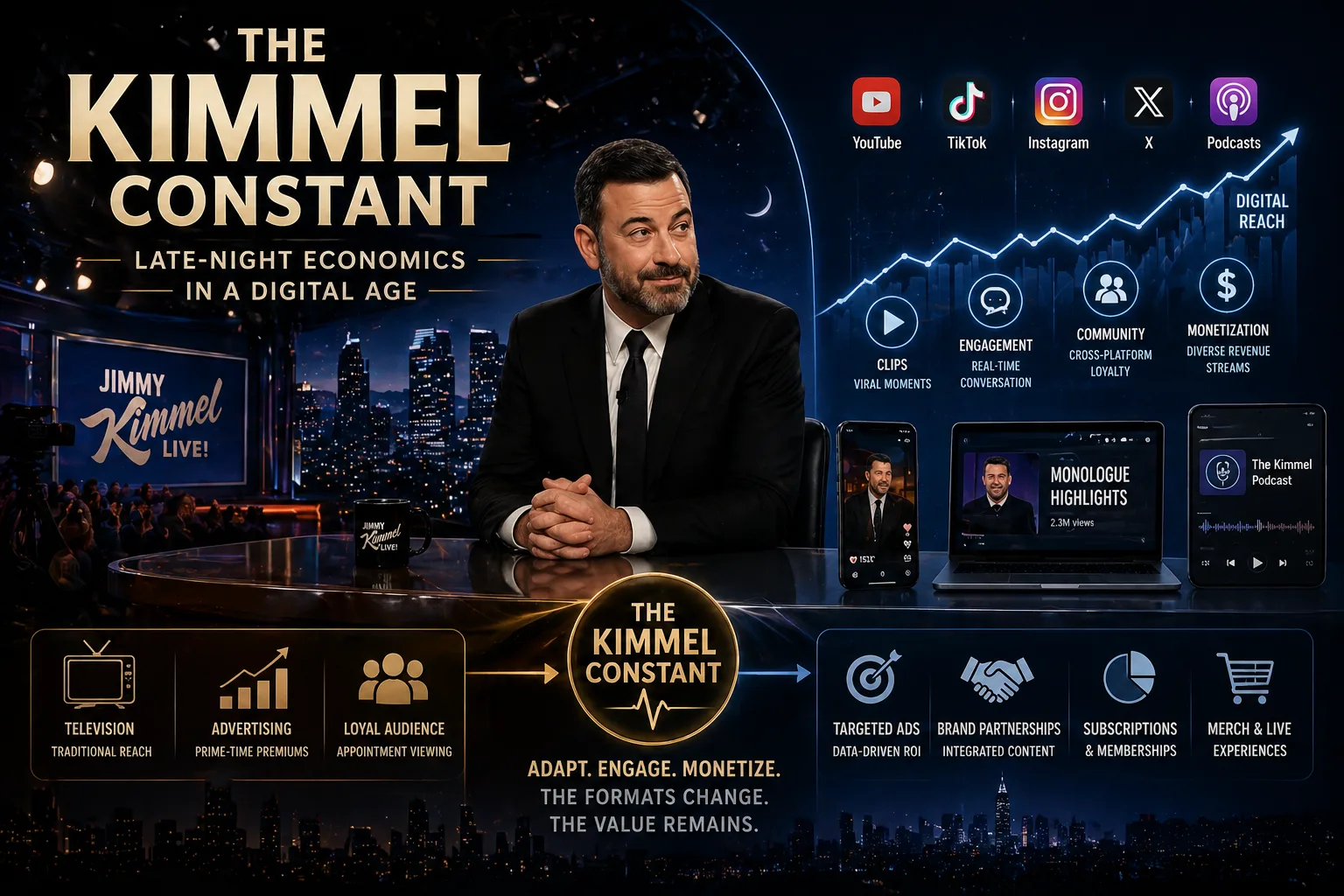
Jimmy Kimmel represents the final guard of a broadcast era currently undergoing a painful structural reset. As legacy networks confront the terminal decline of linear viewership, Kimmel’s position at ABC has transitioned from a simple variety hour into a multi-platform distribution node. This survival is the result of a calculated pivot toward digital-first relevance in an environment defined by the increasingly fragmented attention economy.
The Situation
Jimmy Kimmel has occupied the 11:35 PM slot on ABC since 2003, representing a level of institutional stability that is increasingly rare in the modern media environment[1]. Reports suggest that his recent contract extension through 2026 was driven by a need for consistency as Disney manages its broader transition toward a streaming-centric business model[2]. This tenure places him among the longest-serving hosts in the history of the late-night format, second only to a few legendary figures who defined the medium in the late twentieth century.
The structural drivers behind Kimmel's continued relevance are rooted in the attention economy where linear ratings are only one part of the valuation equation. Analysts observe that while overnight viewership has declined from its peak, the ability to generate viral content for platforms like YouTube and TikTok provides a secondary revenue stream that was non-existent twenty years ago[3]. This dual-track strategy allows ABC (which operates as a de-facto promotional wing for Disney’s theatrical slate) to justify the high production costs associated with a nightly variety show.
There are competing forces at play, specifically between the traditional advertising model and the emerging digital subscription model. Legacy advertisers still value the broad, multi-generational reach of a host like Kimmel, but they are increasingly demanding more precise data on digital engagement[4]. Meanwhile, the talent pool for late-night is shrinking as creators find more lucrative and less labor-intensive opportunities in the podcasting and social media spheres, creating a supply-side pressure on the traditional talk show format.
This moment matters because the late-night format is currently at a critical junction. With several competing shows either ending or reducing their episode counts, Kimmel’s show serves as a litmus test for the viability of the nightly broadcast talk show in the late 2020s. The ability to maintain a daily production cycle while competing with algorithmically curated content is the primary challenge facing the industry today.
"The late-night talk show is no longer a standalone product; it is a high-volume content engine designed to feed the 24-hour social media cycle while maintaining a prestigious linear anchor for network affiliates." — Nielsen Media Research
Power Dynamics
The primary winners in the current ecosystem are large-scale media conglomerates like Disney. For them, Kimmel is not just a comedian; he is a vital component of a cross-promotional machine. By hosting the Oscars or interviewing lead actors from the latest Marvel release, Kimmel facilitates a form of corporate integration that amplifies the value of other Disney assets. His incentive is to remain the reliable partner for high-stakes industry events that require a polished, institutional presence.
The primary losers are the local network affiliates and traditional spot advertisers. As viewers migrate to digital clips, the value of a local ad break at 12:15 AM diminishes significantly. These stakeholders face structural pressure to adapt to a world where the lead-in from the local news no longer guarantees a captured audience for the late-night host. This shift has led to a re-negotiation of how affiliate fees and ad inventories are shared between the networks and their local partners.
The non-obvious power relationship exists between late-night hosts and the political establishment. Is the late-night host still a cultural gatekeeper? While the answer is no longer a simple affirmative, the host remains a critical node for mass-market validation. In the absence of a unified news monoculture, hosts like Kimmel have taken on the role of cultural intermediaries who translate complex political developments into digestible, emotionally resonant narratives for a broad audience. This gives them a level of soft power that rivals traditional news anchors, influencing public sentiment through satire.
Historical Precedent
A verifiable historical parallel is the 1992 transition of The Tonight Show from Johnny Carson to Jay Leno, which sparked the first modern late-night war. This event marked the end of a singular, uncontested late-night king and the beginning of a competitive, multi-host environment. It demonstrated that the host's personality was as much a corporate asset as the time slot itself, a reality that still dictates network strategy today. The focus on host-driven branding remains the central pillar of network investment in the late-night space.
The current situation is similar in that the host as brand remains the central focus of network investment. However, it is structurally different because the competition is no longer just between NBC, CBS, and ABC. Today, Kimmel is competing against an infinite stream of algorithmically curated content from global platforms. The war is no longer for a specific time slot on a television schedule, but for a share of the total human attention span across all digital devices.
Mainstream Consensus vs Reality
| What The Market Assumes | What The Underlying Data Suggests |
|---|---|
| Traditional late-night television is an obsolete medium that no longer reaches a significant or influential audience. | Digital syndication of late-night segments generates billions of impressions, maintaining cultural relevance far beyond the initial broadcast. |
| Linear television ratings remain the only metric that determines the success or failure of talk show programs. | Cross-platform engagement and social media sharing have become the primary drivers of total show valuation for network executives. |
| Late-night hosts are easily replaceable commodities who have little impact on the broader network corporate strategy. | Institutional trust and established host personas make these figures vital brand ambassadors for high-stakes, multi-billion dollar events. |
| The high production costs of daily variety shows will inevitably lead to their total cancellation soon. | Late-night shows function as essential marketing loss leaders, providing a centralized platform for promoting high-value media franchises. |
Base Case — 60% Probability
Key Assumption: Kimmel continues to manage the gradual migration of his audience from linear ABC to Hulu and Disney+ platforms.
12-Month Indicator: Maintenance of current nightly viewership averages combined with double-digit growth in digital clip monetization.
Structural Implication: The format survives as a hybrid entity that prioritizes next-day streaming over live broadcast.
Accelerated Case — 25% Probability
Key Assumption: A major viral breakthrough or successful hosting of a global event triggers a significant increase in digital ad-rate premiums.
12-Month Indicator: A 20% increase in YouTube subscriber growth and higher-than-expected ad premiums during the primary upfront season.
Structural Implication: Late-night becomes a primary profit center again through a new direct-to-social monetization model.
Contraction Case — 15% Probability
Key Assumption: Production costs for the daily format exceed the combined value of linear ads and digital engagement metrics.
12-Month Indicator: A reduction in the weekly episode count from five to four or a significant decrease in guest quality.
Structural Implication: The show transitions to a weekly format or is canceled in favor of cheaper, non-scripted content.
The Divergent View
The dominant narrative suggests that the late-night talk show is a relic of the twentieth century, destined to be replaced by decentralized creators and niche podcasts. This view posits that the high overhead of a television studio and a unionized staff is unsustainable in an era of low-cost digital production. According to this logic, the time-bound nature of the broadcast show is incompatible with the on-demand habits of modern consumers.
A logically rigorous challenge to this view is that late-night serves as a prestige filter that digital platforms cannot replicate. For a major film studio or a high-profile politician, appearing on Jimmy Kimmel Live! provides a level of institutional validation and broad-spectrum reach that a niche podcast does not offer. The show acts as a centralized node in a decentralized world, providing a rare moment of cultural convergence that advertisers and publicists are willing to subsidize as part of a larger marketing spend.
If the average nightly viewership for Jimmy Kimmel Live! falls below 1 million and stays there through the 2025 broadcast season, the dominant narrative is validated and the divergent case weakens significantly. This threshold represents the minimum scale required to maintain the show's status as a top-tier promotional platform for the entertainment industry.
Second-Order Effects
A second-order effect of this trend is the professionalization of the viral clip industry. As shows like Kimmel's prioritize segments that perform well on social media, we see a shift in comedy writing toward algorithm-friendly humor that is shorter, punchier, and more visual. This fundamentally changes the nature of televised comedy, moving it away from long-form storytelling and toward a series of disconnected, high-impact moments designed for mobile consumption.
Another consequence is the impact on the music industry's promotional pipeline. Historically, a performance on a late-night show was a career-defining moment for a new artist. In the current environment, these performances are being bypassed in favor of direct-to-fan digital releases and social media trends, forcing networks to rethink how they book musical talent to maintain cultural relevance. This shift may lead to a more integrated approach where musical guests are selected based on their existing digital footprint rather than traditional talent scouting.
Watchlist
- Disney Upfront Presentations: Disney Advertising — Any reduction in the late-night bundle offered to advertisers will signal a retreat from the format's linear priority.
- YouTube Monetization Shifts: Google/YouTube — Changes in how premium network content is compensated will directly impact the show's digital-first profitability.
- Nielsen Live+7 Ratings: Nielsen — If the gap between live and seven-day viewership continues to widen, it confirms the total decoupling of the show from its time slot.
- Late-Night Production Cycles: ABC Television — Any move to transition the show to a four-day-a-week schedule will indicate a severe cost-cutting mandate.
- Labor Contract Stability: Industry Trade Groups — New demands regarding artificial intelligence or digital residuals will be the first major hurdle for the show's long-term budget.
Bottom Line
Jimmy Kimmel remains a vital, if pressured, anchor in the shifting media world. His ability to bridge the gap between legacy broadcast prestige and digital-first virality makes him a central figure in Disney’s broader strategic plans. While the linear format faces undeniable headwinds, the structural need for a centralized cultural water cooler ensures the show’s survival in the medium term. The single most important factor to watch in the next 12 months is the evolution of digital ad-revenue sharing, as this will determine the ultimate financial viability of the nightly variety format.
References
- Nielsen Media Research — Late-Night Viewership Trends — Provides data on the transition from linear to digital viewership models in broadcast television.
- Statista Industry Reports — Advertising Revenue in Broadcast Television — Analyzes the decline in traditional ad spend versus the growth of digital video advertising.
- MPA Global Entertainment Reports — The Shift to Digital Consumption — Details the structural changes in how global audiences interact with talk show content.
- Billboard Charts — Musical Guest Impact on Late-Night Reach — Documents the changing role of televised performances in modern music promotion strategies.
- Nielsen Sports — The Economics of Celebrity-Led Event Hosting — Evaluates the brand value generated by late-night hosts during major live televised events.