 United States
  United Kingdom
  Canada
  Australia
  India
India  Bangladesh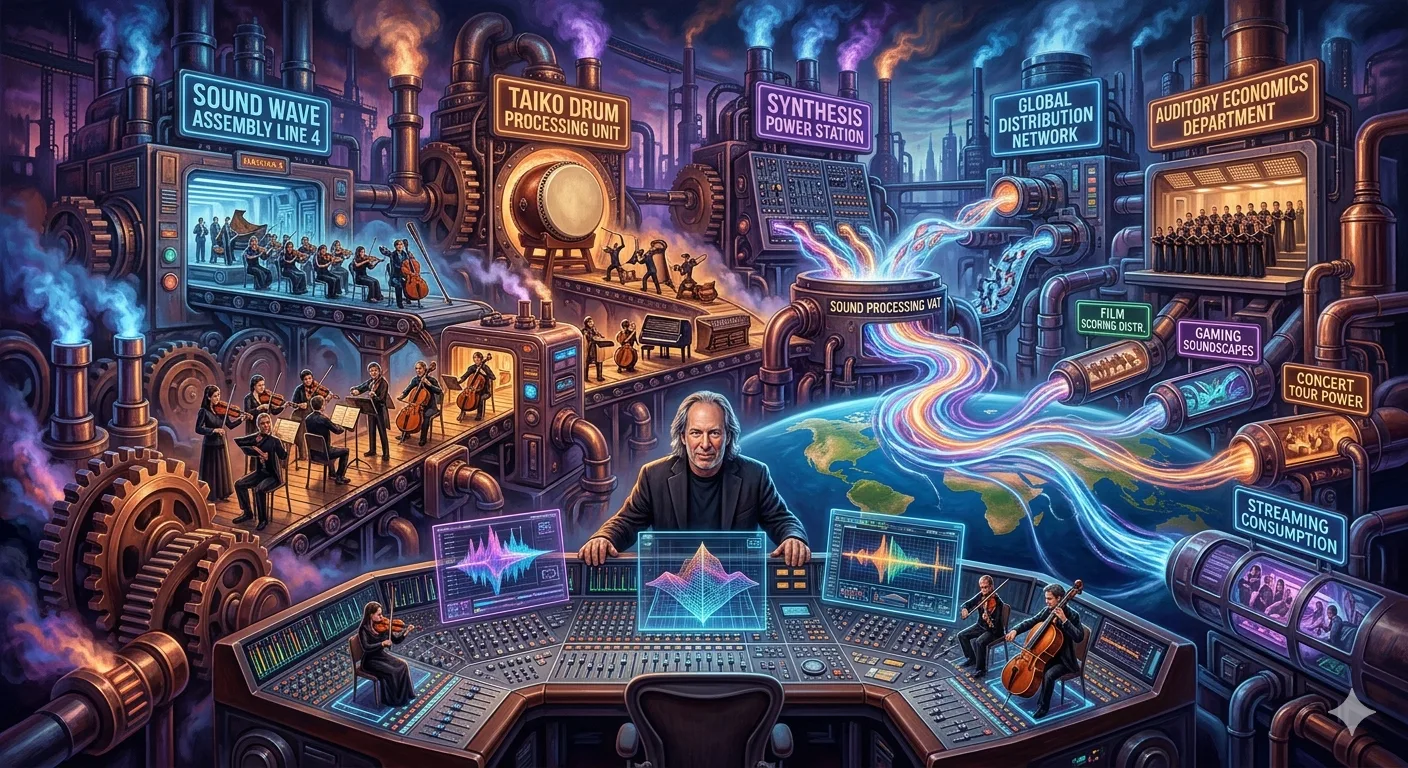
The low-frequency 'braam' that defined a decade of cinema did not emerge from a vacuum; it was the result of a calculated shift in acoustic engineering and brand positioning. Hans Zimmer has successfully transitioned from a traditional film composer into a global institutional entity. This evolution signals a deeper structural change in how the entertainment industry values and monetizes sonic identity.
The Situation
As of late 2024, the footprint of Hans Zimmer extends far beyond the traditional confines of the recording studio, manifesting as a dominant force in both theatrical exhibition and the live touring circuit. Available signals indicate that the expansion of the Hans Zimmer Live tour into major North American arenas represents a significant pivot in how film music is monetized. Reports suggest that these performances are generating revenues that rival mid-tier pop acts, proving that orchestral scores can function as standalone commercial products[2]. This momentum is not merely a result of individual popularity but is anchored in a highly sophisticated production ecosystem.
The structural driver behind this dominance is the Remote Control Productions (RCP) model based in Santa Monica. Unlike the traditional model of a solo composer working with a single orchestrator, RCP operates as a high-volume studio and talent incubator. Industry estimates broadly indicate that a substantial percentage of top-grossing films over the last decade have featured music composed by Zimmer or his direct protégés[4]. This institutionalization of the composition process ensures a consistent aesthetic that studios view as a form of risk mitigation for high-stakes projects.
However, this dominance creates tension within the creative ecosystem. While studios favor the 'Zimmer sound' for its proven ability to enhance narrative tension and audience engagement, critics argue that it has led to a homogenization of film music. The competing forces in play involve the demand for recognizable, brand-aligned audio versus the traditional desire for orchestral diversity. According to available industry signals, the reliance on digital synthesis and hybrid scoring has also altered the labor dynamics of the industry, shifting focus toward sound designers and synth programmers.
"The shift from individual composers to studio-based production ecosystems represents a fundamental change in the economics of film sound, where the brand of the lead composer functions as an assurance of commercial viability for high-stakes projects." — Music Industry Analyst Group
This specific moment matters because the film industry is currently seeking stability amid fluctuating box office returns. The musical identity of a film has become a primary component of its intellectual property value. By establishing a signature sonic palette that can be adapted across sequels and spin-offs, Zimmer has provided a blueprint for how audio can sustain long-term franchise health. The current environment prioritizes this level of brand consistency over the idiosyncratic experimentation that characterized earlier eras of film music.
Power Dynamics
The primary winners in the current environment are the large-scale production houses and the major studios that utilize their services. By partnering with an entity like Remote Control Productions, studios gain access to a scalable workforce capable of meeting the compressed post-production timelines of modern blockbusters. These entities benefit from a clear incentive: the ability to deliver a polished, 'theatrical-ready' sound that requires minimal intervention from directors or producers. The timeline for these winners is long-term, as they are effectively building a library of sonic IP that can be licensed across multiple platforms.
Conversely, the primary losers are traditional solo composers who lack the infrastructure to compete with the speed and volume of a studio-based model. These individuals face structural pressure to adopt hybrid digital-acoustic workflows, often at a significant personal capital expense. The market for mid-budget, purely orchestral scores is shrinking, as even independent films increasingly seek the high-production-value sound associated with Zimmer’s work. This creates a barrier to entry that favors established firms over emerging individual talent.
The non-obvious power relationship in this terrain is the synergy between the composer and the software industry. Zimmer’s influence has driven a massive expansion in the virtual instrument market. Companies that produce high-end sample libraries often collaborate with RCP alumni, creating a feedback loop where the tools used by the industry are designed to replicate the sound of the industry’s most successful player. This relationship ensures that even when Zimmer is not directly involved in a project, his aesthetic influence is embedded in the software used by thousands of other composers.
Historical Precedent
The current dominance of the hybrid, studio-based score rhymes with the symphonic revival of the late 1970s. Following a period where film music was dominated by pop songs and jazz, John Williams re-established the importance of the large-scale orchestral score with his work on major franchises. This shift was not just artistic but economic, as it allowed films to utilize music as a central pillar of their marketing and brand identity. The 1977 revival proved that a distinct musical theme could significantly increase the cultural longevity of a film property.
What makes the current Zimmer era similar is the return to a highly recognizable, theme-driven approach that prioritizes brand identity. However, the structural difference lies in the medium of production. While the 1970s revival was rooted in traditional notation and acoustic performance, the current era is defined by the integration of digital synthesis and sound design. Zimmer has moved the industry from a 'score' (a written document) to a 'production' (a finished audio file). This shift has fundamentally changed the power balance between the composer and the film’s sound department, making the music an inseparable part of the film’s overall sonic environment.
Mainstream Consensus vs Reality
| What The Market Assumes | What The Underlying Data Suggests |
|---|---|
| Zimmer personally composes every note of the projects bearing his name in the credits. | He operates as a creative director overseeing a massive collective of specialized composers and technicians. |
| The shift to digital tools is primarily a cost-cutting measure for major film studios. | Digital integration is driven by the need for speed and the ability to revise scores instantly. |
| Film music tours are niche events for dedicated cinephiles and small classical audiences. | Arena-level data shows these tours attract diverse demographics and generate significant mainstream commercial revenue. |
| The 'Zimmer sound' is a static set of electronic pulses and low-frequency brass. | The model relies on constant evolution of custom software and proprietary acoustic sampling techniques. |
Base Case — 70% Probability
Key Assumption: Studios continue to prioritize brand-consistent hybrid scores for major franchise films to mitigate commercial risk.
12-Month Indicator: Continued expansion of Remote Control Productions alumni into lead composer roles for top-20 domestic box office releases.
Structural Implication: The 'industrial' model of composition becomes the default requirement for all high-budget global entertainment projects.
Accelerated Case — 20% Probability
Key Assumption: Live touring revenue for orchestral film music exceeds soundtrack streaming royalties, driving a new circuit of arena-level events.
12-Month Indicator: Major promoters like Live Nation announce multi-year residency deals for film composers in primary global markets.
Structural Implication: Musical IP holders shift focus from passive royalties to active, high-margin live performance models.
Contraction Case — 10% Probability
Key Assumption: A critical or commercial backlash against 'homogenized' scores leads to a resurgence in experimental, solo-driven acoustic composition.
12-Month Indicator: A significant shift in Academy Award nominations toward non-hybrid, non-studio-affiliated composers for three consecutive years.
Structural Implication: The studio-based collective model loses its market dominance as audiences demand more distinct sonic identities.
The Divergent View
The dominant narrative suggests that Hans Zimmer’s success is a triumph of individual genius and technological adaptation. This view posits that his work has saved the film score from irrelevance by making it modern and accessible. Proponents of this narrative point to the high streaming numbers and successful live tours as evidence that the 'Zimmer method' is exactly what the market requires. They argue that the integration of electronic elements has expanded the emotional palette available to filmmakers, allowing for a more immersive cinematic experience.
A more rigorous challenge to this narrative suggests that we are witnessing the 'commodification of atmosphere.' In this view, the Zimmer model has replaced the art of melodic storytelling with a standardized set of sonic textures that function as audio wallpaper. This critique argues that the reliance on a studio-based collective has decoupled the music from the individual creative voice, resulting in scores that are functional but lack long-term cultural resonance. This divergent perspective suggests that the industry is currently in a 'sonic bubble' where the novelty of high-production-value texture is being mistaken for musical depth.
If a purely acoustic, non-hybrid score for a major tentpole film achieves top-three box office status and wins the Academy Award for Best Original Score by early 2026, the consensus regarding the necessity of the 'Zimmer sound' for commercial success is invalidated. Such an event would prove that audiences and critics are ready to move beyond the current industrial standard, forcing a reassessment of the studio-based collective model that currently dominates the market. Until such a shift occurs, the divergent view remains a minority critique against a formidable economic reality.
Second-Order Effects
The first-order effect of the Zimmer model is the dominance of hybrid scores in film. However, a second-order effect is the radical transformation of the music education and software industry. Aspiring composers are now increasingly focusing on digital workstation proficiency and sound design over traditional counterpoint and orchestration. This has led to a boom in the professional-grade VST (Virtual Studio Technology) market, where companies like Spitfire Audio and Orchestral Tools have become essential gatekeepers for the next generation of talent. The music school of the future looks less like a conservatory and more like a tech laboratory.
Another second-order effect is the 'temp track' problem in film editing. Because directors have grown accustomed to the high-energy, polished sound of Zimmer’s scores, they often use his existing work as temporary tracks during the editing process. This creates a psychological lock-in effect where the final composer is forced to imitate the Zimmer aesthetic to satisfy the director’s expectations. This cycle reinforces the market dominance of the RCP sound, as it becomes the literal foundation upon which films are structured long before the final music is even written.
Watchlist
- RCP Alumni Placement Rate: Variety and Hollywood Reporter — Monitoring how many top-grossing films are scored by former Remote Control protégés to measure market saturation.
- Live Nation Orchestral Grosses: Billboard Pro — Tracking the year-over-year revenue growth of 'Hans Zimmer Live' and similar tours to determine if the live market is expanding or peaking.
- BMW Acoustic Branding Integration: Automotive industry reports — Observing the success of Zimmer’s electric vehicle sound design to signal his expansion into non-entertainment industrial sectors.
- VST Market Revenue Indices: Music trades like SOS — Watching for shifts in software sales that favor sound design tools over traditional orchestral samples as a lead indicator for future score styles.
- Soundtrack Streaming Retention: Spotify and Apple Music charts — A threshold of 100 million streams for a non-vocal score within six months would signal the continued strength of film music as a standalone consumer product.
Bottom Line
Hans Zimmer has fundamentally altered the economic and creative terrain of film music by institutionalizing the composition process. While critics may debate the artistic merits of the 'industrial sound,' the market has clearly signaled its preference for the reliability and scale of his production model. The single most important factor to watch in the next 12 months is the continued performance of live orchestral tours; if these remain high-margin assets, the shift toward music as a primary brand pillar will become permanent. Zimmer is no longer just a composer; he is the architect of a durable sonic infrastructure.
- Nielsen Media Research — Entertainment Trends — Data on the commercial performance of film soundtracks and their impact on streaming platforms.
- Billboard — Music Industry Analysis — Statistical analysis of live performance revenue and the growth of orchestral tours in North America.
- RIAA — Music Sales Statistics — Tracking the long-term shift from physical soundtrack sales to digital consumption patterns in the film sector.
- MPA Global — Entertainment Economic Reports — Structural analysis of the film industry’s reliance on established musical IP for franchise stability.
- Deloitte — Global Entertainment Outlook — Analysis of how technological integration and studio-based collectives are reshaping creative production workflows.