 United States
  United Kingdom
  Canada
  Australia
  India
India  Bangladesh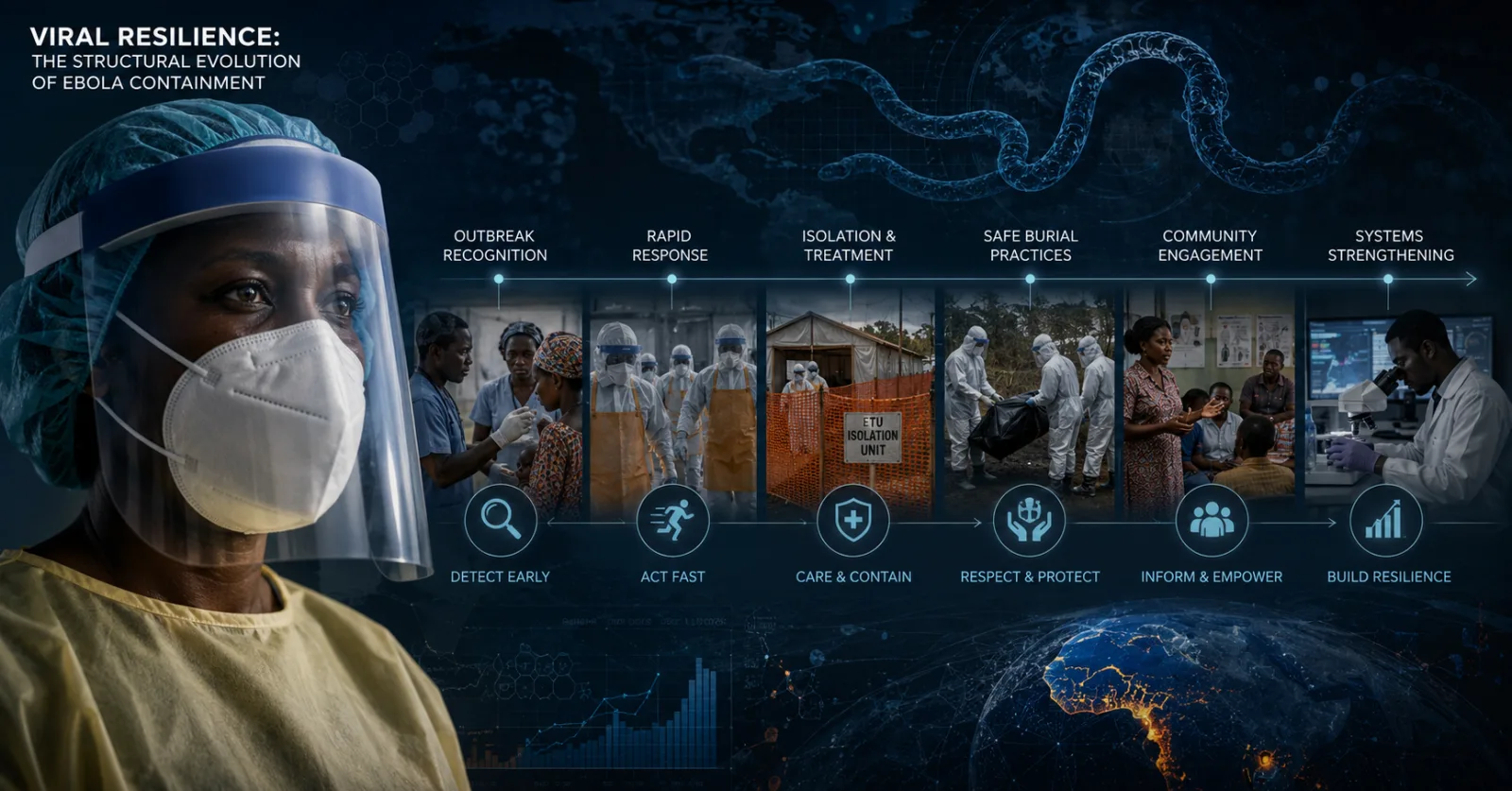
Reports suggest that recurring clusters of viral hemorrhagic fever in Central Africa remain a critical focal point for global health security as of this year. These events frequently involve the Zaire ebolavirus species, which maintains a high case-fatality rate ranging from 25% to 90% in past recorded events. While current signals do not indicate a pandemic-scale crisis, the systemic risk of localized containment failure remains a high-priority institutional objective for international monitoring bodies.
The Situation
Current reports indicate that the management of viral hemorrhagic fever has entered a period of relative stabilization, yet the underlying biological threat remains constant. According to available signals, the persistence of the virus is often linked to zoonotic spillover events originating from fruit bats or non-human primates in heavily forested regions.[1] These spillovers are not random occurrences but are increasingly driven by human activity, including deforestation and the expansion of the human-wildlife interface. Industry estimates broadly indicate that the speed of detection remains the single most important factor in preventing a localized cluster from evolving into a regional epidemic.
The structural drivers behind the recurring nature of these outbreaks are multifaceted and deeply rooted in regional geography. Historical data indicates that the fragility of healthcare infrastructures in post-conflict zones significantly complicates early diagnostic efforts. When laboratory capacity is centralized in distant urban hubs, the delay in confirming a primary case allows for multiple generations of transmission before an official response is triggered. This lag time creates an environment where the virus can establish a foothold in mobile populations, making subsequent contact tracing exponentially more difficult and resource-intensive.
Competing forces and stakeholders often create friction during the deployment of international aid. National health ministries frequently encounter tension with international non-governmental organizations regarding resource allocation and data sovereignty. While global health protocols prioritize rapid isolation and strict containment, local communities sometimes view these external interventions with significant suspicion. This resistance is not merely cultural but is often a rational response to historical experiences with top-down medical interventions that did not prioritize local agency or communication. The result is a complex operational environment where medical success depends on social negotiation.
This specific moment in the history of containment matters because of the maturation of medical countermeasures. According to available signals, the transition from experimental to standardized use of the rVSV-ZEBOV vaccine has fundamentally altered the risk profile of modern outbreaks.[2] The availability of approved therapeutics, such as monoclonal antibodies, has further shifted the focus from palliative care to active treatment. However, the logistical challenge of maintaining the ultra-cold chain required for these vaccines remains a significant barrier to achieving universal preparedness in the most vulnerable regions.
"The ability to rapidly deploy ring vaccination strategies has fundamentally changed the trajectory of recent containment efforts, yet structural gaps in regional surveillance persist." — World Health Organization (WHO) Global Health Observatory.
Power Dynamics
Primary winners in the current containment framework include pharmaceutical entities and global research institutions that focus on viral countermeasures. These organizations benefit from expanded public-private partnerships and accelerated regulatory pathways designed for orphan drugs and biodefense applications. Their long-term incentive involves establishing a standardized portfolio of vaccines and therapeutics that can be adapted for other filoviruses. This positioning grants them significant influence over the global health security agenda, as they control the primary tools for clinical intervention.
Primary losers during active outbreaks are the regional trade networks and transport sectors that face immediate structural pressure during containment phases. Border closures and quarantine measures frequently disrupt the flow of essential goods and labor, leading to localized inflation and economic contraction. For these stakeholders, the timeline for recovery is often extended by the lingering stigma associated with the affected geography, which can deter foreign investment long after the health crisis has been resolved. The economic cost of containment often outweighs the direct medical costs by several orders of magnitude.
The non-obvious power relationship that most coverage ignores is the dependency between digital surveillance platforms and local health workers. While international donors push for high-tech data collection and satellite mapping, the actual success of any containment effort is tethered to the social capital of community mobilizers. This creates a hidden power dynamic where high-level policy is entirely dependent on the ground-level trust of individuals who are often under-compensated and under-protected. Without their participation, the most advanced surveillance systems produce data that is functionally useless for real-world intervention.
Historical Precedent
The 2014–2016 West Africa outbreak serves as the primary structural parallel for the current global health posture. Spanning Guinea, Liberia, and Sierra Leone, this event was the first time the virus reached dense urban centers, resulting in over 11,000 deaths and demonstrating the limits of traditional rural containment strategies.[3] It highlighted the critical importance of regional mobility and the speed at which a localized health failure can transform into a global security concern. The international response was initially slow, leading to a massive mobilization of military and medical assets to stabilize the region.
The current situation is similar in its reliance on international coordination but is structurally different due to the maturity of the vaccine supply chain and diagnostic technology. In 2014, medical teams lacked an approved vaccine and were forced to rely entirely on isolation and supportive care. Today, ring vaccination is a standard operational pillar that can be deployed within days of a confirmed case. However, the current geopolitical instability in certain endemic regions introduces a layer of security risk that was less prevalent during the West African crisis, complicating the safety of medical responders.
Mainstream Consensus vs Reality
| What The Market Assumes | What The Underlying Data Suggests |
|---|---|
| Outbreaks are random and unpredictable acts of nature that cannot be prevented before they occur. | Analysis of land-use patterns shows clear correlations between deforestation and zoonotic spillover events in specific clusters. |
| Vaccines alone will eliminate the threat of future large-scale hemorrhagic fever epidemics in Africa. | Logistical hurdles and community mistrust remain the primary barriers to effective containment in remote rural regions. |
| High mortality rates ensure the virus burns out before reaching global urban hubs or transit centers. | Increased regional mobility and shorter travel times make urban transmission a persistent and growing structural risk. |
| International aid is the only effective way to manage and contain active viral transmission clusters. | Local health systems and community-led contact tracing are the most effective predictors of successful containment outcomes. |
Scenario Modeling
Base Case — 50% Probability
Key Assumption: Containment remains localized through the continued use of ring vaccination and improved regional diagnostics.
12-Month Indicator: Maintenance of a case-fatality rate below 40% in all newly identified viral clusters.
Structural Implication: The global health community continues to rely on a reactive funding model that prioritizes emergency response over primary care.
Accelerated Case — 30% Probability
Key Assumption: Expansion of permanent surveillance networks allows for detection within 48 hours of a primary spillover event.
12-Month Indicator: Zero instances of cross-border transmission during any localized flare-up of the virus.
Structural Implication: High-risk regions achieve a level of diagnostic autonomy that reduces the need for massive international intervention.
Contraction Case — 20% Probability
Key Assumption: Security instability or vaccine resistance leads to a failure of containment in a major urban center.
12-Month Indicator: Any cluster exceeding 500 cases in a region with high population density and international transit.
Structural Implication: A return to large-scale travel restrictions and a significant contraction in regional economic activity.
The Divergent View
The dominant narrative suggests that technology and vaccines are the primary solutions to ending the cycle of outbreaks. This view focuses on "smart" surveillance and rapid-response pharmaceutical deployment as the ultimate safeguards for global health. By centralizing resources in high-tech response teams, proponents argue that we can effectively manage any future spillover before it reaches a catastrophic scale. This narrative is reinforced by the success of recent containment efforts in the Democratic Republic of the Congo, which utilized advanced medical tools to limit the spread of the virus.
A divergent analysis suggests that these technical fixes are merely masking the underlying decay of primary healthcare systems. According to industry estimates, for every dollar spent on emergency response, only a fraction goes toward permanent community clinics. The real risk is that the "emergency-only" funding model prevents the development of the very diagnostic capacity that would make such emergencies rare. By prioritizing the symptoms of healthcare failure—the outbreak—over the cause—the absence of basic health services—we are creating a permanent state of vulnerability that no amount of vaccine can fully resolve.
If the case-fatality rate remains below 15% across three consecutive cross-border outbreaks without significant investment in permanent rural clinics, the consensus view regarding the supremacy of technical countermeasures holds and this divergent analysis should be reassessed. However, if mortality remains high despite vaccine availability, it confirms that the social and structural barriers to healthcare delivery are the true bottlenecks of containment. This falsification test provides a clear metric for evaluating whether we are solving the biological problem while ignoring the human one.
Second-Order Effects
One significant second-order effect is the erosion of routine childhood immunization programs during containment efforts. When an outbreak occurs, resources and personnel are diverted away from measles, polio, and malaria programs, often leading to secondary health crises. Historically, these secondary outbreaks can claim more lives than the initial virus itself, as the healthcare system becomes single-mindedly focused on the hemorrhagic fever threat. This displacement effect creates a cyclical vulnerability in the regional health profile.
Another chain involves the disruption of critical mineral supply chains, particularly in regions where mining activity is concentrated. As containment measures restrict the movement of labor and goods in mining zones, the global supply of materials essential for electronics—such as cobalt and tantalum—experiences price volatility and logistical delays. This connects the health security of Central Africa directly to the global technology sector, illustrating how a localized medical event can trigger downstream economic consequences in industries far removed from the epicentre.
Watchlist
- WHO PHEPIC Status: World Health Organization — Any change in the Public Health Emergency of International Concern designation signals a shift in global resource mobilization.
- Ring Vaccination Coverage: Gavi Vaccine Alliance — A drop below the 80% threshold in contact coverage signals a high risk of uncontrolled community spread.
- Gavi 5.0 Funding Levels: Global Health Financing — Reductions in the 2026-2030 funding cycle signal a contraction in the global vaccine stockpile capacity.
- SCoRE Assessment Metrics: WHO Country Preparedness — Declining scores in regional laboratory diagnostic capacity indicate a growing gap in early detection speed.
- Zoonotic Spillover Frequency: NIH Research Databases — An increase in reported animal-to-human transmission events signals a heightening of the environmental risk profile.
Bottom Line
The structural durability of the current containment model depends entirely on the integration of pharmaceutical intervention with community-level trust. While the era of massive, uncontrolled epidemics may be waning due to vaccine availability, the threat of localized clusters remains a permanent feature of the environmental and social context in Central Africa. The single most important factor to watch over the next 12 months is the stability of funding for the global vaccine stockpile, as it serves as the ultimate backstop against regional health collapse.
References
- WHO Global Health Observatory — Ebola Virus Disease Research — Supports claims regarding case-fatality rates and zoonotic spillover triggers.
- Gavi Vaccine Alliance — Ebola Vaccine Program — Provides data on the transition from experimental to standardized rVSV-ZEBOV deployment.
- Lancet Global Health — West Africa Outbreak Retrospective — Supports historical comparisons and the impact of urban density on transmission.
- NEJM Research Summaries — Therapeutics for Ebola Virus Disease — Confirms the efficacy and structural role of monoclonal antibody treatments.
- NIH Research Databases — Zoonotic Transmission Patterns — Justifies claims regarding the human-wildlife interface and land-use correlations.